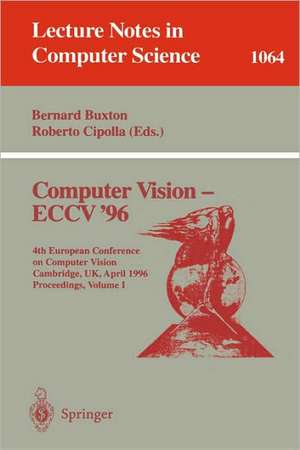
Computer Vision - ECCV '96
Editat de Bernard Buxton, Roberto Cipollaen Limba Engleză Paperback – 4 apr 1996
The papers in volume I are grouped in sections on structure from motion; recognition; geometry and stereo; texture and features; tracking; grouping and segmentation; stereo; and recognition, matching, and segmentation.
Preț: 673.24 lei
Preț vechi: 841.55 lei
-20%
Puncte Express: 1010
Carte tipărită la comandă
Livrare economică 28 noiembrie-12 decembrie
Livrare prin curier în România Termenul estimat este afișat lângă disponibilitate.
Transport gratuit pentru acest produs Plată online sau ramburs, în funcție de opțiunile comenzii.
Retur gratuit în 14 zile Comandă securizată și suport în română.
Specificații
ISBN-13: 9783540611226
ISBN-10: 3540611223
Pagini: 756
Ilustrații: XXII, 730 p.
Dimensiuni: 155 x 235 x 41 mm
Greutate: 1.12 kg
Ediția:1996
Editura: Springer
Locul publicării:Berlin, Heidelberg, Germany
ISBN-10: 3540611223
Pagini: 756
Ilustrații: XXII, 730 p.
Dimensiuni: 155 x 235 x 41 mm
Greutate: 1.12 kg
Ediția:1996
Editura: Springer
Locul publicării:Berlin, Heidelberg, Germany
V-ar putea interesa
-
 -27%Preț: 833.99 lei1147.93 lei
 -
 Visual Motion of Curves and SurfacesRoberto Cipolla-20%Preț: 328.45 lei410.57 lei
 -
 The Mathematics of Surfaces IXRoberto CipollaPreț: 403.19 lei
 -
 Embedded Multimedia Security SystemsAmit Pande-36%Preț: 531.18 lei830.10 lei
 -
 The Illusion of RealityHoward L. ResnikoffPreț: 379.62 lei
 -
 Understanding Images: Finding Meaning in Digital ImageryFrancis T. Marchese-20%Preț: 621.49 lei776.87 lei
 -
 Digital Image Processing HandbookNiceto Salazar-20%Preț: 576.87 lei721.08 lei
 -
 Deep Learning and Data Labeling for Medical ApplicationsGustavo Carneiro-20%Preț: 334.80 lei418.50 lei
 -
 -20%Preț: 312.17 lei390.21 lei
 -
 -20%Preț: 320.72 lei400.90 lei
 -
 -20%Preț: 337.30 lei421.62 lei
 -
 -20%Preț: 344.49 lei430.61 lei
 -
 Computational Color ImagingSimone Bianco-20%Preț: 322.16 lei402.70 lei
 -
 -20%Preț: 333.24 lei416.55 lei
 -
 Die Interpretation des Verhaltens mehrerer Akteure in SzenenfolgenGudula Retz-Schmidt-20%Preț: 397.82 lei497.28 lei
 -
 Active Visual Inference of Surface ShapeRoberto CipollaPreț: 368.96 lei
 -
 Shape, Contour and Grouping in Computer VisionDavid A. Forsyth-20%Preț: 338.45 lei423.07 lei
 -
 Computer Vision: Detection, Recognition and ReconstructionRoberto Cipolla-20%Preț: 1229.71 lei1537.14 lei
 -
 -20%Preț: 315.16 lei393.95 lei
 -
 Fullspace-ProjektionGordian Overschmidt-20%Preț: 385.24 lei481.55 lei
 -
 -20%Preț: 402.57 lei503.22 lei
 -
 Computational Topology in Image ContextMassimo Ferri-20%Preț: 413.61 lei517.02 lei
 -
 Registration and Recognition in Images and VideosRoberto Cipolla-20%Preț: 1029.57 lei1286.97 lei
 -
 -20%Preț: 300.33 lei375.41 lei
 -
 -20%Preț: 259.68 lei324.61 lei
 -
 Pathological Brain DetectionShui-Hua Wang-20%Preț: 347.14 lei433.92 lei
 -
 Facial Kinship VerificationHaibin Yan-20%Preț: 335.21 lei419.01 lei
Public țintă
ResearchCuprins
Self-calibration from image triplets.- Parallax geometry of pairs of points for 3D scene analysis.- Euclidean 3D reconstruction from image sequences with variable focal lengths.- Eigenfaces vs. Fisherfaces: Recognition using class specific linear projection.- Rapid object indexing and recognition using enhanced geometric hashing.- Recognition of geons by parametric deformable contour models.- Automatic extraction of generic house roofs from high resolution aerial imagery.- Three dimensional object modeling via minimal surfaces.- Class based reconstruction techniques using singular apparent contours.- Reliable surface reconstruction from multiple range images.- Shape from appearance: A statistical approach to surface shape estimation.- Volumic segmentation using hierarchical representation and triangulated surface.- Oriented projective geometry for computer vision.- Fast computation of the fundamental matrix for an active stereo vision system.- On binocularly viewed occlusion junctions.- Understanding the shape properties of trihedral polyhedra.- Nonlinear scale-space from n-dimensional sieves.- Hierarchical curve reconstruction. Part I: Bifurcation analysis and recovery of smooth curves.- Texture feature coding method for classification of liver sonography.- Local appropriate scale in morphological scale-space.- Scale-space with casual time direction.- Tracing crease curves by solving a system of differential equations.- Flows under min/max curvature flow and mean curvature: Applications in image processing.- Decomposition of the Hough transform: Curve detection with efficient error propagation.- Image retrieval using scale-space matching.- Optimal surface smoothing as filter design.- Segmentation in dynamic image sequences by isolation of coherent wave profiles.- Texture segmentation using local energy in wavelet scale space.- Tracking medical 3D data with a deformable parametric model.- EigenTracking: Robust matching and tracking of articulated objects using a view-based representation.- Contour tracking by stochastic propagation of conditional density.- Learning dynamics of complex motions from image sequences.- Quantitative analysis of grouping processes.- Geometric saliency of curve correspondences and grouping of symmetric contours.- Computing contour closure.- Visual organization of illusory surfaces.- Uncalibrated relief reconstruction and model alignment from binocular disparities.- Dense depth map reconstruction: A minimization and regularization approach which preserves discontinuities.- Stereo without search.- Informative views and sequential recognition.- Unsupervised texture segmentation using selectionist relaxation.- Robust affine structure matching for 3D object recognition.- Automatic face recognition: What representation?.- Genetic search for structural matching.- Automatic selection of reference views for image-based scene representations.- Object recognition using subspace methods.- Detecting, localizing and grouping repeatedscene elements from an image.- Image recognition with occlusions.- Silhouette-based object recognition with occlusion through curvature scale space.- A focused target segmentation paradigm.- Generalized image matching: Statistical learning of physically-based deformations.- Reasoning about occlusions during hypothesis verification.- Object recognition using multidimensional receptive field histograms.- Normalization by optimization.- Extracting curvilinear structures: A differential geometric approach.- Affine / photometric invariants for planar intensity patterns.- Image synthesis from a single example image.- Complexity of indexing: Efficient and learnable large database indexing.- Spatiotemporal representations for visual navigation.- Decoupling the 3D motion space by fixation.- Automatic singularity test for motion analysis by an information criterion.- Shape ambiguities in structure from motion.