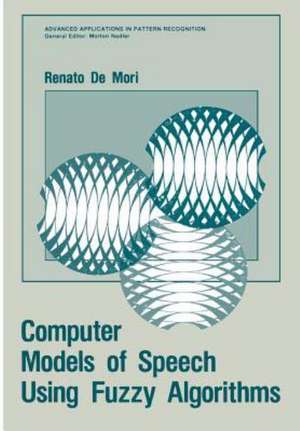
Computer Models of Speech Using Fuzzy Algorithms: Advanced Applications in Pattern Recognition
Autor Renato Demorien Limba Engleză Paperback – 3 noi 2011



Preț: 389.30 lei
Puncte Express: 584
Carte tipărită la comandă
Livrare economică 24 noiembrie-08 decembrie
Livrare prin curier în România Termenul estimat este afișat lângă disponibilitate.
Transport gratuit de la 400.00 lei Plată online sau ramburs, în funcție de opțiunile comenzii.
Retur gratuit în 14 zile Comandă securizată și suport în română.
Specificații
ISBN-13: 9781461337447
ISBN-10: 1461337445
Pagini: 512
Ilustrații: XXVI, 482 p.
Dimensiuni: 170 x 244 x 27 mm
Greutate: 0.81 kg
Ediția:Softcover reprint of the original 1st ed. 1983
Editura: Springer Us
Colecția Springer
Seria Advanced Applications in Pattern Recognition
Locul publicării:New York, NY, United States
ISBN-10: 1461337445
Pagini: 512
Ilustrații: XXVI, 482 p.
Dimensiuni: 170 x 244 x 27 mm
Greutate: 0.81 kg
Ediția:Softcover reprint of the original 1st ed. 1983
Editura: Springer Us
Colecția Springer
Seria Advanced Applications in Pattern Recognition
Locul publicării:New York, NY, United States
V-ar putea interesa
-
 Capillarity and Wetting PhenomenaPierre Gilles de Gennes-15%Preț: 609.27 lei716.78 lei
 -
 Hazard Analysis Techniques for System Safety 2eClifton A. Ericson-23%Preț: 774.87 lei1006.33 lei
 -
 Guidelines for Asset Integrity ManagementCcps (Center for Chemical Process Saf-9%Preț: 930.04 lei1022.02 lei
 -
 Current Trends of Surface Science and CatalysisJeong Young Park-15%Preț: 668.50 lei786.47 lei
 -
 Preț: 52.18 lei
 -
 -9%Preț: 1061.48 lei1166.47 lei
 -
 OrganikumKlaus Schwetlick-8%Preț: 500.94 lei544.50 lei
 -
 CrystallographyWalter Borchardt-Ott-15%Preț: 534.69 lei629.04 lei
 -
 Frustrated Lewis Pairs IGerhard Erker-18%Preț: 1270.64 lei1549.56 lei
 -
 Plasma Chemistry IIIS. Veprek-15%Preț: 636.56 lei748.89 lei
Public țintă
ResearchCuprins
1. Computer Models for Speech Understanding.- 1.1 Motivations for speech understanding researches.- 1.2 Tasks, difficulties and types of models.- 1.3 A passive model for automatic speech recognition.- 1.4 Active models for speech understanding.- 1.5 On the use of fuzzy set theory.- 1.6 The structure of the book.- 2. Generation and Recognition of Acoustic Patterns.- 2.1 Speech generation.- 2.2 Techniques for generating acoustic patterns.- 2.3 Background on syntactic pattern recognition.- 2.4 Acoustic Cue Extraction for Speech Patterns.- 2.5 Classification of speech patterns.- 2.6 Automatic recognition of continuous speech.- 2.7 References.- 3. On the Use of Syntactic Pattern Recognition and fuzzy Set Theory.- 3.1 Introduction and motivations.- 3.2 The syntactic (structural) approach to the interpretation of speech patterns.- 3.3 The syntax for the recognition of the phonetic feature “vocalic”.- 3.4 Background on fuzzy set theory.- 3.5 Fuzzy relations and languages.- 3.6 Use of fuzzy algorithms for feature hypothesization.- 3.7 References.- 4. Design Principles for Controlling the Use of Structural Rules for Segmentation.- 4.1 The meaning of the meaning.- 4.2 The control problem in the segmentation process.- 4.3 Computation with linguistic probabilities.- 4.4 Segmentation of continuous speech into pseudo-syllabic nuclei.- 4.5 A parallel processing model for generating phoneme hypotheses.- 4.6 A review of previous work on phoneme recognition.- 4.7 References.- 5. Rules for Characterizing Sonorant Sounds.- 5.1 A fragmant of the structural knowledge source for pseudo-syllables.- 5.2 Extraction of detailed spectral features for sonorant sounds.- 5.3 Generation of hypotheses about vowels.- 5.4 Use of formants for the recognition of liquids and nasals.- 5.5 Detailedrecognition of nasal sounds.- 5.6 Structure of the procedural knowledge.- 5.7 References.- 6. Rules for Characterizing the Nonsonorant Sounds.- 6.1 Introduction.- 6.2 Recognition of the phonetic features of nonsonorant sounds.- 6.3 Bottom-up generation of phonemic hypotheses of plosive sounds.- 6.4 Rules for the recognition of plosive sounds.- 6.5 Experimental results.- 6.6 References.- 7. The Lexical Knowledge Source.- 7.1 Word recognition in continuous speech.- 7.2 Dynamic programming for matching word patterns of quasi-continuous feature vectors.- 7.3 Matching speech states.- 7.4 Word detection by the hypothesize-and-test paradigm.- 7.5 The lexical component as a problem solver.- 7.6 The structure of the lexical knowledge.- 7.7 Strategies for lexical access.- 7.8 Selection of candidates and hypothesis evaluation.- 7.9 Strategies for the generation of lexical hypotheses.- 7.10 References.- 8. On the Structure and Use of Task-Dependent Knowledge.- 8.1 Introduction.- 8.2 Finite-state language models.- 8.3 Measuring evidences.- 8.4 Search strategies.- 8.5 On the use of production systems for problem solving.- 8.6 Scheduling of interpretation processes based on approximate reasoning.- 8.7 Outline of a semantically-guided use of task-dependent knowledge.- 8.8 Evaluating language complexity.- 8.9 Review of recent work on task-dependent knowledge.- 8.10 References.- 9. Automatic Learning of Fuzzy Relations.- 9.1 Introduction.- 9.2 Formal definition of the problem and an example of application.- 9.3 A simple preliminary learning case.- 10. Towards a Parallel System.- 10.1 A new model for lexical access.- 10.2 Description of acoustic cues.- 10.3 The knowledge of the descriptor of the global spectral features.- 10.4 Conclusions.