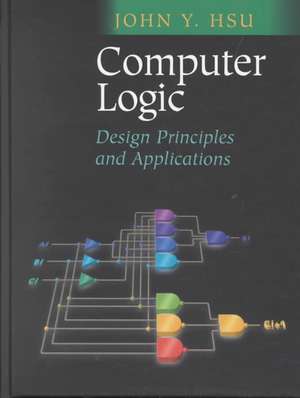
Computer Logic
Autor John Y. Hsuen Limba Engleză Hardback – 2 apr 2002
Preț: 347.46 lei
Preț vechi: 434.33 lei
-20%
Puncte Express: 521
Carte tipărită la comandă
Livrare economică 07-21 decembrie
Livrare prin curier în România Termenul estimat este afișat lângă disponibilitate.
Transport gratuit de la 400.00 lei Plată online sau ramburs, în funcție de opțiunile comenzii.
Retur gratuit în 14 zile Comandă securizată și suport în română.
Specificații
ISBN-13: 9780387953045
ISBN-10: 0387953043
Pagini: 208
Ilustrații: XIII, 198 p.
Dimensiuni: 183 x 260 x 16 mm
Greutate: 0.53 kg
Ediția:2002
Editura: Springer
Locul publicării:New York, NY, United States
ISBN-10: 0387953043
Pagini: 208
Ilustrații: XIII, 198 p.
Dimensiuni: 183 x 260 x 16 mm
Greutate: 0.53 kg
Ediția:2002
Editura: Springer
Locul publicării:New York, NY, United States
V-ar putea interesa
-
 Fundamentals of Digital Logic with Verilog DesignStephen Brown-18%Preț: 1491.35 lei1818.72 lei
 -
 -40%Preț: 493.65 lei820.18 lei
 -
 Logic and Computer Design FundamentalsMorris Mano-23%Preț: 1557.40 lei2022.59 lei
 -
 Code: The Hidden Language of Computer Hardware and SoftwareCharles Petzold-20%Preț: 189.39 lei236.74 lei
 -
 Principles of Computer HardwareAlan Clements-28%Preț: 623.58 lei861.14 lei
 -
 Computer Architecture: A Quantitative ApproachJohn L. Hennessy-39%Preț: 539.69 lei882.55 lei
 -
 Foundations of Computer EngineeringMarilyn Wolf-40%Preț: 476.75 lei796.01 lei
 -
 Fundamentals of Digital Logic with VHDL Design ISEStephen Brown-21%Preț: 346.64 lei438.67 lei
 -
 Digital Electronics: Principles and Applications ISERoger Tokheim-8%Preț: 474.65 lei515.92 lei
 -
 -4%Preț: 412.66 lei429.86 lei
 -
 Digital Electronics: A Practical Approach with VHDLWilliam Kleitz-13%Preț: 581.68 lei668.61 lei
 -
 -11%Preț: 721.06 lei810.18 lei
 -
 Logic and Computer Design Fundamentals, Global EditionM. Morris Mano-11%Preț: 679.86 lei763.89 lei
 -
 Foundations of Analog and Digital Electronic CircuitsAnant Agarwal-27%Preț: 551.94 lei754.30 lei
 -
 Computer ArchitectureCharles Fox-35%Preț: 303.05 lei467.47 lei
 -
 Introduction to Logic Circuits & Logic Design with VerilogBrock J. Lameres-19%Preț: 571.32 lei705.33 lei
 -
 Digital ElectronicsGareth MonkmanPreț: 411.88 lei
Public țintă
Professional/practitionerCuprins
1 Introduction.- 1.1 Prolog.- 1.2 Digital Concept.- 1.3 Number Systems.- 1.4 Number Conversions.- 1.5 Unsigned Integers Vs. Signed Integers.- 1.6 External Codes.- 1.7 Digitizing Concept.- 1.8 Summary Points.- Problems.- 2 Boolean Algebra.- 2.1 Boolean Constant Vs. Boolean Variable.- 2.2 Basic Laws.- 2.3 Basic Theorems.- 2.4 Other Logical Operators.- 2.5 Algebraic Simplifications.- 2.6 Karnaugh Maps.- 2.7 Summary Points.- Problems.- 3 Transistor Circuits.- 3.1 Introduction.- 3.2 Scale of Integration.- 3.3 Bipolar Transistors.- 3.4 Unipolar Transistors.- 3.5 Electronic Design Issues.- 3.6 Digital Waveforms.- 3.7 Summary Points.- Problems.- 4 Combinational Logic Circuits.- 4.1 Basic Logic Gates.- 4.2 Other Types of Logic Gates.- 4.3 Combinational Circuit Design Cases.- 4.4 Binary Adders.- 4.5 Carry Propagated Adder.- 4.6 Multiplication Tree.- 4.7 Programmable Logic Arrays.- 4.8 Memories.- 4.9 Summary Points.- Problems.- 5 Sequential Logic Circuits.- 5.1 Sequential Circuit Elements.- 5.2 RS Flip-Flops.- 5.3 Other Types of Flip-Flops.- 5.4 Sequential Circuit Design Cases.- 5.5 Sequencer t2167.- 5.7 Verilog.- 5.8 Summary Points.- Problems.- APPENDIX A Acronyms and Abbreviations.- APPENDIX B Logic Symbols and Equations.- References.