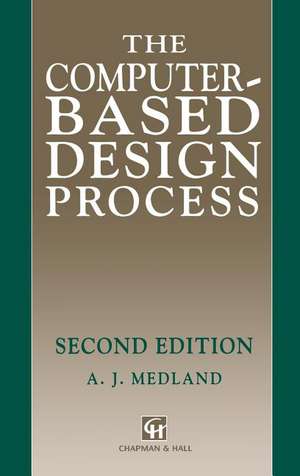
Computer-based Design Process
Autor A. J. Medlanden Limba Engleză Hardback – 30 apr 1992
Preț: 978.15 lei
Preț vechi: 1192.87 lei
-18%
Puncte Express: 1467
Carte tipărită la comandă
Livrare economică 07-21 decembrie
Livrare prin curier în România Termenul estimat este afișat lângă disponibilitate.
Transport gratuit pentru acest produs Plată online sau ramburs, în funcție de opțiunile comenzii.
Retur gratuit în 14 zile Comandă securizată și suport în română.
Specificații
ISBN-13: 9780412447808
ISBN-10: 0412447800
Pagini: 264
Ilustrații: XIV, 248 p.
Dimensiuni: 160 x 241 x 19 mm
Greutate: 0.51 kg
Ediția:Second Edition 1992
Editura: Springer
Locul publicării:Dordrecht, Netherlands
ISBN-10: 0412447800
Pagini: 264
Ilustrații: XIV, 248 p.
Dimensiuni: 160 x 241 x 19 mm
Greutate: 0.51 kg
Ediția:Second Edition 1992
Editura: Springer
Locul publicării:Dordrecht, Netherlands
V-ar putea interesa
-
 Intelligent Manufacturing PlanningD. H. Norrie-18%Preț: 982.89 lei1198.66 lei
-
 -18%Preț: 992.65 lei1210.55 lei
-
 Workflow and Process AutomationAndrzej Cichocki-20%Preț: 668.03 lei835.04 lei
-
 -23%Preț: 607.16 lei788.52 lei
-
 Improving the Performance of Neutral File Data TransfersRaymond J. Goult-20%Preț: 614.83 lei768.53 lei
-
 Advanced Modelling for CAD/CAM SystemsHans Grabowski-20%Preț: 314.14 lei392.67 lei
-
 Understanding Autonomous Cooperation and Control in LogisticsMichael Hülsmann-18%Preț: 956.31 lei1166.23 lei
-
 Precision Assembly Technologies and SystemsSvetan Ratchev-60%Preț: 275.75 lei687.40 lei
-
 CAD/CAM in PracticeA. J. MedlandPreț: 372.46 lei
Public țintă
ResearchRecenzii
`...the book is well structured in its presentation and coverage of design theory. The holistic approach to design and the principles of constraint modelling are explained clearly and unambiguously...The book is well laid out and easy to assimilate (owing to its structured content) with a good index...the book is a worthwhile text, if only for its coverage of design theory and CAD process'- Int. Journal of Production Research
Cuprins
Preface.- The role of computer graphics in the design process.- Constructing the ideal system.- Acknowledgements.- 1: The Design Process.- An overview.- Computer aided design and manufacture (CAD and CAM).- The relationship between activity, weight, control and role.- Product constraints.- Man-machine interactions.- Proposed design approach.- 2: Design Theory.- Fundamental requirements.- Spatial associations.- Functional associations.- 3: Local Space Modelling.- Logical spaces.- Interpretive geometric models.- 4: System Configuration.- Software.- Hardware.- 5: Design Records.- Hierarchical, networked and relational data bases.- Assembly records.- 6: Drawing Office Procedures.- Space allocation and role.- Application of HERMS.- Integration and control procedures.- Application examples.- 7: Mechanical Functions of Performance.- The functional design of mechanisms.- Kinematic modelling.- Dynamic modelling.- Conclusions.- 8: Future Developments.- The design base.- Tolerance modelling.- Modelling force fit.- Assemblability.- Standard parts and catalogues.- Factory layout and process control.- Electronics modelling.- References.