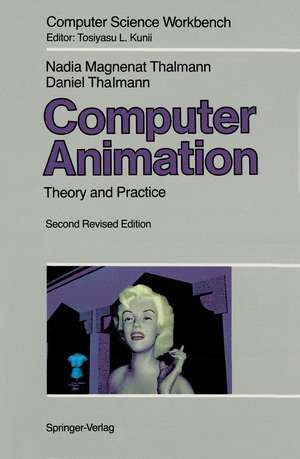
Computer Animation: Computer Science Workbench
Autor Nadia Magnenat-Thalmann, Daniel Thalmannen Limba Engleză Paperback – 3 ian 2012
Preț: 322.55 lei
Preț vechi: 403.20 lei
-20%
Puncte Express: 484
Carte tipărită la comandă
Livrare economică 01-15 decembrie
Livrare prin curier în România Termenul estimat este afișat lângă disponibilitate.
Transport gratuit de la 400.00 lei Plată online sau ramburs, în funcție de opțiunile comenzii.
Retur gratuit în 14 zile Comandă securizată și suport în română.
Specificații
ISBN-13: 9784431681076
ISBN-10: 4431681078
Pagini: 264
Ilustrații: XIII, 245 p.
Dimensiuni: 170 x 244 x 15 mm
Greutate: 0.46 kg
Ediția:Second Edition 1990
Editura: Springer
Colecția Computer Science Workbench
Seria Computer Science Workbench
Locul publicării:Tokyo, Japan
ISBN-10: 4431681078
Pagini: 264
Ilustrații: XIII, 245 p.
Dimensiuni: 170 x 244 x 15 mm
Greutate: 0.46 kg
Ediția:Second Edition 1990
Editura: Springer
Colecția Computer Science Workbench
Seria Computer Science Workbench
Locul publicării:Tokyo, Japan
V-ar putea interesa
-
 -27%Preț: 833.99 lei1147.93 lei
 -
 Crowd SimulationDaniel Thalmann-20%Preț: 675.79 lei844.74 lei
 -
 Digital Image Processing HandbookNiceto Salazar-20%Preț: 576.87 lei721.08 lei
 -
 Deep Learning and Data Labeling for Medical ApplicationsGustavo Carneiro-20%Preț: 334.80 lei418.50 lei
 -
 -20%Preț: 312.17 lei390.21 lei
 -
 -20%Preț: 320.72 lei400.90 lei
 -
 -20%Preț: 337.30 lei421.62 lei
 -
 -20%Preț: 344.49 lei430.61 lei
 -
 Computational Color ImagingSimone Bianco-20%Preț: 322.16 lei402.70 lei
 -
 -20%Preț: 333.24 lei416.55 lei
 -
 Modula-2: An IntroductionDaniel Thalmann-20%Preț: 621.14 lei776.43 lei
 -
 -20%Preț: 313.42 lei391.77 lei
 -
 Computer Vision SystemsBernt Schiele-20%Preț: 336.31 lei420.38 lei
 -
 Computer Analysis of Images and PatternsWladyslaw Skarbek-20%Preț: 647.64 lei809.56 lei
 -
 Computer Vision - ACCV'98Roland Chin-20%Preț: 648.87 lei811.09 lei
 -
 Scale-Space Theories in Computer VisionMads Nielsen-20%Preț: 344.59 lei430.74 lei
 -
 Combinatorial Image AnalysisValentin E. Brimkov-20%Preț: 330.58 lei413.22 lei
 -
 New Advances in Virtual HumansNadia Magnenat-Thalmann-20%Preț: 1017.95 lei1272.44 lei
 -
 Image AnalysisArnt-Borre Salberg-20%Preț: 675.79 lei844.74 lei
 -
 Modelling the Physiological HumanNadia Magnenat-Thalmann-20%Preț: 331.86 lei414.82 lei
 -
 -20%Preț: 300.33 lei375.41 lei
 -
 -20%Preț: 259.68 lei324.61 lei
 -
 Creating and Animating the Virtual WorldNadia Magnenat Thalmann-20%Preț: 322.11 lei402.64 lei
 -
 State-of-the-art in Computer Animation: Proceedings of Computer Animation ’89Nadia Magnenat-Thalmann-20%Preț: 334.60 lei418.25 lei
 -
 Pathological Brain DetectionShui-Hua Wang-20%Preț: 347.14 lei433.92 lei
 -
 Facial Kinship VerificationHaibin Yan-20%Preț: 335.21 lei419.01 lei
Public țintă
ResearchCuprins
1. Introduction.- 2. Conventional Animation.- 2.1 Basic Principles of Conventional Animation.- 2.2 How Are Cartoon Animated Films Made?.- 2.3 Multiplane and Shooting Phase.- 2.4 Some Techniques and Special Camera Effects.- 2.5 Bar, Route, Model, and Exposure Sheets.- 2.6 Postproduction.- 2.7 Historical Background.- 2.8 Applications of Animation.- 3. Computer Animation.- 3.1 The Role of the Computer in Animation.- 3.2 How to Classify Computer Animation Systems?.- 3.3 Real-time vs Frame-by-frame.- 3.4 Frame Buffer Animation and Real-time Playback.- 3.5 Systems vs Languages.- 4. The Development of Computer Animation in Various Organizations.- 4.1 The Early Systems: BEFLIX and EXPLOR.- 4.2 Picture-driven Animation: GENESYS.- 4.3 Analog Systems: SCANIMATE and CAESAR.- 4.4 ANIMATOR, ARTÄ, and MOP.- 4.5 Computer Animation at the National Research Council of Canada.- 4.6 Computer Animation at Ohio State University.- 4.7 From GRASS to ZGRASS.- 4.8 New York Institute of Technology, Lucasfilm, and Pixar.- 4.9 MAGI/Synthavision, Robert Abel, Triple I, and Digital Effects.- 4.10 And the Others?.- 5. Keyframe and Painting Systems.- 5.1 Computer-assisted Animation.- 5.2 The Input of Drawings.- 5.3 In-between Calculations.- 5.4 The Laws of Animation.- 5.5 Skeleton Techniques.- 5.6 The Path of Motion and P-curves.- 5.7 In-betweening Using Moving Point Constraints.- 5.8 Coloring Techniques.- 5.9 Paint Systems.- 5.10 Color Simulation and Dithering.- 5.11 Gradation Techniques.- 6. Object Modeling in 3D Animation.- 6.1 What Is 3D Animation?.- 6.2 Object Representation.- 6.3 Surface Modeling.- 6.4 Object Creation.- 7. Motion Control in 3D Animation.- 7.1 A Classification of 3D Computer Animation Methods.- 7.2 A Unified View.- 7.3 A Comparison of Methods.- 7.4 Three-dimensional ShapeInterpolation.- 7.5 A Case Study: The Multiple Track Animator System.- 7.6 Parametric Keyframe Animation.- 7.7 The Use of Splines in Keyframe Animation.- 7.8 Principles of Algorithmic Animation.- 7.9 Motion Specification will Synchronization.- 8. Hidden Surfaces, Reflectance, and Shading.- 8.1 Hidden Surfaces.- 8.2 Light Reflection Models.- 8.3 Surface Shading.- 8.4 Rendering of Parametric and Patch Surfaces.- 8.5 Complex Light Sources.- 9. Transparency, Texture, Shadows, and Anti-aliasing.- 9.1 Ray-tracing Algorithms.- 9.2 Ray-tracing Problems.- 9.3 Optimization Techniques for Ray-tracing.- 9.4 Transparency.- 9.5 Texture.- 9.6 Fractals.- 9.7 Fuzzy Objects Modeling and Particle Systems.- 9.8 Shadows.- 9.9 Spatial Anti-aliasing.- 9.10 Motion Blur and Temporal Anti-aliasing.- 10. Human Modeling and Animation.- 10.1 Stick, Surface, and Volume Models.- 10.2 The NUDES System.- 10.3 The Badler Bubbleman.- 10.4 Labanotation.- 10.5 Parametric Keyframe Animation of Articulated Bodies.- 10.6 Body Deformations and JLD Operators.- 10.7 Hand Animation.- 10.8 Facial Animation.- 10.9 A Three-level Approach Based on Abstract Muscles.- 11. Object-oriented and Actor Languages and Systems.- 11.1 Classes, Modules, and Processes.- 11.2 Kay’s Work and SMALLTALK.- 11.3 Hewitt’s Actor Theory.- 11.4 LOGO and the DIRECTOR Actor-based Animation Language.- 11.5 AS AS: The Actor/Scriptor Animation System.- 11.6 CINEMIRA: A Language Based on Actor and Camera Data Types.- 11.7 MÏRANIM: An Extensible Director-oriented 3D Animation System.- 12. Automatic Motion Control.- 12.1 Mechanics, Robotics, and A.I. in Computer Animation.- 12.2 First Step: Positional Constraints and Inverse Kinematics.- 12.3 Second Step: Motion Control Using Dynamics.- 12.4 Third Step: Impact of the Environment.- 12.5Fourth Step: Task Planning.- 12.6 Fifth Step: Behavioral Animation.- 13. Case Studies of Computer-generated Films.- 13.1 The Film Dream Flight.- 13.2 The Film Rendez-vous à Montréal.- 13.3 The Film Eglantine.- 13.4 The Film Galaxy Sweetheart.- References.- Appendix: Computer-generated Films.