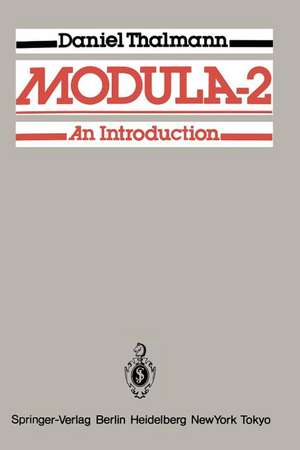
Modula-2: An Introduction
Autor Daniel Thalmannen Limba Engleză Paperback – oct 1985
Preț: 621.14 lei
Preț vechi: 776.43 lei
-20%
Puncte Express: 932
Carte tipărită la comandă
Livrare economică 26 noiembrie-10 decembrie
Livrare prin curier în România Termenul estimat este afișat lângă disponibilitate.
Transport gratuit pentru acest produs Plată online sau ramburs, în funcție de opțiunile comenzii.
Retur gratuit în 14 zile Comandă securizată și suport în română.
Specificații
ISBN-13: 9783540132974
ISBN-10: 354013297X
Pagini: 308
Ilustrații: XII, 292 p.
Dimensiuni: 155 x 235 x 16 mm
Greutate: 0.44 kg
Ediția:Softcover reprint of the original 1st ed. 1985
Editura: Springer Berlin, Heidelberg
Colecția Springer
Locul publicării:Berlin, Heidelberg, Germany
ISBN-10: 354013297X
Pagini: 308
Ilustrații: XII, 292 p.
Dimensiuni: 155 x 235 x 16 mm
Greutate: 0.44 kg
Ediția:Softcover reprint of the original 1st ed. 1985
Editura: Springer Berlin, Heidelberg
Colecția Springer
Locul publicării:Berlin, Heidelberg, Germany
V-ar putea interesa
-
 C Primer PlusStephen Prata-20%Preț: 421.53 lei526.92 lei
 -
 Python CookbookDavid Beazley-20%Preț: 345.79 lei432.23 lei
 -
 The Fortran 2003 HandbookJeanne C. Adams-20%Preț: 1530.72 lei1913.41 lei
 -
 Yii Rapid Application Development HotshotLauren O'MearaPreț: 306.65 lei
 -
 Practical Programming 2ePaul Gries-20%Preț: 219.71 lei274.64 lei
 -
 Programming Ruby 1.9 & 2.0Dave Thomas-20%Preț: 341.10 lei426.37 lei
 -
 Programming in PrologWilliam F. Clocksin-20%Preț: 478.60 lei598.25 lei
Public țintă
ResearchCuprins
1 Introduction.- 1.1 The Role and Origins of Programming.- 1.2 The Evolution of Programming Languages.- 1.3 The “Module”l Concept.- 1.4 Lexical, Syntactic and Semantic Analysis.- 1.5 The MODULA-2 Vocabulary.- 1.6 Syntactic Diagrams.- 1.7 Structure of a MODULA-2 Program.- 1.8 A First Program: How to Write a String.- 1.9 Some Basic Considerations for Writing Programs.- Summary.- 2 Numbers.- 2.1 Integer and Real Numbers.- 2.2 Operators.- 2.3 The MathLibO Module.- 2.4 Arithmetic Expressions.- 2.5 How to Write Numbers.- 2.6 Program Examples.- Summary.- 3 Constants, Variables and Data Typesb.- 3.1 Constants.- 3.2 Variables and Data Types.- 3.3 INTEGER, CARDINAL and REAL Types.- 3.4 The Assignment Statement.- 3.5 Type Conversion.- 3.6 An Example: Exchange of Two Values.- Summary.- 4 The Boolean and CHAR Types.- 4.1 Boolean Constants and Operations.- 4.2 Boolean Expressions.- 4.3 Relational Operators.- 4.4 Two Program Examples.- 4.5 The Type CHAR.- Summary.- 5 Basic Control Statements.- 5.1 The IF Statement.- 5.2 The WHILE Statementb.- 5.3 The REPEAT Statement.- 5.4 Program Examples.- Summary.- 6 The Input/Output Modules.- 6.1 The Role of the Read Operation.- 6.2 Text Input.- 6.3 The InOut and ReallnOut Modules.- 6.4 Program Examples.- Summary.- 7 Enumeration and Subrange Types.- 7.1 Enumeration Types.- 7.2 Order in Enumeration Types.- 7.3 Subrange Types.- 7.4 A Program Example.- Summary.- 8 Other Control Statements.- 8.1 The LOOP Statement.- 8.2 The FOR Statement.- 8.3 The CASE Statement.- 8.4 Program Examples.- Summary.- 9 Array Types.- 9.1 One-Dimensional Arrays.- 9.2 Program Examples.- 9.3 String Types.- 9.4 Program Examples: Palindromes.- 9.5 Multi-Dimensional Arrays.- 9.6 Program Examples.- Summary.- 10 Procedures and Locality.- 10.1 The Procedure Concept.- 10.2Locality.- 10.3 Parameters.- 10.4 A Program Example.- Summary.- 11 Transmission of Parameters and Scope.- 11.1 Variable and Value Parameters.- 11.2 Open Array Parameters.- 11.3 Rules of Scope.- Summary.- 12 Function Procedures and Procedure Types.- 12.1 The Function Procedure Concept.- 12.2 A Complete Example.- 12.3 Procedure Types.- 12.4 A Complete Example.- Summary.- 13 Recursion.- 13.1 The Concept of Recursion.- 13.2 The Towers of Hanoi.- 13.3 Quicksort and Permutations.- 13.4 Indirect Recursion and Recursive Descent.- Summary.- 14 Modules.- 14.1 The Module Concept.- 14.2 Definition Modules.- 14.3 Implementation Modules.- 14.4 Separate Compilation.- 14.5 A Complete Example: The Stack.- Summary.- 15 Local Modules.- 15.1 The Concept of Local Modules.- 15.2 Import/Export Lists.- 15.3 Rules of Scope.- 15.4 Local Modules Defined Side by Side.- 15.5 Modules Defined Local to a Procedure.- 15.6 A Complete Example.- Summary.- 16 Records.- 16.1 RECORDTypes.- 16.2 Manipulation of Records and Fields.- 16.3 The WITH Statement.- 16.4 An Example of Data Abstraction: The Use of Multiple Stacks.- 16.5 Records with Variant Parts.- Summary.- 17 Sets.- 17.1 SET Types and the BITSET Type.- 17.2 Set Constants and Variables.- 17.3 Set Operators.- 17.4 The Standard Procedures INCL and EXCL.- 17.5 An Example of a Module for Processing Bitsets.- Summary.- 18 Streams.- 18.1 The Stream Concept.- 18.2 Access to a Stream Component.- 18.3 Text Streams.- 18.4 A Program Example: Bold Text.- Summary.- 19 Dynamic Data Structures.- 19.1 Pointers.- 19.2 Dynamic Allocation.- 19.3 Lists.- 19.4 A Complete Example of List Processing with a Local Module.- 19.5 Stacks and fifo Queues: Two List Processing Modules.- 19.6 Binary Trees.- Summary.- 20 Processes.- 20.1 Concurrency.- 20.2 Processes.- 20.3 Monitors.- 20.4 Signals.- 20.5 A Classical Example: A Shared Buffer.- Summary.- 21 Low-Level Features.- 21.1 Why Low-Level Programming?.- 21.2 The Type WORD.- 21.3 The Type ADDRESS.- 21.4 Type Transfer Functions.- 21.5 Coroutines.- 21.6 An Application of Coroutines.- 21.7 Dynamic Storage.- 21.8 Device Handling, Interrupts and Fixed Addresses.- 21.9 Low-Level File Operations.- 21.10 Generic Modules.- Summary.- References.- Appendix 1: The Syntax of MODULA-2.- Appendix 2: Keywords and Standard Identifiers.