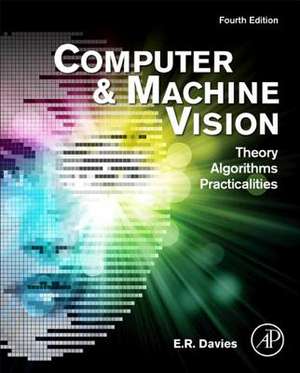
Computer and Machine Vision: Theory, Algorithms, Practicalities
Autor E. R. Daviesen Limba Engleză Hardback – 18 apr 2012
Considerăm acest volum ca fiind o resursă de referință pentru inginerii R&D și cercetătorii post-doctorali care posedă deja o bază solidă în procesarea de semnal și matematică aplicată. Computer and Machine Vision nu se limitează la expunerea teoretică, ci impune o rigoare algoritmică necesară implementării în sisteme electronice complexe. Această a patra ediție, semnată de E. R. Davies, extinde aria de aplicabilitate către domenii critice precum securitatea și industria auto.
Structura lucrării este una progresivă și exhaustivă, organizată în 27 de capitole. Primele secțiuni fundamentează operațiile de filtrare, detecția marginilor și morfologia matematică, evoluând natural către analiza formelor binare și transformata Hough. Ceea ce diferențiază acest titlu este atenția acordată constrângerilor practice de design; autorul dedică spațiu generos calibrării camerelor, vederii stereoscopice și, esențial pentru practicieni, designului hardware pentru procesarea în timp real. Cititorul care a aplicat ideile din Machine Vision de Wesley E. Snyder va găsi aici o continuare necesară, trecând de la exerciții de programare la arhitecturi de sistem complete și studii de caz industriale, precum inspecția vizuală automatizată.
În contextul operei sale, Computer and Machine Vision reprezintă fundamentul metodologic pe care se sprijină lucrările sale ulterioare, precum Advanced Methods and Deep Learning in Computer Vision. Dacă volumul mai recent se concentrează pe revoluția rețelelor neuronale, prezenta lucrare rămâne indispensabilă pentru înțelegerea mecanismelor robuste de extragere a trăsăturilor și a statisticilor fundamentale, elemente fără de care viziunea artificială modernă nu poate fi optimizată.
Preț: 451.87 lei
Preț vechi: 733.99 lei
-38%
Carte tipărită la comandă
Livrare economică 20 noiembrie-04 decembrie
Specificații
ISBN-10: 0123869080
Pagini: 912
Dimensiuni: 191 x 235 x 46 mm
Greutate: 1.68 kg
Ediția:Revised
Editura: Elsevier
V-ar putea interesa
-
 Foundations of Computer VisionAntonio Torralba-25%Preț: 618.65 lei823.02 lei
 -
 Computer Architecture: A Quantitative ApproachJohn L. Hennessy-39%Preț: 534.37 lei882.55 lei
 -
 Object DetectionCyganek-20%Preț: 865.81 lei1082.26 lei
 -
 The Art of ElectronicsPaul Horowitz-9%Preț: 706.10 lei775.93 lei
 -
 Integrated Automotive Safety HandbookMark GonterPreț: 382.52 lei
 -
 Computer Vision: Challenges, Trends, and OpportunitiesMd Atiqur Rahman Ahad-20%Preț: 1086.86 lei1358.57 lei
 -
 Computer Vision: Object Detection In Adversarial VisionMrinal Kanti Bhowmik-18%Preț: 1103.65 lei1345.92 lei
 -
 Digital Image Processing, Global EditionRafael Gonzalez-11%Preț: 663.18 lei745.14 lei
 -
 -20%Preț: 1153.31 lei1441.65 lei
 -
 Machine VisionJill Walker RettbergPreț: 141.20 lei
 -
 Computer VisionSota R Yoshida-35%Preț: 1530.00 lei2369.66 lei
 -
 Computer VisionRichard Szeliski-20%Preț: 445.89 lei557.35 lei
 -
 Handbook of Image Processing and Computer VisionArcangelo Distante-20%Preț: 1471.45 lei1839.31 lei
 -
 Preț: 434.53 lei
 -
 Digital Image ProcessingWilhelm Burger-20%Preț: 695.42 lei869.26 lei
 -
 Computer Analysis of Images and PatternsModesto Castrillón-Santana-20%Preț: 327.69 lei409.62 lei
 -
 Computer VisionRoberto Cipolla-20%Preț: 1280.88 lei1601.11 lei
 -
 -24%Preț: 1187.07 lei1561.94 lei
 -
 Computer Vision, Pattern Recognition, Image Processing, and GraphicsSantanu Chaudhury-20%Preț: 644.26 lei805.32 lei
Public țintă
Embedded, electronic systems, signal/image processing and computer engineering R&D engineers; post graduates and PhD researchers in machine and computer vision.De ce să citești această carte
Recomandăm această carte inginerilor care dezvoltă sisteme de vedere artificială pentru medii industriale sau automotive. Veți câștiga o înțelegere profundă a algoritmilor de detecție și a provocărilor hardware, trecând dincolo de simple biblioteci software. Este un ghid practic care transformă teoria matematică în soluții de inspecție, supraveghere și navigație autonomă, fiind esențial pentru oricine dorește să construiască sisteme vizuale robuste și eficiente.
Cuprins
1 Vision, the Challenge 2 Images and Imaging Operations 3 Basic Image Filtering Operations 4 Thresholding Techniques 5 Edge Detection 6 Corner and Interest Point Detection 7 Mathematical Morphology 8 Texture 9 Binary Shape Analysis 10 Boundary Pattern Analysis 11 Line Detection 12 Circle and Ellipse Detection 13 The Hough Transform and Its Nature 14 Abstract Pattern Matching Techniques 15 The Three-Dimensional World 16 Tackling the perspective n-point problem 17 Invariants and perspective 18 Image transformations and camera calibration 19 Motion 20 Automated Visual Inspection 21 Inspection of Cereal Grains 22 Surveillance 23 In-Vehicle Vision Systems24 Statistical Pattern Recognition 25 Image Acquisition 26 Real-Time Hardware and Systems Design Considerations 27 Epilogue-Perspectives in Vision Appendix Robust statistics References Index
Descriere
Computer and Machine Vision: Theory, Algorithms, Practicalities (previously entitled Machine Vision) clearly and systematically presents the basic methodology of computer and machine vision, covering the essential elements of the theory while emphasizing algorithmic and practical design constraints. This fully revised fourth edition has brought in more of the concepts and applications of computer vision, making it a very comprehensive and up-to-date tutorial text suitable for graduate students, researchers and R&D engineers working in this vibrant subject.
Key features include:
- Practical examples and case studies give the ‘ins and outs’ of developing real-world vision systems, giving engineers the realities of implementing the principles in practice.
- New chapters containing case studies on surveillance and driver assistance systems give practical methods on these cutting-edge applications in computer vision.
- Necessary mathematics and essential theory are made approachable by careful explanations and well-illustrated examples.
- Updated content and new sections cover topics such as human iris location, image stitching, line detection using RANSAC, performance measures, and hyperspectral imaging.
- The ‘recent developments’ section now included in each chapter will be useful in bringing students and practitioners up to date with the subject.
Roy Davies is Emeritus Professor of Machine Vision at Royal Holloway, University of London. He has worked on many aspects of vision, from feature detection to robust, real-time implementations of practical vision tasks. His interests include automated visual inspection, surveillance, vehicle guidance and crime detection. He has published more than 200 papers, and three books - Machine Vision: Theory, Algorithms, Practicalities (1990), Electronics, Noise and Signal Recovery (1993), and Image Processing for the Food Industry (2000); the first of these has been widely used internationally for more than 20 years, and is now out in this much enhanced fourth edition. Roy holds a DSc at the University of London, and has been awarded Distinguished Fellow of the British Machine Vision Association, and Fellow of the International Association of Pattern Recognition.
- Mathematics and essential theory are made approachable by careful explanations and well-illustrated examples.
- Updated content and new sections cover topics such as human iris location, image stitching, line detection using RANSAC, performance measures, and hyperspectral imaging.
- The ‘recent developments’ section now included in each chapter will be useful in bringing students and practitioners up to date with the subject.