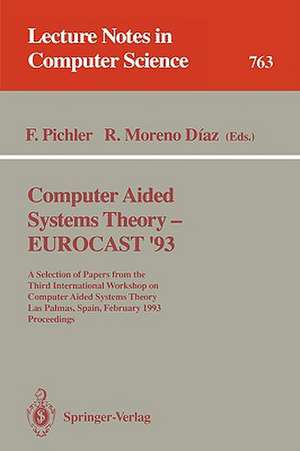
Computer Aided Systems Theory - EUROCAST '93
Editat de Franz Pichler, Roberto Moreno Díazen Limba Engleză Paperback – 28 ian 1994
Preț: 343.97 lei
Preț vechi: 429.96 lei
-20%
Puncte Express: 516
Carte tipărită la comandă
Livrare economică 03-17 decembrie
Livrare prin curier în România Termenul estimat este afișat lângă disponibilitate.
Transport gratuit de la 400.00 lei Plată online sau ramburs, în funcție de opțiunile comenzii.
Retur gratuit în 14 zile Comandă securizată și suport în română.
Specificații
ISBN-13: 9783540576013
ISBN-10: 3540576010
Pagini: 468
Ilustrații: XI, 457 p.
Dimensiuni: 155 x 235 x 26 mm
Greutate: 0.7 kg
Ediția:1994
Editura: Springer
Locul publicării:Berlin, Heidelberg, Germany
ISBN-10: 3540576010
Pagini: 468
Ilustrații: XI, 457 p.
Dimensiuni: 155 x 235 x 26 mm
Greutate: 0.7 kg
Ediția:1994
Editura: Springer
Locul publicării:Berlin, Heidelberg, Germany
V-ar putea interesa
-
 Formal Methods for Multi-Agent Feedback Control SystemsDimos V. Dimarogonas-20%Preț: 610.14 lei762.68 lei
 -
 Computer Architecture: A Quantitative ApproachJohn L. Hennessy-39%Preț: 534.37 lei882.55 lei
 -
 Notes on the Synthesis of FormChristopher AlexanderPreț: 235.55 lei
 -
 -19%Preț: 526.02 lei649.41 lei
 -
 Modeling of Physical Systems: Simulation and Contr olJoseph J. Beaman-23%Preț: 617.13 lei801.46 lei
 -
 MechatronicsW. Bolton-11%Preț: 667.57 lei750.07 lei
 -
 Modern Systems Analysis and Design, Global EditionJoseph Valacich-8%Preț: 606.91 lei659.70 lei
 -
 -11%Preț: 674.61 lei758.00 lei
 -
 Foundations of Analog and Digital Electronic CircuitsAnant Agarwal-28%Preț: 546.19 lei754.30 lei
 -
 Components Operationally: Reversibility and System EngineeringClaudio Antares Mezzina-20%Preț: 389.32 lei486.66 lei
 -
 Networked SystemsSalem Lahlou-20%Preț: 996.76 lei1245.95 lei
 -
 -20%Preț: 391.26 lei489.08 lei
 -
 -20%Preț: 878.12 lei1097.66 lei
 -
 Advanced Control Methods for Industrial ProcessesPablo A. López-Pérez-23%Preț: 698.89 lei907.65 lei
 -
 AAD Algorithms-Aided DesignArturo TedeschiPreț: 356.48 lei
 -
 Data-Driven Cyber Physical SystemsFangyu Li-18%Preț: 1044.71 lei1274.04 lei
 -
 -23%Preț: 648.30 lei840.50 lei
Public țintă
ResearchCuprins
Systems theory and engineering.- Computer-Aided Systems technology: Its role in advanced computerization.- Computer aided nonlinear system design based on algebraic system representation and on nonlinear bundle graphs.- A new model-based approach to the co-design of heterogeneous systems.- Towards an “Erlangen Program” for general linear systems theory.- The shape of complex systems.- Polynomial systems theory for n-D systems applied to vision-based control.- A representation of software systems evolution based on the theory of the General System.- Theoretical considerations about subset descriptions.- Sampled data passive systems.- Computer-Aided Systems Technology for CAD environments: Complexity issues and a repository-based approach.- On requirements for a CAST-tool for complex, reactive system analysis, design and evaluation.- Automating the modeling of dynamic systems.- Formal methods and their future.- Formal description of bus interfaces using methods of system theory.- CAST tools for intelligent control in manufacturing automation.- An algebraic transformation of the minimum automaton identification problem.- On possibilistic automata.- On automatic adjustment of the sampling period.- FSM shift register realization for improved testability.- Cluster-based modelling of processes with unknown qualitative variables.- The role of partitions and functional in descriptor computation for data receptive fields.- On some algorithmic and computational problems for neuronal diffusion models.- Hierarchic representation for spatial knowledge.- Probabilistic models in qualitative simulation.- STIMS-Medtool: Integration of expert systems with systems modelling and simulation.- Systems concept for visual texture change detection strategy.- Qualitative computation withneural nets: Differential equations like examples.- Interpretation-driven low-level parameter adaptation in scene analysis.- General systems theory as a framework for model-based diagnosis.- Technical applications of knowledge-based systems.- CASE — Computer-aided systems engineering, a new approach for developing IM-systems with special consideration of CIM systems.- Modelling and analysis of complex stochastic systems: From a specific example to a general environment.- System theoretic approach to migration of project models.- Computer-aided analysis and design of sequential control in industrial processes.