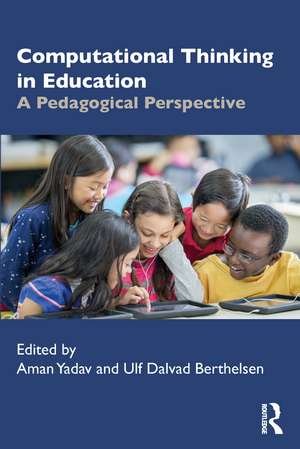
Computational Thinking in Education: A Pedagogical Perspective
Editat de Aman Yadav, Ulf Berthelsenen Limba Engleză Paperback – 23 noi 2021
Computational Thinking in Compulsory Education explores the relevance of computational thinking in primary and secondary education.
As today's school-aged students prepare to live and work in a thoroughly digitized world, computer science is providing a wealth of new learning concepts and opportunities across domains. This book offers a comprehensive overview of computational thinking, its history, implications for equity and inclusion, analyses of competencies in practice, and integration into learning, instruction, and assessment through scaffolded teacher education.
Computer science education faculty and pre- and in-service educators will find a fresh pedagogical approach to computational thinking in primary and secondary classrooms.
Preț: 381.48 lei
Carte disponibilă
Livrare economică 02-16 noiembrie
Livrare express 17-23 octombrie pentru 30.93 lei
Specificații
ISBN-10: 0367610353
Pagini: 236
Ilustrații: 2 Tables, black and white; 10 Line drawings, black and white; 29 Halftones, black and white; 39 Illustrations, black and white
Dimensiuni: 152 x 229 x 17 mm
Greutate: 0.36 kg
Ediția:1
Editura: Taylor & Francis
Colecția Routledge
Locul publicării:Oxford, United Kingdom
V-ar putea interesa
-
 Dyslexia in Practice: A Guide for TeachersJanet Townend-18%Preț: 910.71 lei1110.62 lei
 -
 Leader ReadyTimothy CusackPreț: 283.98 lei
 -
 Resistance from the RightLauren Lassabe ShepherdPreț: 223.17 lei
 -
 The U.S. Secretaries of Education: A Short History of Their Lives and ImpactCatherine L. Sommervold-26%Preț: 175.92 lei236.86 lei
 -
 -25%Preț: 137.30 lei183.95 lei
 -
 -25%Preț: 219.94 lei292.57 lei
 -
 Classroom Management: Authentic Experiences in Classroom TeachingJacqueline G. Van Schooneveld-21%Preț: 141.74 lei179.96 lei
 -
 Putting It All Together: Creating and Scaling Exceptional LearningJeffery W. Galle-25%Preț: 178.45 lei238.48 lei
 -
 -25%Preț: 220.65 lei293.00 lei
 -
 -21%Preț: 134.95 lei171.57 lei
 -
 -21%Preț: 135.62 lei171.96 lei
 -
 -21%Preț: 135.92 lei172.14 lei
 -
 -25%Preț: 179.88 lei239.44 lei
 -
 -25%Preț: 141.27 lei189.10 lei
 -
 Creative Teaching: Ideas to Boost Student InterestJames P. Downing-25%Preț: 193.31 lei259.05 lei
 -
 -25%Preț: 193.86 lei260.12 lei
 -
 Technology Supported Learning and TeachingJohn O'Donoghue-15%Preț: 541.10 lei636.60 lei
 -
 Let's Celebrate Today: Calendars, Events, and HolidaysDiana F. Marks-22%Preț: 270.63 lei348.18 lei
 -
 Preț: 341.34 lei
 -
 -34%Preț: 598.51 lei912.99 lei
 -
 Personalführung für die Kita-LeitungChristine GeiersbachPreț: 345.18 lei
Public țintă
PostgraduateCuprins
Matti Tedre & Peter J. Denning
2 Computational Thinking Today
Shuchi Grover
3 A Computational Thinking Integration Model for Primary and Secondary Classrooms
Steven Azeka & Aman Yadav
4 Democracy and Computation: A Normative Perspective on the Magic of the New Millennium
Ulf Dalvad Berthelsen & Carsten Fogh Nielsen
5 Computational Thinking as Subject Matter: As an Independent Subject or Integrated across Subjects?
Morten Tannert, Rasmus Fink Lorentzen, and Ulf Dalvad Berthelsen
6 Assessment of Computational Thinking
David Weintrop, Daisy Rutstein, Marie Bienkowski, and Steven McGee
7 Ethnocomputing and Computational Thinking
Michael Lachney, Briana Green, Madison C. Allen, and Lakisha Foy
8 Professional Development as a Bridge between Teacher Competencies and Computational Thinking Integration
Secil Caskurlu, Aman Yadav, Kyle Dunbar, and Rafi Santo
9 Preparing the Next Generation of Teachers: Revamping Teacher Education for the 21st Century
Anne Leftwich, Aman Yadav, and Chrystalla Mouza
10 Integrating Computing through Task-Specific Programming for Disciplinary Relevance: Considerations and Examples
Mark Guzdial & Tamara Shreiner
11 Computational Thinking as District Strategy: Moving the CS vs CT Debate from the Ivory Tower to the Schoolhouse
Rafi Santo, June Ahn, and Leigh Ann DeLyser
Notă biografică
Ulf Dalvad Berthelsen is an Associate Professor in the School of Communication and Culture at Aarhus University, Denmark.
Recenzii
—Lauren Margulieux, Assistant Professor and Computer Science Endorsement Director at Georgia State University, USA
"As computer science education moves into school classrooms around the globe, this book addresses central questions of what computational thinking should mean in K-12 education. The contributing chapters address critical issues in district initiatives, teacher professional development, student assessment, and subject matter integration."
—Yasmin B. Kafai, Lori and Michael Milken President’s Distinguished Professor at University of Pennsylvania, USA
"Currently, the prevailing belief in most countries is that a compulsory education in computer science is indispensable for all children and young people in order to enable them to lead autonomous, self-determined and responsible lives in the information society. Computational thinking represents the currently best-known and most widely accepted didactical approach to this end. This book finally offers a comprehensive analysis of the pedagogical aspects of this approach, which is urgently needed for implementation in schools. It is a must-read for all researchers and practitioners who are serious about computational thinking."
—Peter Hubwieser, Professor for Computer Science Education at the Technical University of Munich, Germany
"This is a great, essential book for a field that is both fresh and long-established. Some of itsauthors are among the world's most esteemed researchers in the field, and others are emerging with exiting new ideas. The book addresses a wealth of very important issues, from questions about the raison d'etre altogether of teaching computational thinking to innovative considerations of hard-nosed problems of how to prepare pre- and in-service teachers for the task. I highly recommend this book to everyone interested in the broad field of technology in education."
—Jeppe Bundsgaard, Professor of Education in the Danish School of Education at Aarhus University, Denmark
Descriere
Computational Thinking in Compulsory Education explores the relevance of computational thinking in primary and secondary education.
As today's school-aged students prepare to live and work in a thoroughly digitized world, computer science is providing a wealth of new learning concepts and opportunities across domains. This book offers a comprehensive overview of computational thinking, its history, implications for equity and inclusion, analyses of competencies in practice, and integration into learning, instruction, and assessment through scaffolded teacher education.
Computer science education faculty and pre- and in-service educators will find a fresh pedagogical approach to computational thinking in primary and secondary classrooms.