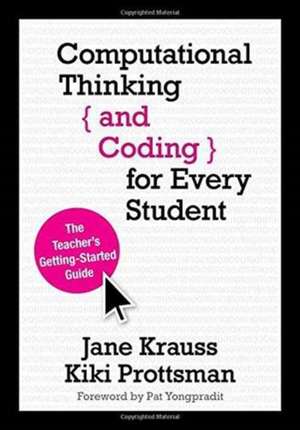
Computational Thinking and Coding for Every Student
Autor Jane Krauss, Kiki Prottsmanen Limba Engleză Paperback – 18 noi 2016
Evoluția educației digitale a transgresat simpla utilizare a dispozitivelor, migrând spre dezvoltarea unor structuri cognitive fundamentale. Reținem că Computational Thinking and Coding for Every Student nu este un manual tehnic de programare, ci o resursă pedagogică ce ancorează conceptele abstracte în realități familiare. Remarcăm efortul autoarelor Jane Krauss și Kiki Prottsman de a demistifica informatica, demonstrând cum activități precum tricotatul sau rezolvarea unui Sudoku sunt, în esență, exerciții de gândire computațională. Comparabil cu Teaching Computational Thinking and Coding in Primary Schools de David Morris în rigoarea cu care tratează curriculumul, volumul de față se distinge prin abordarea sa incluzivă, fiind conceput special pentru profesorii care nu sunt specialiști în tehnologie. Structura cărții este ingenios organizată sub formă de producție cinematografică: prima parte, „Storyboarding”, stabilește fundamentul teoretic și de ce este iresponsabil să privăm elevii de aceste competențe, în timp ce partea a doua, „Casting Call”, oferă strategii de implementare imediată. Subliniem continuitatea metodologică a lui Jane Krauss; dacă în lucrarea sa anterioară, Thinking Through Project-Based Learning, se concentra pe învățarea prin proiecte ca vehicul pentru o înțelegere profundă, aici aplică aceleași principii pentru a integra coding-ul în diverse discipline. Lucrarea ghidează educatorii prin exerciții de tip „warm-up”, promovează mișcarea în clasă și oferă liste esențiale de „Așa da/Așa nu”, transformând anxietatea tehnologică într-o explorare creativă partajată cu elevii.
Preț: 184.95 lei
Carte disponibilă
Livrare economică 06-20 noiembrie
Specificații
ISBN-10: 1506341284
Pagini: 210
Dimensiuni: 178 x 254 x 12 mm
Greutate: 0.41 kg
Ediția:1
Editura: Corwin
Locul publicării:Thousand Oaks, United States
V-ar putea interesa
-
 Design for How People LearnJulie DirksenPreț: 269.01 lei
 -
 Preț: 103.37 lei
 -
 Language and Literacy in Science EducationJerry Wellington-30%Preț: 179.99 lei256.37 lei
 -
 Meaning Making in Secondary Science ClassroomsEduardo Mortimer-27%Preț: 203.19 lei277.33 lei
 -
 Technology Leadership for School ImprovementRosemary Papa-23%Preț: 949.05 lei1232.53 lei
 -
 Empowering Students With TechnologyAlan NovemberPreț: 245.18 lei
 -
 Teaching Digital NativesMarc R. PrenskyPreț: 296.81 lei
 -
 Preț: 300.31 lei
 -
 Digital Learning for All, NowJonathan P. Costa Sr.Preț: 283.15 lei
 -
 Apps for LearningHarry J. DickensPreț: 212.03 lei
 -
 Worlds of MakingLaura FlemingPreț: 91.84 lei
 -
 -25%Preț: 179.65 lei240.77 lei
De ce să citești această carte
Această carte este esențială pentru educatorii care doresc să integreze gândirea computațională fără a deveni experți în software. Cititorul câștigă o metodologie clară pentru a preda logica din spatele codului prin activități accesibile, de la strategii low-tech la programarea în perechi. Este resursa ideală pentru a transforma elevii din consumatori pasivi de tehnologie în creatori activi și gânditori critici, pregătiți pentru provocările secolului XXI.
Despre autor
Jane Krauss este un nume de referință în dezvoltarea curriculară, cu o vastă experiență ca profesoară în Oregon și fost director la ISTE (International Society for Technology in Education). În prezent, își dedică expertiza Centrului Național pentru Femei și Tehnologia Informației (NCWIT), promovând diversitatea în domeniul tehnic. Co-autoarea Kiki Prottsman completează acest profil cu o abordare pragmatică asupra educației informatice. Împreună, acestea combină pedagogia bazată pe proiecte cu expertiza în tehnologie, oferind soluții aplicabile pentru cadrele didactice din întreaga lume.
Descriere scurtă
Recenzii
This book will help a lot of educators take their first steps toward bringing
high quality programming experiences to their students. It offers clear examples
and good strategies supported by research and best practices.
Wondering whether this book is for you? Check out the “dos and don’ts” of
Chapter 5 and then take them to heart. I did!
This book is so clear and so encouraging. I recommend it to my Girls Excelling
in Math and Science (GEMS) leaders as we work to incorporate more
computer science into our activities. The authors present a comprehensive
introduction to computing in a way that’s useful, readable, and fun.
Cuprins
Preface
Why This Book? Why Now?
What to Expect
A Note About Preparation
Lights, Camera, Action!
Acknowledgments
About the Authors
Part 1: Storyboarding
Chapter 1. An Introduction to Computer Science
Computer Science Is Within You
An Introduction to Computational Thinking
What Computer Science Is
What Computer Science Is Not
Chapter 2. Why Kids Should Have the Opportunity to Learn
What Computer Science Really Teaches
A Look Back
It Would Be Irresponsible Not to Introduce Computer Science
Part 2: Casting Call
Chapter 3. Try Your Hand at Coding
Time Well Spent
Key Strategy: Pair Programming
Teacher Warm-ups and Exercises
Chapter 4. Getting Started in the Classroom
Start Low-Tech
Encourage Movement
Foster Critical Consumption
Protect Privacy and Prevent Cyberbullying
Achieve Access
Banish Anxiety
Chapter 5. Dos and Don’ts of Teaching Computer Science
1. DON’T Expect to Be an Expert
2. DO Let Your Class Explore
3. DO Let Your Class Share
4. DO Give Kids Time to Move
5. DO Get Creative
6. DON’T Be a Bore
7. DO Relate Computer Science to Students’ Lives
8. DON’T Expect Cookie-Cutter Results
9. DO Set Students up for Success
10. DO Treat CS as an Art
11. DO Give It a Try
Part 3: In Production
Chapter 6. Activities That Foster Computational Thinking
Thinking Computationally
Digging Deeper Into Computational Thinking
Chapter 7. Decomposition
Decomposition Resources
Lesson Plan: Break It Down!
Decomposition: Break It Up!
Chapter 8. Pattern Recognition (With Pattern Matching)
Pattern Recognition Resources
Lesson Plan: Divine Patterns
Chapter 9. Abstraction
Abstraction Resources
Lesson Plan: So Abstract
Sample Stories
Chapter 10. Automation
Automation Resources
Lesson Plan: Algorithms and Automation— A Compliment Generator
A Last Word on Computational Thinking
What’s Next?
Chapter 11. Activities That Foster Spatial Reasoning
Spatial Abilities Tied to Success in STEM
“Spatialize” Your Teaching
Wrapping It Up
Chapter 12: Making With Code
Making Within STEAM Studies
Design for Design Thinking
“Freestyle” Making
Part 4: Your Feature Presentation
Chapter 13. Designing a Curriculum Continuum Across K–12
Chapter 14. Important Ideas Across All Grades
Pair Programming
Learning to Learn
Resources at the Ready
Equitable Practices
Chapter 15. The Elementary Pathway
Kindergarten and First Grade
Second and Third Grades
Fourth and Fifth Grades
Out-of-School Learning in the Elementary Grades
Elementary Computer Science Resources
Curriculum: Build an Alligator!
Chapter 16. The Middle School Pathway
Out-of-School Time in the Middle Grades
Middle School Computer Science Resources
Curriculum: Create Your Own Fortune
Chapter 17. The High School Pathway
Out-of-School Time in High School
High School Computer Science Resources
Curriculum: Roll the Dice
Chapter 18. Adapting Lessons for Your Class
1. The Lessons Are Only Suggestions
2. Adapt a Lesson for Younger Students
3. Adapt a Lesson for Older Students
4. Create a Lesson to Squeeze Into Other Curricula
Chapter 19. What People Are Doing and How They Are Doing It Well
Taking It to the Streets: Build Community Enthusiasm for Computer Science
Testimonials
Afterword: Opportunities Abound
Discussion Guide
Glossary
References
Index
Notă biografică
Jane also writes and offers professional development internationally around the topic of project-based learning with technology. With Suzie Boss, she is coauthor of Reinventing Project-Based Learning: Your Field Guide to Real World Projects in the Digital Age (2nd ed., 2014, ISTE) and Thinking Through Project-Based Learning: Guiding Deeper Inquiry (2013, Corwin).
In her free time, Jane enjoys dabbling in glasswork and mosaics, and keeps fit running and hiking on woodland trails just outside her door in Eugene, Oregon.