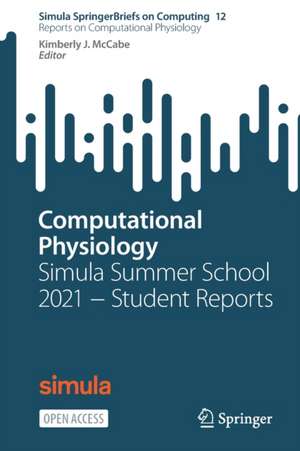
Computational Physiology
Editat de Kimberly J. McCabeen Limba Engleză Paperback – 9 mai 2022
In June through August of 2021, Simula held the seventh annual Summer School in Computational Physiology in collaboration with the University of Oslo (UiO) and the University of California, San Diego (UCSD). The course focuses on modeling excitable tissues, with a special interest in cardiac physiology and neuroscience. The majority of the school consists of group research projects conducted by Masters and PhD students from around the world, and advised by scientists at Simula, UiO and UCSD. Each group then produced a report that addreses a specific problem of importance in physiology and presents a succinct summary of the findings. Reports may not necessarily represent new scientific results; rather, they can reproduce or supplement earlier computational studies or experimental findings.
Reports from eight of the summer projects are included as separate chapters. The fields represented include cardiac geometry definition (Chapter 1), electrophysiology and pharmacology (Chapters 2–5), fluid mechanics in blood vessels (Chapter 6), cardiac calcium handling and mechanics (Chapter 7), and machine learning in cardiac electrophysiology (Chapter 8).
Preț: 413.60 lei
Puncte Express: 620
Carte tipărită la comandă
Livrare economică 17 noiembrie-01 decembrie
Livrare prin curier în România Termenul estimat este afișat lângă disponibilitate.
Transport gratuit pentru acest produs Plată online sau ramburs, în funcție de opțiunile comenzii.
Retur gratuit în 14 zile Comandă securizată și suport în română.
Specificații
ISBN-13: 9783031051630
ISBN-10: 3031051637
Pagini: 124
Ilustrații: XI, 109 p. 47 illus., 45 illus. in color.
Dimensiuni: 155 x 235 x 8 mm
Greutate: 0.2 kg
Ediția:1st edition 2022
Editura: Springer
Locul publicării:Cham, Switzerland
ISBN-10: 3031051637
Pagini: 124
Ilustrații: XI, 109 p. 47 illus., 45 illus. in color.
Dimensiuni: 155 x 235 x 8 mm
Greutate: 0.2 kg
Ediția:1st edition 2022
Editura: Springer
Locul publicării:Cham, Switzerland
Cuprins
A Pipeline for Automated Coordinate Assignment in Anatomically Accurate Biventricular Models 3D Simulations of Fetal and Maternal Ventricular Excitation for Investigating the Abdominal ECG.- Ordinary Differential Equation-based Modeling of Cells in Human Cartilage.- Conduction Velocity in Cardiac Tissue as Function of Ion Channel Conductance and Distribution.- Computational Prediction of Cardiac Electropharmacology – How Much Does the Model Matter?.- A Computational Study of Flow Instabilities in Aneurysms.- Investigating the Multiscale Impact of Deoxyadenosine Triphosphate (dATP) on Pulmonary Arterial Hypertension (PAH) Induced Heart Failure.- Identifying Ionic Channel Block in a Virtual Cardiomyocyte Population Using Machine Learning Classifiers.
Textul de pe ultima copertă
This open access volume compiles student reports from the 2021 Simula Summer School in Computational Physiology. Interested readers will find herein a number of modern approaches to modeling excitable tissue. This should provide a framework for tools available to model subcellular and tissue-level physiology across scales and scientific questions. In June through August of 2021, Simula held the seventh annual Summer School in Computational Physiology in collaboration with the University of Oslo (UiO) and the University of California, San Diego (UCSD). The course focuses on modeling excitable tissues, with a special interest in cardiac physiology and neuroscience. The majority of the school consists of group research projects conducted by Masters and PhD students from around the world, and advised by scientists at Simula, UiO and UCSD. Each group then produced a report that addreses a specific problem of importance in physiology and presents a succinct summary of the findings. Reportsmay not necessarily represent new scientific results; rather, they can reproduce or supplement earlier computational studies or experimental findings.
Reports from eight of the summer projects are included as separate chapters. The fields represented include cardiac geometry definition (Chapter 1), electrophysiology and pharmacology (Chapters 2–5), fluid mechanics in blood vessels (Chapter 6), cardiac calcium handling and mechanics (Chapter 7), and machine learning in cardiac electrophysiology (Chapter 8).
Reports from eight of the summer projects are included as separate chapters. The fields represented include cardiac geometry definition (Chapter 1), electrophysiology and pharmacology (Chapters 2–5), fluid mechanics in blood vessels (Chapter 6), cardiac calcium handling and mechanics (Chapter 7), and machine learning in cardiac electrophysiology (Chapter 8).
Caracteristici
This book is open access, which means that you have free and unlimited access Research case studies in computational physiology A variety of numerical tools for simulating biological systems Demonstrated tools and methods for modeling excitable tissue