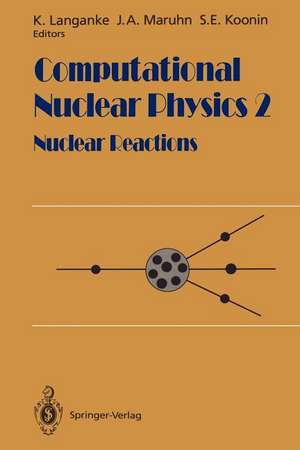
Computational Nuclear Physics 2: Nuclear Reactions
Editat de K. Langanke, J. A. Maruhn, S. E. Kooninen Limba Engleză Paperback – 18 oct 2011
Preț: 695.09 lei
Preț vechi: 847.67 lei
-18%
Puncte Express: 1043
Carte tipărită la comandă
Livrare economică 14-28 octombrie
Livrare prin curier în România Termenul estimat este afișat lângă disponibilitate.
Transport gratuit pentru acest produs Plată online sau ramburs, în funcție de opțiunile comenzii.
Retur gratuit în 14 zile Comandă securizată și suport în română.
Specificații
ISBN-13: 9781461393375
ISBN-10: 146139337X
Pagini: 220
Ilustrații: XIV, 203 p.
Dimensiuni: 155 x 235 x 12 mm
Greutate: 0.31 kg
Ediția:Softcover reprint of the original 1st ed. 1993
Editura: Springer
Colecția Springer
Locul publicării:New York, NY, United States
ISBN-10: 146139337X
Pagini: 220
Ilustrații: XIV, 203 p.
Dimensiuni: 155 x 235 x 12 mm
Greutate: 0.31 kg
Ediția:Softcover reprint of the original 1st ed. 1993
Editura: Springer
Colecția Springer
Locul publicării:New York, NY, United States
V-ar putea interesa
-
 Weinberg, S: Dreams Of A Final TheorySteven WeinbergPreț: 113.24 lei
 -
 Elementary Atomic StructureG. K. Woodgate-29%Preț: 410.61 lei574.51 lei
 -
 Molecular BeamsNorman Ramsey-31%Preț: 574.64 lei829.00 lei
 -
 -21%Preț: 364.97 lei459.72 lei
 -
 -22%Preț: 474.68 lei611.28 lei
 -
 -28%Preț: 516.21 lei717.85 lei
 -
 Nuclear Physics - Principles & ApplicationsJohn LilleyPreț: 393.27 lei
 -
 Introduction to High Energy PhysicsDonald H. Perkins-8%Preț: 597.19 lei649.12 lei
 -
 A Walk through the Southern SkyMilton HeifetzPreț: 266.96 lei
 -
 -15%Preț: 680.10 lei800.11 lei
 -
 Introducing Particle PhysicsTom WhyntiePreț: 62.84 lei
 -
 Quantum PhysicsAlistair I M RaePreț: 65.69 lei
 -
 INTR TO BLACK HOLES, INFORMATION & THE..Susskind LeonardPreț: 130.04 lei
Public țintă
Professional/practitionerCuprins
1. One-Boson-Exchange Potentials and Nucleon-Nucleon Scattering.- 1.1 The Meson Theory of Nuclear Forces.- 1.2 Relativistic Two-Nucleon Scattering.- 1.3 One-Boson-Exchange Potentials.- 1.4 Numerics and Codes.- 1.5 Using the Codes.- 1.6 What Else?.- Acknowledgments.- References.- 2. The G-Matrix in Finite Nuclei.- 2.1 Introduction.- 2.2 The G-Matrix, a First Step Towards an Effective NN Interaction.- 2.3 The Solution of the Bethe-Goldstone Equation.- 2.4 Details of the Numerical Calculation.- 2.5 Some Examples for Tests and Studies.- 2.6 Technical Note.- References.- 3. The Nuclear-Matter Effective Interaction.- 3.1 Background.- 3.2 The Bethe-Goldstone Equation in Uniform Matter.- 3.3 The Reference Spectrum Method.- 3.4 The Legindgaard Representation.- 3.5 Numerical Methods.- 3.6 Remarks on the Code.- 3.7 Performance.- 3.8 Things to Do.- References.- 4. Microscopic Description of Nuclear Collisions.- 4.1 Introduction.- 4.2 Theoretical Background to the Resonating Group Method.- 4.3 A Short Description of the Numerical Methods Used and the Program Structure.- 4.4 Installation and Use of the Codes.- 4.5 Physical Applications.- 4.6 Technical Note.- References.- 5. The Distorted-Wave Born Approximation.- 5.1 General Description of DWUCK4.- 5.2 Specific Cases of Reactions.- 5.3 Description of the Input for DWUCK4.- 5.4 Sample Cases-Input and Output.- 5.5 Things to Do.- 5.6 Technical Note.- References.- 6. Statistical-Model Calculations with Angular-Momentum Coupling.- 6.1 Background.- 6.2 Basic Features of the Code.- 6.3 Level-Density Tables.- 6.4 Transmission Coefficients.- 6.5 Fission Barrier and Probability.- 6.6 Angular Distribution.- 6.7 Special Programming Features.- 6.8 Input and Output Files.- 6.9 Summary.- 6.10 Technical Note.- References.- 7. The Time-Dependent Hartree-Fock Approximation for Nuclear Slabs.- 7.1 Background.- 7.2 Interaction.- 7.3 Reduction to One Dimension.- 7.4 Numerical Methods.- 7.5 Remarks on the Code.- 7.6 Running the Code.- 7.7 Things to Do.- References.- 8. The Vlasov-Uehling-Uhlenbeck Model.- 8.1 Introduction.- 8.2 Theoretical Description of Heavy-Ion Collisions.- 8.3 The VUU Equation.- 8.4 The Nuclear Equation of State.- 8.5 Numerical Realization.- 8.6 The Basic Structure of the Program.- 8.7 Running the Program.- 8.8 Input Examples.- 8.9 Interpretation of the Output.- 8.10 Output Analysis with VUUANL.- 8.11 Final Comments on Using the Program.- 8.12 Test Output.- References.- 9. The Friction Model for Deep-Inelastic and Fusion Reactions.- 9.1 Introduction.- 9.2 Description of the Program.- 9.3 The Structure of the Final Printout File.- 9.4 Running the Code with the Sample Input.- References.- 10. The Quark Model and the Nucleon-Nucleon Interaction.- 10.1 Introduction.- 10.2 The Resonating Group Method.- 10.3 The Hamiltonian of the Six-Quark System.- 10.4 Remarks on the Code.- 10.5 Technical Note.- References.- 11. Hadron-Hadron and Hadron-Nucleus Scattering.- 11.1 Introduction.- 11.2 Multiple Scattering Off Nuclei.- 11.3 Hadronic Interactions in the Quark Model.- 11.4 Conclusion.- 11.5 Technical Note.- References.