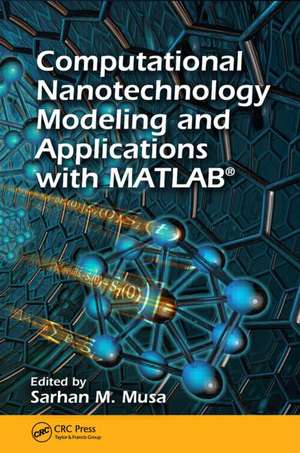
Computational Nanotechnology: Modeling and Applications with MATLAB(R): Nano and Energy
Editat de Sarhan M. Musaen Limba Engleză Hardback – 30 iun 2011
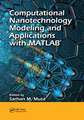
Computational Nanotechnology: Modeling and Applications with MATLAB® provides expert insights into current and emerging methods, opportunities, and challenges associated with the computational techniques involved in nanoscale research. Written by, and for, those working in the interdisciplinary fields that comprise nanotechnology—including engineering, physics, chemistry, biology, and medicine—this book covers a broad spectrum of technical information, research ideas, and practical knowledge. It presents an introduction to computational methods in nanotechnology, including a closer look at the theory and modeling of two important nanoscale systems: molecular magnets and semiconductor quantum dots.
Topics covered include:
- Modeling of nanoparticles and complex nano and MEMS systems
- Theory associated with micromagnetics
- Surface modeling of thin films
- Computational techniques used to validate hypotheses that may not be accessible through traditional experimentation
- Simulation methods for various nanotubes and modeling of carbon nanotube and silicon nanowire transistors

Preț: 1456.54 lei
Preț vechi: 1776.27 lei
-18% Nou
Puncte Express: 2185
Preț estimativ în valută:
257.74€ • 302.23$ • 226.35£
257.74€ • 302.23$ • 226.35£
Carte tipărită la comandă
Livrare economică 06-20 februarie 26
Preluare comenzi: 021 569.72.76
Specificații
ISBN-13: 9781439841761
ISBN-10: 1439841764
Pagini: 537
Ilustrații: 281 b/w images, 45 tables and approx 630
Dimensiuni: 178 x 254 x 35 mm
Greutate: 1.18 kg
Ediția:New.
Editura: CRC Press
Seria Nano and Energy
ISBN-10: 1439841764
Pagini: 537
Ilustrații: 281 b/w images, 45 tables and approx 630
Dimensiuni: 178 x 254 x 35 mm
Greutate: 1.18 kg
Ediția:New.
Editura: CRC Press
Seria Nano and Energy
V-ar putea interesa
-
 Fundamentals of Technical MathematicsSarhan M. Musa-8%Preț: 432.09 lei469.66 lei
 -
 Nanoscience: Colloidal and Interfacial AspectsVictor M. Starov-31%Preț: 694.82 lei1003.58 lei
 -
 Computational Finite Element Methods in NanotechnologySarhan M. Musa-18%Preț: 1461.56 lei1782.38 lei
 -
 -32%Preț: 1402.33 lei2058.58 lei
 -
 A Laboratory Course in Nanoscience and NanotechnologyGerrard Eddy Jai Poinern-15%Preț: 673.58 lei792.45 lei
 -
 Nanoscale Flow: Advances, Modeling, and ApplicationsSarhan M. Musa-51%Preț: 930.88 lei1887.41 lei
 -
 -18%Preț: 1437.15 lei1752.62 lei
 -
 -15%Preț: 607.96 lei715.25 lei
 -
 Nanoparticles in Anti-Microbial MaterialsFiona Regan-14%Preț: 1075.05 lei1250.06 lei
 -
 Network Security and CryptographySarhan M. Musa-20%Preț: 267.40 lei334.25 lei
 -
 Performance Analysis of Computer NetworksMatthew N. O. Sadiku-20%Preț: 325.79 lei407.24 lei
 -
 -18%Preț: 1198.72 lei1461.86 lei
 -
 Nanomedicine and NanobiotechnologyStergios Logothetidis-15%Preț: 609.39 lei716.93 lei
 -
 BionanoelectronicsDaniela Dragoman-24%Preț: 848.40 lei1116.30 lei
 -
 Nanostructured Materials and Their ApplicationsStergios Logothetidis-18%Preț: 1061.48 lei1294.49 lei
 -
 -18%Preț: 933.31 lei1138.18 lei
 -
 Carbon Nanotubes: Synthesis, Structure, Properties, and ApplicationsMildred S. Dresselhaus-18%Preț: 863.27 lei1052.77 lei
Public țintă
Professionals, researchers, and students in engineering, physics, chemistry, biology, and medicine, among other fieldsCuprins
Introduction to Computational Methods in Nanotechnology, O. Ciftja and S.M. Musa
Computational Modeling of Nanoparticles, U. Riaz and S.M. Ashraf
Micromagnetics: Finite Element Analysis of Nano- Sized Magnetic Materials Using MATLAB®, S.-L. Chin and T. Flack
System-Level Modeling of N/MEMS, J.V. Clark
Numerical Integrator for Continuum Equations of Surface Growth and Erosion, A. Keller, S. Facsko, and R. Cuerno
Configuration Optimizations and Photophysics Simulations of Single-Wall Nanotubes of Carbon, Silicon-Carbide, and Carbon-Nitride, W.-D. Cheng, C.-S. Lin, G.-L. Chai, and S.-P. Huang
MATLAB® Applications in Behavior Analysis of Systems Consisting of Carbon Nanotubes through Molecular Dynamics Simulation, M. Foroutan and S. Khoee
Device and Circuit Modeling of Nano-CMOS, M.L.P. Tan, D.C.Y. Chek, and V.K. Arora
Computational and Experimental Approaches to Cellular and Subcellular Tracking at the Nanoscale, Z. Al-Rekabi, D. Tremblay, K. Haase, R.L. Leask, and A.E. Pelling
Computational Simulations of Nanoindentation and Nanoscratch, C.-D. Wu, T.-H. Fang, and J.-F. Lin
Modeling of Reversible Protein Conjugation on Nanoscale Surface, K. Yokoyama
Computational Technology in Nanomedicine, V. Wiwanitkit
Future Directions: Opportunities and Challenges, G.C. Giakos
Appendix A: Material and Physical Constants
Appendix B: Symbols and Formulas
Appendix C: MATLAB®
Computational Modeling of Nanoparticles, U. Riaz and S.M. Ashraf
Micromagnetics: Finite Element Analysis of Nano- Sized Magnetic Materials Using MATLAB®, S.-L. Chin and T. Flack
System-Level Modeling of N/MEMS, J.V. Clark
Numerical Integrator for Continuum Equations of Surface Growth and Erosion, A. Keller, S. Facsko, and R. Cuerno
Configuration Optimizations and Photophysics Simulations of Single-Wall Nanotubes of Carbon, Silicon-Carbide, and Carbon-Nitride, W.-D. Cheng, C.-S. Lin, G.-L. Chai, and S.-P. Huang
MATLAB® Applications in Behavior Analysis of Systems Consisting of Carbon Nanotubes through Molecular Dynamics Simulation, M. Foroutan and S. Khoee
Device and Circuit Modeling of Nano-CMOS, M.L.P. Tan, D.C.Y. Chek, and V.K. Arora
Computational and Experimental Approaches to Cellular and Subcellular Tracking at the Nanoscale, Z. Al-Rekabi, D. Tremblay, K. Haase, R.L. Leask, and A.E. Pelling
Computational Simulations of Nanoindentation and Nanoscratch, C.-D. Wu, T.-H. Fang, and J.-F. Lin
Modeling of Reversible Protein Conjugation on Nanoscale Surface, K. Yokoyama
Computational Technology in Nanomedicine, V. Wiwanitkit
Future Directions: Opportunities and Challenges, G.C. Giakos
Appendix A: Material and Physical Constants
Appendix B: Symbols and Formulas
Appendix C: MATLAB®
Notă biografică
Sarhan Musa received his Ph.D. in electrical engineering in 2001 from City University of New York. He is currently an associate professor in the engineering technology department of Prairie View A&M University, Texas. From 2009 to 2010, Dr. Musa was a visiting professor in the department of electrical computer engineering and also worked in the Nanoelectronic Systems Laboratory (NSL) at Rice University, Texas. His research interests include computational methods in nanotechnology, numerical modeling of electromagnetic systems, and computer communication networks. He currently serves on the Editorial Board of Journal of Modern Applied Science, and he is a senior member of the Institute of Electrical and Electronics Engineers (IEEE). He is also a 2010 Boeing Welliver Fellow.