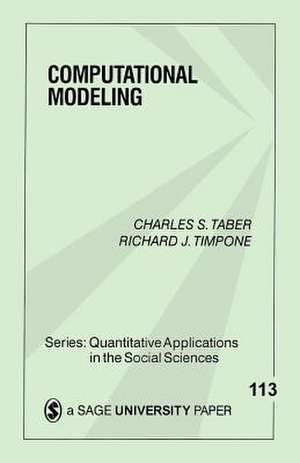
Computational Modeling
Autor Charles S. Taber, Richard J. Timpone Editat de Richard John Timponeen Limba Engleză Paperback – mar 1996
Preț: 280.00 lei
Preț vechi: 349.99 lei
-20%
Puncte Express: 420
Carte tipărită la comandă
Livrare economică 04-18 decembrie
Livrare prin curier în România Termenul estimat este afișat lângă disponibilitate.
Transport gratuit de la 400.00 lei Plată online sau ramburs, în funcție de opțiunile comenzii.
Retur gratuit în 14 zile Comandă securizată și suport în română.
Specificații
ISBN-13: 9780803972704
ISBN-10: 0803972709
Pagini: 104
Dimensiuni: 140 x 216 x 6 mm
Greutate: 0.13 kg
Ediția:New.
Editura: SAGE Publications
Locul publicării:Thousand Oaks, United States
ISBN-10: 0803972709
Pagini: 104
Dimensiuni: 140 x 216 x 6 mm
Greutate: 0.13 kg
Ediția:New.
Editura: SAGE Publications
Locul publicării:Thousand Oaks, United States
V-ar putea interesa
-
 The Designer's Guide to VHDLPeter J. Ashenden-34%Preț: 375.93 lei572.56 lei
 -
 Deep SimplicityJohn GribbinPreț: 92.84 lei
 -
 Evolution of Networks: From Biological Nets to the Internet and WWWS. N. Dorogovtsev-23%Preț: 432.72 lei558.75 lei
 -
 Introduction to Systems TheoryNiklas LuhmannPreț: 169.40 lei
 -
 Introduction ModelicaFritzson-8%Preț: 452.76 lei492.13 lei
 -
 Optimal Estimation of Dynamic SystemsJohn L. Crassidis-18%Preț: 1494.88 lei1823.02 lei
 -
 -15%Preț: 572.75 lei673.83 lei
 -
 Switching in Systems and ControlDaniel Liberzon-15%Preț: 584.73 lei687.91 lei
 -
 Perturbation Analysis of Optimization ProblemsJ.Frederic Bonnans-18%Preț: 1341.26 lei1635.67 lei
 -
 Modeling and Control of Discrete-Event Dynamic SystemsBranislav Hrúz-15%Preț: 471.15 lei554.30 lei
Cuprins
Introduction
Dynamic Simulation Models
Knowledge-Based Systems
Models of Machine Learning
Evaluating Computational Models
Dynamic Simulation Models
Knowledge-Based Systems
Models of Machine Learning
Evaluating Computational Models
Descriere
Computational modelling allows researchers to combine the rich detail of qualitative research with the rigour of quantitative and formal research, as well as to represent complex structures and processes within a theoretical model. After an introduction to modelling, the authors discuss the role of computational methods in the social sciences. They treat computational methods, including dynamic simulation, knowledge-based models and machine learning, as a single broad class of research tools and develop a framework for incorporating them within established traditions of social science research. They provide a concise description of each method and a variety of social science illustrations, including four detailed examples.