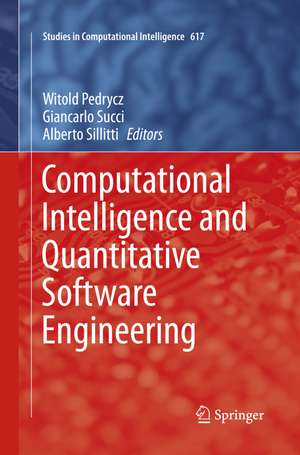
Computational Intelligence and Quantitative Software Engineering
Editat de Witold Pedrycz, Giancarlo Succi, Alberto Sillittien Limba Engleză Paperback – 30 mar 2018
Software Engineering is an intensive knowledge-based endeavor of inherent human-centric nature, which profoundly relies on acquiring semiformal knowledge and then processing it to produce a running system. The knowledge spans a wide variety of artifacts, from requirements, captured in the interaction with customers, to design practices, testing, and code management strategies, which rely on the knowledge of the running system. This volume consists of contributions written by widely acknowledged experts in the field who reveal how the Software Engineering benefits from the key foundations and synergistically existing technologies of Computational Intelligence being focused on knowledge representation, learning mechanisms, and population-based global optimization strategies.
This book can serve as a highly useful reference material for researchers, software engineers and graduate students and senior undergraduate students in Software Engineering and its sub-disciplines, Internet engineering, Computational Intelligence, management, operations research, and knowledge-based systems.
Preț: 619.78 lei
Preț vechi: 774.72 lei
-20%
Puncte Express: 930
Carte tipărită la comandă
Livrare economică 27 noiembrie-11 decembrie
Livrare prin curier în România Termenul estimat este afișat lângă disponibilitate.
Transport gratuit pentru acest produs Plată online sau ramburs, în funcție de opțiunile comenzii.
Retur gratuit în 14 zile Comandă securizată și suport în română.
Specificații
ISBN-13: 9783319798660
ISBN-10: 3319798669
Pagini: 220
Ilustrații: IX, 207 p. 41 illus., 26 illus. in color.
Dimensiuni: 155 x 235 x 13 mm
Greutate: 0.34 kg
Ediția:Softcover reprint of the original 1st edition 2016
Editura: Springer
Locul publicării:Cham, Switzerland
ISBN-10: 3319798669
Pagini: 220
Ilustrații: IX, 207 p. 41 illus., 26 illus. in color.
Dimensiuni: 155 x 235 x 13 mm
Greutate: 0.34 kg
Ediția:Softcover reprint of the original 1st edition 2016
Editura: Springer
Locul publicării:Cham, Switzerland
V-ar putea interesa
-
 -20%Preț: 89.95 lei112.23 lei
 -
 Fuzzy Evolutionary ComputationWitold Pedrycz-18%Preț: 981.42 lei1196.85 lei
 -
 Computer VisionSimon J. D. Prince-20%Preț: 582.72 lei728.39 lei
 -
 Machine LearningPeter Flach-20%Preț: 386.84 lei483.55 lei
 -
 Multi-Agent Machine LearningSchwartz-20%Preț: 675.81 lei844.77 lei
 -
 Wavelet Neural NetworksAntonis K Alexandridis-20%Preț: 634.18 lei792.72 lei
 -
 Practical Introduction to CompDawson-Howe-20%Preț: 518.21 lei647.76 lei
 -
 Reasoning and Unification over Conceptual GraphsDan Corbett-20%Preț: 614.52 lei768.14 lei
 -
 Machine Learning: An Algorithmic Perspective, Second EditionStephen Marsland-20%Preț: 625.22 lei781.53 lei
 -
 -9%Preț: 987.33 lei1084.98 lei
 -
 Extreme Programming and Agile Processes in Software EngineeringPekka Abrahamsson-20%Preț: 332.26 lei415.32 lei
 -
 Extreme Programming and Agile Processes in Software EngineeringMichele Marchesi-20%Preț: 344.83 lei431.04 lei
 -
 -20%Preț: 321.94 lei402.43 lei
 -
 Human-Centric Information Processing Through Granular ModellingAndrzej Bargiela-18%Preț: 919.07 lei1120.81 lei
 -
 -20%Preț: 326.42 lei408.02 lei
 -
 -20%Preț: 324.19 lei405.23 lei
 -
 Believable BotsPhilip Hingston-20%Preț: 676.70 lei845.88 lei
 -
 Frontiers of Combining SystemsPascal Fontaine-20%Preț: 338.85 lei423.56 lei
 -
 Embedded and Real Time System Development: A Software Engineering PerspectiveMohammad Ayoub Khan-20%Preț: 677.34 lei846.67 lei
 -
 Discovery ScienceJohannes Fürnkranz-20%Preț: 339.07 lei423.84 lei
 -
 Modeling and Using ContextPatrick Brézillon-20%Preț: 327.07 lei408.84 lei
 -
 Hybrid ClassifiersMichal Wozniak-20%Preț: 671.62 lei839.52 lei
 -
 The Semantic Web - ISWC 2013Harith Alani-20%Preț: 332.39 lei415.48 lei
 -
 Transactions on Computational Collective Intelligence XINgoc Thanh Nguyen-20%Preț: 318.89 lei398.61 lei
Cuprins
The Role of Computational Intelligence in Quantitative Software Engineering.- Computational Intelligence: An Introduction.- Towards Benchmarking Feature Subset Selection Methods for Software Fault Prediction.- Evolutionary Computation for Software Product Line Testing: An Overview and Open Challenges.- Metaheuristic Optimisation and Mutation-Driven Test Data Generation.- Measuring the Utility of Functional-Based Software Using Centroid-Adjusted Class Labelling.- Toward Accurate Software Effort Prediction Using Multiple Classifier Systems.- Complex Specifications Requirements Software Quantitative.- Possibilistic Assessment of Process-Related Disclosure Risks on the Cloud.
Recenzii
“An overview of the current state of the art in the use of computational intelligence in software engineering is presented in this book. … Each application chapter concludes with a comprehensive bibliography. … The book can be recommended to practitioners interested in improving their quantitative evaluations in the field of software engineering.” (J. P. E. Hodgson, Computing Reviews, March, 2016)
Textul de pe ultima copertă
In a down-to-the earth manner, the volume lucidly presents how the fundamental concepts, methodology, and algorithms of Computational Intelligence are efficiently exploited in Software Engineering and opens up a novel and promising avenue of a comprehensive analysis and advanced design of software artifacts. It shows how the paradigm and the best practices of Computational Intelligence can be creatively explored to carry out comprehensive software requirement analysis, support design, testing, and maintenance.
Software Engineering is an intensive knowledge-based endeavor of inherent human-centric nature, which profoundly relies on acquiring semiformal knowledge and then processing it to produce a running system. The knowledge spans a wide variety of artifacts, from requirements, captured in the interaction with customers, to design practices, testing, and code management strategies, which rely on the knowledge of the running system. This volume consists of contributions written by widely acknowledged experts in the field who reveal how the Software Engineering benefits from the key foundations and synergistically existing technologies of Computational Intelligence being focused on knowledge representation, learning mechanisms, and population-based global optimization strategies.
This book can serve as a highly useful reference material for researchers, software engineers and graduate students and senior undergraduate students in Software Engineering and its sub-disciplines, Internet engineering, Computational Intelligence, management, operations research, and knowledge-based systems.
Software Engineering is an intensive knowledge-based endeavor of inherent human-centric nature, which profoundly relies on acquiring semiformal knowledge and then processing it to produce a running system. The knowledge spans a wide variety of artifacts, from requirements, captured in the interaction with customers, to design practices, testing, and code management strategies, which rely on the knowledge of the running system. This volume consists of contributions written by widely acknowledged experts in the field who reveal how the Software Engineering benefits from the key foundations and synergistically existing technologies of Computational Intelligence being focused on knowledge representation, learning mechanisms, and population-based global optimization strategies.
This book can serve as a highly useful reference material for researchers, software engineers and graduate students and senior undergraduate students in Software Engineering and its sub-disciplines, Internet engineering, Computational Intelligence, management, operations research, and knowledge-based systems.
Caracteristici
Offers introductory chapters on Computational Intelligence so that the volume is made self-contained and easily accessible to the community of Computational Intelligence as well as researchers working in Software Engineering Each chapter is authored by an expert in the area, and includes a comprehensive and fully updated list of references The main topics are arranged into five sections: Introduction to Computational Intelligence, Principles of Software Engineering, Methodological developments in CI environment of Software Engineering, Algorithmic studies, and Case studies - a suite of representative areas of applications