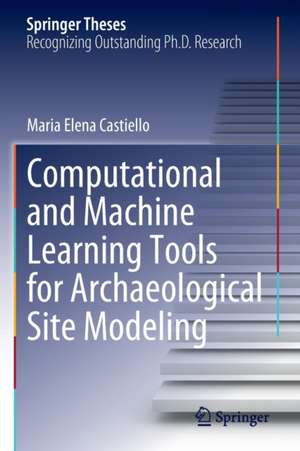
Computational and Machine Learning Tools for Archaeological Site Modeling: Springer Theses
Autor Maria Elena Castielloen Limba Engleză Paperback – 26 ian 2023
This book describes a novel machine-learning based approach to answer some traditional archaeological problems, relating to archaeological site detection and site locational preferences. Institutional data collected from six Swiss regions (Zurich, Aargau, Grisons, Vaud, Geneva and Fribourg) have been analyzed with an original conceptual framework based on the Random Forest algorithm. It is shown how the algorithm can assist in the modelling process in connection with heterogeneous, incomplete archaeological datasets and related cultural heritage information. Moreover, an in-depth review of past and more recent works of quantitative methods for archaeological predictive modelling is provided. The book guides the readers to set up their own protocol for: i) dealing with uncertain data, ii) predicting archaeological site location, iii) establishing environmental features importance, iv) and suggest a model validation procedure. It addresses both academics and professionals in archaeology and cultural heritage management, and offers a source of inspiration for future research directions in the field of digital humanities and computational archaeology.
Din seria Springer Theses
- 15%
 Preț: 663.23 lei
 - 15%
 Preț: 661.49 lei
 - 15%
 Preț: 660.04 lei
 - 18%
 Preț: 1438.89 lei
 -
 Preț: 397.39 lei
 - 18%
 Preț: 1150.06 lei
 - 18%
 Preț: 1261.12 lei
 - 15%
 Preț: 665.20 lei
 -
 Preț: 404.91 lei
 -
 Preț: 401.44 lei
 - 18%
 Preț: 1151.50 lei
 -
 Preț: 410.46 lei
 - 18%
 Preț: 1034.72 lei
 - 18%
 Preț: 977.51 lei
 - 18%
 Preț: 1144.10 lei
 - 15%
 Preț: 663.23 lei
 - 18%
 Preț: 1031.60 lei
 - 15%
 Preț: 638.81 lei
 - 18%
 Preț: 978.49 lei
 -
 Preț: 398.83 lei
 - 15%
 Preț: 667.93 lei
 -
 Preț: 399.72 lei
 - 15%
 Preț: 658.80 lei
 - 15%
 Preț: 663.97 lei
 - 15%
 Preț: 664.46 lei
 - 18%
 Preț: 1263.02 lei
 - 15%
 Preț: 663.48 lei
 - 18%
 Preț: 1035.90 lei
 - 18%
 Preț: 1273.75 lei
 - 18%
 Preț: 1152.69 lei
 - 15%
 Preț: 661.99 lei
 - 18%
 Preț: 1152.90 lei
 - 18%
 Preț: 1264.69 lei
 - 18%
 Preț: 1038.03 lei
 - 18%
 Preț: 1036.63 lei
 - 18%
 Preț: 1156.95 lei
 - 18%
 Preț: 1036.70 lei
 - 18%
 Preț: 979.42 lei
 - 15%
 Preț: 642.59 lei
 - 15%
 Preț: 665.96 lei
 - 18%
 Preț: 976.57 lei
 - 18%
 Preț: 1443.18 lei
 -
 Preț: 401.44 lei
 -
 Preț: 399.14 lei
 - 18%
 Preț: 1034.98 lei
 - 18%
 Preț: 1148.15 lei
 - 15%
 Preț: 658.33 lei
 - 15%
 Preț: 662.51 lei
 - 15%
 Preț: 659.03 lei
 - 15%
 Preț: 659.78 lei
Preț: 1402.66 lei
Preț vechi: 1753.32 lei
-20%
Puncte Express: 2104
Carte tipărită la comandă
Livrare economică 30 noiembrie-14 decembrie
Livrare prin curier în România Termenul estimat este afișat lângă disponibilitate.
Transport gratuit pentru acest produs Plată online sau ramburs, în funcție de opțiunile comenzii.
Retur gratuit în 14 zile Comandă securizată și suport în română.
Specificații
ISBN-13: 9783030885694
ISBN-10: 3030885690
Pagini: 316
Ilustrații: XVIII, 296 p. 159 illus., 139 illus. in color.
Dimensiuni: 155 x 235 x 18 mm
Greutate: 0.48 kg
Ediția:1st ed. 2022
Editura: Springer
Colecția Springer Theses
Seria Springer Theses
Locul publicării:Cham, Switzerland
ISBN-10: 3030885690
Pagini: 316
Ilustrații: XVIII, 296 p. 159 illus., 139 illus. in color.
Dimensiuni: 155 x 235 x 18 mm
Greutate: 0.48 kg
Ediția:1st ed. 2022
Editura: Springer
Colecția Springer Theses
Seria Springer Theses
Locul publicării:Cham, Switzerland
Cuprins
Introduction.- Space, Environment and Quantitative approaches in Archaeology.- Predictive Modeling.- Materials and Data.
Textul de pe ultima copertă
This book describes a novel machine-learning based approach to answer some traditional archaeological problems, relating to archaeological site detection and site locational preferences. Institutional data collected from six Swiss regions (Zurich, Aargau, Grisons, Vaud, Geneva and Fribourg) have been analyzed with an original conceptual framework based on the Random Forest algorithm. It is shown how the algorithm can assist in the modelling process in connection with heterogeneous, incomplete archaeological datasets and related cultural heritage information. Moreover, an in-depth review of past and more recent works of quantitative methods for archaeological predictive modelling is provided. The book guides the readers to set up their own protocol for: i) dealing with uncertain data, ii) predicting archaeological site location, iii) establishing environmental features importance, iv) and suggest a model validation procedure. It addresses both academics and professionals in archaeology and cultural heritage management, and offers a source of inspiration for future research directions in the field of digital humanities and computational archaeology.
Caracteristici
Nominated as an outstanding PhD thesis by the University of Bern, Switzerland Describes novel methods for investigating archaeological settlement patterns and locational preference choices Proposes a machine learning model for archaeological site prediction and detection