Cantitate/Preț
Produs

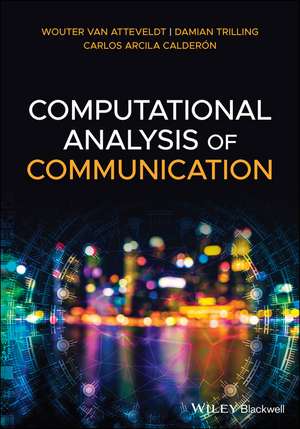
Computational Analysis of Communication

Autor Wouter van Atteveldt, Damian Trilling, Carlos Arcila Calderon
en Limba Engleză Paperback – 2 mar 2022

Autorii Wouter van Atteveldt, Damian Trilling și Carlos Arcila Calderon aduc o autoritate incontestabilă în acest volum, fiind specialiști care activează la intersecția dintre științele sociale și informatică. În calitate de editori ai publicației Computational Communication Research, aceștia au structurat lucrarea ca pe un ghid metodologic riguros, fundamentat pe necesitatea de a traduce tehnici complexe de analiză în instrumente accesibile cercetătorilor din sociologie, psihologie și studii media. Descoperim aici o resursă care completează perspectiva oferită de Doing Computational Social Science de John McLevey, adăugând o dimensiune aplicată specifică prin integrarea directă a codului Python și a fluxurilor de lucru pentru date audio-vizuale, elemente mai puțin explorate în manualele introductive generale. Față de lucrarea anterioară a autorului, Computational Methods for Communication Science, acest titlu extinde cadrul teoretic către o zonă practică, oferind instrucțiuni pas cu pas pentru instalarea mediilor de lucru precum RStudio și Jupyter Notebook. Structura volumului reflectă o progresie didactică logică: începe cu fundamentele programării și tipurile de date (întregi, liste, dicționare), avansează către structuri de control și funcții, pentru ca în final să abordeze analiza de rețea și vizualizarea informațiilor geografice. Reținem faptul că Computational Analysis of Communication nu se limitează la execuția tehnică, ci dedică spațiu critic eticii cercetării și proprietății datelor, asigurând un parcurs complet de la colectarea primară la interpretarea normativă a rezultatelor.

Citește tot Restrânge

Preț: 33382 lei

Puncte Express: 501

Carte disponibilă

Livrare economică 14-28 mai
Livrare express 29 aprilie-05 mai pentru 10154 lei


Specificații

ISBN-13: 9781119680239
ISBN-10: 1119680239
Pagini: 336
Dimensiuni: 177 x 253 x 21 mm
Greutate: 0.64 kg
Editura: Wiley
Locul publicării:Hoboken, United States

De ce să citești această carte

Această carte este esențială pentru studenții și profesioniștii din științele sociale care doresc să utilizeze tehnici de machine learning și analiză computațională fără a avea o bază tehnică solidă. Cititorul câștigă abilități practice de codare în Python și R, aplicate direct pe studii de caz din comunicare, beneficiind de un format hibrid ce include resurse online și exemple de cercetare actuale.


Despre autor

Wouter van Atteveldt este profesor de metode computaționale și comunicare politică, fiind unul dintre pionierii utilizării analizei automate de conținut în științele sociale. Împreună cu Damian Trilling și Carlos Arcila Calderon, formează o echipă editorială de elită în cadrul International Communication Association. Expertiza lor cumulată acoperă dezvoltarea de software open-source pentru cercetare, analiza sentimentelor și modelarea rețelelor sociale. Activitatea lor este centrală pentru comunitatea Computational Communication Research, promovând standarde înalte de transparență și reproductibilitate în utilizarea algoritmilor pentru studierea comportamentului uman și a fluxurilor de informații digitale.


Cuprins

Preface xi Acknowledgments xiii 1 Introduction 1 1.1 The Role of Computational Analysis in the Social Sciences 1 1.2 Why Python and/or R? 3 1.3 How to Use This Book 4 1.4 Installing R and Python 5 1.4.1 Installing R and RStudio 7 1.4.2 Installing Python and Jupyter Notebook 9 1.5 Installing Third-Party Packages 12 2 Getting Started: Fun with Data and Visualizations 13 2.1 Fun With Tweets 14 2.2 Fun With Textual Data 15 2.3 Fun With Visualizing Geographic Information 17 2.4 Fun With Networks 19 3 Programming Concepts for Data Analysis 23 3.1 About Objects and Data Types 24 3.1.1 Storing Single Values: Integers, Floating-Point Numbers, Booleans 25 3.1.2 Storing Text 26 3.1.3 Combining Multiple Values: Lists, Vectors, And Friends 28 3.1.4 Dictionaries 32 3.1.5 From One to More Dimensions: Matrices and n-Dimensional Arrays 33 3.1.6 Making Life Easier: Data Frames 34 3.2 Simple Control Structures: Loops and Conditions 35 3.2.1 Loops 36 3.2.2 Conditional Statements 37 3.3 Functions and Methods 39 4 How to Write Code 43 4.1 Re-using Code: How Not to Re-Invent the Wheel 43 4.2 Understanding Errors and Getting Help 46 4.2.1 Error Messages 46 4.2.2 Debugging Strategies 48 4.3 Best Practice: Beautiful Code, GitHub, and Notebooks 49 5 From File to Data Frame and Back 55 5.1 Why and When Do We Use Data Frames? 56 5.2 Reading and Saving Data 57 5.2.1 The Role of Files 57 5.2.2 Encodings and Dialects 59 5.2.3 File Handling Beyond Data Frames 61 5.3 Data from Online Sources 62 6 Data Wrangling 65 6.1 Filtering, Selecting, and Renaming 66 6.2 Calculating Values 67 6.3 Grouping and Aggregating 69 6.3.1 Combining Multiple Operations 70 6.3.2 Adding Summary Values 71 6.4 Merging Data 72 6.4.1 Equal Units of Analysis 72 6.4.2 Inner and Outer Joins 75 6.4.3 Nested Data 76 6.5 Reshaping Data: Wide To Long And Long To Wide 78 6.6 Restructuring Messy Data 79 7 Exploratory Data Analysis 83 7.1 Simple Exploratory Data Analysis 84 7.2 Visualizing Data 87 7.2.1 Plotting Frequencies and Distributions 88 7.2.2 Plotting Relationships 92 7.2.3 Plotting Geospatial Data 98 7.2.4 Other Possibilities 99 7.3 Clustering and Dimensionality Reduction 100 7.3.1 k-means Clustering 101 7.3.2 Hierarchical Clustering 102 7.3.3 Principal Component Analysis and Singular Value Decomposition 106 8 Statistical Modeling and Supervised Machine Learning 113 8.1 Statistical Modeling and Prediction 115 8.2 Concepts and Principles 117 8.3 Classical Machine Learning: From Naïve Bayes to Neural Networks 122 8.3.1 Naïve Bayes 122 8.3.2 Logistic Regression 124 8.3.3 Support Vector Machines 125 8.3.4 Decision Trees and Random Forests 127 8.3.5 Neural Networks 129 8.4 Deep Learning 130 8.4.1 Convolutional Neural Networks 131 8.5 Validation and Best Practices 133 8.5.1 Finding a Balance Between Precision and Recall 133 8.5.2 Train, Validate, Test 137 8.5.3 Cross-validation and Grid Search 138 9 Processing Text 141 9.1 Text as a String of Characters 142 9.1.1 Methods for Dealing With Text 144 9.2 Regular Expressions 145 9.2.1 Regular Expression Syntax 146 9.2.2 Example Patterns 147 9.3 Using Regular Expressions in Python and R 150 9.3.1 Splitting and Joining Strings, and Extracting Multiple Matches 151 10 Text as Data 155 10.1 The Bag of Words and the Term-Document Matrix 156 10.1.1 Tokenization 157 10.1.2 The DTM as a Sparse Matrix 159 10.1.3 The DTM as a "Bag of Words" 162 10.1.4 The (Unavoidable) Word Cloud 163 10.2 Weighting and Selecting Documents and Terms 164 10.2.1 Removing stop words 165 10.2.2 Removing Punctuation and Noise 167 10.2.3 Trimming a DTM 170 10.2.4 Weighting a DTM 171 10.3 Advanced Representation of Text 172 10.3.1 n-grams 173 10.2.3 Collocations 174 10.3.3 Word Embeddings 176 10.3.4 Linguistic Preprocessing 177 10.4 Which Preprocessing to Use? 182 11 Automatic Analysis of Text 184 11.1 Deciding on the Right Method 185 11.2 Obtaining a Review Dataset 187 11.3 Dictionary Approaches to Text Analysis 189 11.4 Supervised Text Analysis: Automatic Classification and Sentiment Analysis 191 11.4.1 Putting Together a Workflow 191 11.4.2 Finding the Best Classifier 194 11.4.3 Using the Model 198 11.4.4 Deep Learning 199 11.5 Unsupervised Text Analysis: Topic Modeling 203 11.5.1 Latent Dirichlet Allocation (LDA) 203 11.5.2 Fitting an LDA Model 206 11.5.3 Analyzing Topic Model Results 207 11.5.4 Validating and Inspecting Topic Models 208 11.5.5 Beyond LDA 209 12 Scraping Online Data 212 12.1 Using Web APIs: From Open Resources to Twitter 213 12.2 Retrieving and Parsing Web Pages 219 12.2.1 Retrieving and Parsing an HTML Page 219 12.2.2 Crawling Websites 223 12.2.3 Dynamic Web Pages 225 12.3 Authentication, Cookies, and Sessions 228 12.3.1 Authentication and APIs 228 12.3.2 Authentication and Webpages 229 12.4 Ethical, Legal, and Practical Considerations 230 13 Network Data 233 13.1 Representing and Visualizing Networks 234 13.2 Social Network Analysis 241 13.2.1 Paths and Reachability 242 13.2.2 Centrality Measures 246 13.2.3 Clustering and Community Detection 248 14 Multimedia Data 258 14.1 Beyond Text Analysis: Images, Audio and Video 259 14.2 Using Existing Libraries and APIs 261 14.3 Storing, Representing, and Converting Images 263 14.4 Image Classification 270 14.4.1 Basic Classification with Shallow Algorithms 272 14.4.2 Deep Learning for Image Analysis 273 14.4.3 Re-using an Open Source CNN 279 15 Scaling Up and Distributing 283 15.1 Storing Data in SQL and noSQL Databases 283 15.1.1 When to Use a Database 283 15.1.2 Choosing the Right Database 285 15.1.3 A Brief Example Using SQLite 286 15.2 Using Cloud Computing 286 15.3 Publishing Your Source 290 15.4 Distributing Your Software as Container 291 16 Where to Go Next 293 16.1 How Far Have We Come? 293 16.2 Where To Go Next? 294 16.3 Open, Transparent, and Ethical Computational Science 295 Bibliography 297 Index 303

Notă biografică

Dr. Wouter van Atteveldt is an Associate Professor of Political Communication at Vrije Universiteit, Amsterdam. He is co-founder of the Computational Methods division of the International Communication Association, and Founding Chief Editor of Computational Communication Research. He has published extensively on innovative methods for analyzing political text and contributed to a number of relevant R and Python packages. Dr. Damian Trilling is an Associate Professor, Department of Communication Science, at the University of Amsterdam, and Associate Editor of Computational Communication Research. His research uses computational methods such as the analysis of digital trace data and large-scale text analysis to study the use and effects of news media. He has developed extensive teaching materials to introduce social scientists to the Python programming language. Dr. Carlos Arcila Calderón is an Associate Professor, Department of Sociology and Communication, at the University of Salamanca, Chief Editor of the journal Disertaciones, and member of the Editorial Board of Computational Communication Research. He has published extensively on new media and social media studies, and has led the prototype Autocop, a Spark-based environment to run distributed supervised sentiment analysis of Twitter messages.

Descriere scurtă

Provides clear guidance on leveraging computational techniques to answer social science questions In disciplines such as political science, sociology, psychology, and media studies, the use of computational analysis is rapidly increasing. Statistical modeling, machine learning, and other computational techniques are revolutionizing the way electoral results are predicted, social sentiment is measured, consumer interest is evaluated, and much more. Computational Analysis of Communication teaches social science students and practitioners how computational methods can be used in a broad range of applications, providing discipline-relevant examples, clear explanations, and practical guidance. Assuming little or no background in data science or computer linguistics, this accessible textbook teaches readers how to use state-of-the art computational methods to perform data-driven analyses of social science issues. A cross-disciplinary team of authors--with expertise in both the social sciences and computer science--explains how to gather and clean data, manage textual, audio-visual, and network data, conduct statistical and quantitative analysis, and interpret, summarize, and visualize the results. Offered in a unique hybrid format that integrates print, ebook, and open-access online viewing, this innovative resource: * Covers the essential skills for social sciences courses on big data, data visualization, text analysis, predictive analytics, and others * Integrates theory, methods, and tools to provide unified approach to the subject * Includes sample code in Python and links to actual research questions and cases from social science and communication studies * Discusses ethical and normative issues relevant to privacy, data ownership, and reproducible social science * Developed in partnership with the International Communication Association and by the editors of Computational Communication Research Computational Analysis of Communication is an invaluable textbook and reference for students taking computational methods courses in social sciences, and for professional social scientists looking to incorporate computational methods into their work.