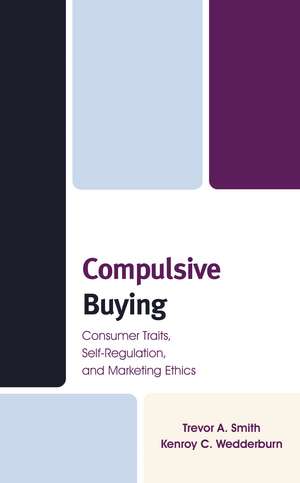
Compulsive Buying: Consumer Traits, Self-Regulation, and Marketing Ethics
Autor Trevor A. Smith, Kenroy C. Wedderburnen Limba Engleză Paperback – 29 aug 2023
Preț: 218.46 lei
Preț vechi: 305.68 lei
-29%
Puncte Express: 328
Carte tipărită la comandă
Livrare economică 23 noiembrie-07 decembrie
Livrare prin curier în România Termenul estimat este afișat lângă disponibilitate.
Transport gratuit de la 400.00 lei Plată online sau ramburs, în funcție de opțiunile comenzii.
Retur gratuit în 14 zile Comandă securizată și suport în română.
Specificații
ISBN-13: 9781793645753
ISBN-10: 1793645752
Pagini: 166
Ilustrații: 4 b/w illustrations; 11 tables;
Dimensiuni: 146 x 226 x 14 mm
Greutate: 0.23 kg
Editura: Bloomsbury Publishing
Colecția Lexington Books
Locul publicării:New York, United States
ISBN-10: 1793645752
Pagini: 166
Ilustrații: 4 b/w illustrations; 11 tables;
Dimensiuni: 146 x 226 x 14 mm
Greutate: 0.23 kg
Editura: Bloomsbury Publishing
Colecția Lexington Books
Locul publicării:New York, United States
V-ar putea interesa
-
 International MarketingAnnie Cui-22%Preț: 564.60 lei719.92 lei
 -
 -18%Preț: 1965.03 lei2396.38 lei
 -
 Remote Work Is The WayIwo SzaparPreț: 80.09 lei
 -
 Collecting True FriendsElizabeth Duncan-HawkerPreț: 105.77 lei
 -
 Pioneers of PromotionJoe DobrowPreț: 249.95 lei
 -
 The Magic SliceJack MurrayPreț: 92.78 lei
 -
 Preț: 409.22 lei
 -
 Find Your SixPatrick KilnerPreț: 158.75 lei
 -
 If Jesus Gave A TED TalkCharles StonePreț: 103.04 lei
 -
 Marketing und Sales AutomationUwe Hannig-15%Preț: 454.23 lei534.39 lei
 -
 Verkaufen an Top-EntscheiderStephan HeinrichPreț: 473.30 lei
 -
 Preț: 398.09 lei
 -
 Content Marketing - Ein DefinitionsansatzManfred UhlPreț: 98.07 lei
 -
 Preț: 286.94 lei
 -
 Preț: 177.29 lei
 -
 Social Media MarketingThomas McArthurPreț: 131.92 lei
 -
 Digital MarketingThomas McArthurPreț: 131.20 lei
Cuprins
Chapter 1: Compulsive Buying Behaviour
Chapter 2: Personality, Personality Traits and Consumer Traits
Chapter 3: A Consumer Trait Model for Predicting Compulsive Buying
Chapter 4: The Influence of the Credit Card on Compulsive Buying
Chapter 5: Self-regulating Compulsive Buying Behaviour
Chapter 6: The Ethical Considerations in Marketing to Compulsive Buyer
Chapter 2: Personality, Personality Traits and Consumer Traits
Chapter 3: A Consumer Trait Model for Predicting Compulsive Buying
Chapter 4: The Influence of the Credit Card on Compulsive Buying
Chapter 5: Self-regulating Compulsive Buying Behaviour
Chapter 6: The Ethical Considerations in Marketing to Compulsive Buyer
Recenzii
The timing of this book is very important, having been released on the heels of the global pandemic and lockdown where much of normal social behavior and economic activities came to a pause and potential reset. Many people have had time to reconsider many what they value most and how they should interact with the material world. This book touches on all the important components of the psychosocial and economic underpinnings of compulsive buying behavior and offers an insightful and important analysis of ethical considerations in marketing to compulsive buyers. These ethical guidelines will offer invaluable insight to persons who have responsibility for the regulation or subsidization of marketing. This text also has significant implications and application to the marketing of ideas, especially those intended to impact prosocial behaviors that aim to enhance the common good. This book will make a significant difference in helping people to rethink ways of shaping and changing a variety of behaviors, not just buying behaviors.
Life has turned upside down for so many people during this COVID period, and we are seeing the emergence of many adaptive and maladaptive strategies that people are using to cope, creating the perfect storm for problems in consumer spending to emerge. Trevor A. Smith and Kenroy C. Wedderburn took a very serious topic and presented it in such a way that it was hard to stop reading. I loved this book as a professional, an academic, and as someone who just loves reading. This book will be useful for students in psychology and marketing.
Since Thorstein Veblen's groundbreaking book The Theory of the Leisure Class (1918)-which coined the expression "conspicuous consumption"-researchers have studied consumer's shopping habits. Beyond the goal of satisfying basic needs, Why do consumers buy? For enjoyment, status, indulgence, social interaction, self-affirmation? And what makes some people become compulsive buyers-shopaholics, unable to say "no"? Looking back over the literature on the subject and their own personal conversations with friends and colleagues, coauthors Smith and Wedderburn develop and put forth a consumer traits model of the compulsive buyer based on demographics and psychographics. This work ultimately attempts to suggest a set of business ethics about marketing to compulsive shoppers and some policy ideas informed by these ethical considerations. Recommended for graduate students, faculty, and professionals.
Life has turned upside down for so many people during this COVID period, and we are seeing the emergence of many adaptive and maladaptive strategies that people are using to cope, creating the perfect storm for problems in consumer spending to emerge. Trevor A. Smith and Kenroy C. Wedderburn took a very serious topic and presented it in such a way that it was hard to stop reading. I loved this book as a professional, an academic, and as someone who just loves reading. This book will be useful for students in psychology and marketing.
Since Thorstein Veblen's groundbreaking book The Theory of the Leisure Class (1918)-which coined the expression "conspicuous consumption"-researchers have studied consumer's shopping habits. Beyond the goal of satisfying basic needs, Why do consumers buy? For enjoyment, status, indulgence, social interaction, self-affirmation? And what makes some people become compulsive buyers-shopaholics, unable to say "no"? Looking back over the literature on the subject and their own personal conversations with friends and colleagues, coauthors Smith and Wedderburn develop and put forth a consumer traits model of the compulsive buyer based on demographics and psychographics. This work ultimately attempts to suggest a set of business ethics about marketing to compulsive shoppers and some policy ideas informed by these ethical considerations. Recommended for graduate students, faculty, and professionals.