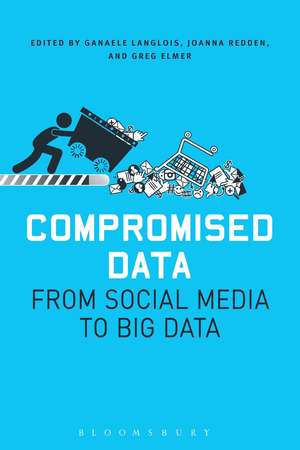
Compromised Data: From Social Media to Big Data
Editat de Dr. Greg Elmer, Dr. Ganaele Langlois, Dr. Joanna Reddenen Limba Engleză Paperback – 10 sep 2015
Compromised Data: From Social Media to Big Data explores how we perform critical research within a compromised social data framework. The expert, international lineup of contributors explores the limits and challenges of social data research in order to invent and develop new modes of doing public research. At its core, this collection argues that we are witnessing a fundamental reshaping of the social through social data mining.
Preț: 219.97 lei
Preț vechi: 257.03 lei
-14%
Puncte Express: 330
Carte tipărită la comandă
Livrare economică 08-22 decembrie
Livrare prin curier în România Termenul estimat este afișat lângă disponibilitate.
Transport gratuit de la 400.00 lei Plată online sau ramburs, în funcție de opțiunile comenzii.
Retur gratuit în 14 zile Comandă securizată și suport în română.
Specificații
ISBN-13: 9781501306518
ISBN-10: 1501306510
Pagini: 296
Ilustrații: black & white illustrations
Dimensiuni: 148 x 226 x 12 mm
Greutate: 0.72 kg
Editura: Bloomsbury Publishing
Colecția Bloomsbury Academic
Locul publicării:New York, United States
ISBN-10: 1501306510
Pagini: 296
Ilustrații: black & white illustrations
Dimensiuni: 148 x 226 x 12 mm
Greutate: 0.72 kg
Editura: Bloomsbury Publishing
Colecția Bloomsbury Academic
Locul publicării:New York, United States
V-ar putea interesa
-
 History and the MediaD. Cannadine-18%Preț: 747.20 lei911.21 lei
 -
 Media and SocietyGraeme Burton-26%Preț: 224.24 lei304.67 lei
 -
 Preț: 168.85 lei
 -
 Strategic Political Communication: Rethinking Social Influence, Persuasion, and PropagandaKaren S. Johnson-Cartee-23%Preț: 263.24 lei343.59 lei
 -
 Guardians of Power: The Myth of the Liberal MediaDavid EdwardsPreț: 215.82 lei
 -
 Comparative Media HistoryJane L ChapmanPreț: 346.26 lei
 -
 Mediated: How the Media Shape the World Around YouThomas de Zengotita-28%Preț: 83.93 lei116.38 lei
 -
 Media DiscourseMary Talbot-17%Preț: 182.67 lei218.86 lei
 -
 Analysing Newspapers: An Approach from Critical Discourse AnalysisDr John E. RichardsonPreț: 256.34 lei
 -
 Media and Translation: An Interdisciplinary ApproachDr Dror Abend-David-24%Preț: 281.65 lei371.49 lei
 -
 The Information BombPaul VirilioPreț: 113.04 lei
 -
 Open SkyPaul VirilioPreț: 91.90 lei
Cuprins
Notes on Contributors
Introduction
Ganaele Langlois, York University; Joanna Redden, University of Calgary and Greg Elmer, Toronto Metropolitan University, Canada
Part 1: Data, Power and Politics
Big Data as System of Knowledge: Investigating Canadian Governance
Joanna Redden, University of Calgary, Canada
Data Mining Research and the Disintegration of Society: the "Project X" Haren Riots
Ingrid M. Hoofd, National University of Singapore, Singapore
Look at the Man Behind the Curtain: Computational Management in "Spontaneous" Citizen Political Campaigning
David Karpf, George Washington University, USA
Part 2: Data Limit(ed)
Easy Data, Hard Data: The politics and pragmatics of Twitter research after the computational turn
Jean Burgess and Axel Bruns, Queensland University of Technology, Australia
Scraping the First Person
Greg Elmer, Toronto Metropolitan University, Canada
Open Data and its Enemies? Digital Methods and Compromised Data
Fenwick McKelvey, Concordia University, Canada
Critical Reverse Engineering: The Case of Twitter and TalkOpen
Robert Gehl, University of Utah, USA
Part 3. Alt-Data
Mapping Movements - Social Movement Research and Big Data: Critiques and Alternatives
Sky Croeser and Tim Highfield, Curtin University, Australia
Data Activism
Alessandra Renzi, Northeastern University, USA, and Ganaele Langlois, York University, Canada
A Contribution to the Political Economy of Personal Archives
Yuk Hui, Leuphana University, Germany
The Haunted Life of Data
Lisa Blackman, Goldsmiths University, UK
Index
Introduction
Ganaele Langlois, York University; Joanna Redden, University of Calgary and Greg Elmer, Toronto Metropolitan University, Canada
Part 1: Data, Power and Politics
Big Data as System of Knowledge: Investigating Canadian Governance
Joanna Redden, University of Calgary, Canada
Data Mining Research and the Disintegration of Society: the "Project X" Haren Riots
Ingrid M. Hoofd, National University of Singapore, Singapore
Look at the Man Behind the Curtain: Computational Management in "Spontaneous" Citizen Political Campaigning
David Karpf, George Washington University, USA
Part 2: Data Limit(ed)
Easy Data, Hard Data: The politics and pragmatics of Twitter research after the computational turn
Jean Burgess and Axel Bruns, Queensland University of Technology, Australia
Scraping the First Person
Greg Elmer, Toronto Metropolitan University, Canada
Open Data and its Enemies? Digital Methods and Compromised Data
Fenwick McKelvey, Concordia University, Canada
Critical Reverse Engineering: The Case of Twitter and TalkOpen
Robert Gehl, University of Utah, USA
Part 3. Alt-Data
Mapping Movements - Social Movement Research and Big Data: Critiques and Alternatives
Sky Croeser and Tim Highfield, Curtin University, Australia
Data Activism
Alessandra Renzi, Northeastern University, USA, and Ganaele Langlois, York University, Canada
A Contribution to the Political Economy of Personal Archives
Yuk Hui, Leuphana University, Germany
The Haunted Life of Data
Lisa Blackman, Goldsmiths University, UK
Index
Recenzii
Big data promise a more efficient understanding of citizen needs, wants, and desires and cast a wide net of harnessing these tendencies in the hope of bringing about more direct forms of democracy. At the same time, however, they do so at the cost of compromising personal data, in effect sacrificing the personal for the political. Compromised Data features contributions from leading scholars who examine the immediacy and complexity of data, big or small, and is a must read for all interested in these issues.
Social theorists and champions of civil rights have long been concerned with the politics and practices of dataveillance, forms of surveillance accomplished through computation instead of by visual inspection. Yet, Compromised Data may be the first book that is so very clear about the threats and dangers of surveillance after the computational turn; after when, that is, the concern is not so much who sees whom, but whose data is captured by whom and what calculations are performed on that data. You have been instrumented -- through all your Internet-enabled devices -- to divulge where you are and when, what you say and write, with whom you associate, and what you are interested in. This book asks in very specific terms how we are compromised by big data.
[CC] The digital age provides society with many advantages in the areas of communication and information on a personal, social, or political level. Here, more then ten international scholars who have examined the importance and complexity of social data and big data issues address the dangers that may occur in surveillance of online sites, including how and by whom this social data may be transformed and eventually controlled. Under the best scenario, data collection and analysis help society further the common good. However, the results of social data analysis can often be compromised. Avenues such as Facebook and Twitter allow users to share personal information, but often these sites are compromised by marketers who may use this information for profit. Clicking on a link frequently gives researchers worthwhile information, but even an innocuous click can be problematic. In addition, privacy is a major issue. Individuals innocently list information about their age, where they work and live, what their interests and concerns are, where they travel, etc., not realizing the potential adverse effects of their actions. Selected information from data collected online can lead to issues related to social profiling and guilt or innocence, as well as flag persons of interest. Overall, a thought-provoking book for all online users. Summing Up: Recommended. All readership levels.
Social theorists and champions of civil rights have long been concerned with the politics and practices of dataveillance, forms of surveillance accomplished through computation instead of by visual inspection. Yet, Compromised Data may be the first book that is so very clear about the threats and dangers of surveillance after the computational turn; after when, that is, the concern is not so much who sees whom, but whose data is captured by whom and what calculations are performed on that data. You have been instrumented -- through all your Internet-enabled devices -- to divulge where you are and when, what you say and write, with whom you associate, and what you are interested in. This book asks in very specific terms how we are compromised by big data.
[CC] The digital age provides society with many advantages in the areas of communication and information on a personal, social, or political level. Here, more then ten international scholars who have examined the importance and complexity of social data and big data issues address the dangers that may occur in surveillance of online sites, including how and by whom this social data may be transformed and eventually controlled. Under the best scenario, data collection and analysis help society further the common good. However, the results of social data analysis can often be compromised. Avenues such as Facebook and Twitter allow users to share personal information, but often these sites are compromised by marketers who may use this information for profit. Clicking on a link frequently gives researchers worthwhile information, but even an innocuous click can be problematic. In addition, privacy is a major issue. Individuals innocently list information about their age, where they work and live, what their interests and concerns are, where they travel, etc., not realizing the potential adverse effects of their actions. Selected information from data collected online can lead to issues related to social profiling and guilt or innocence, as well as flag persons of interest. Overall, a thought-provoking book for all online users. Summing Up: Recommended. All readership levels.