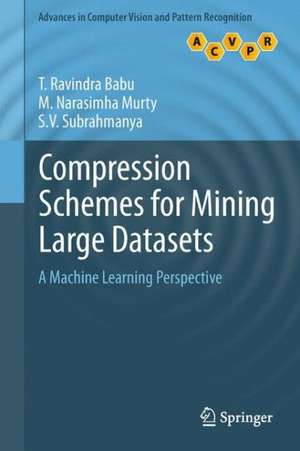
Compression Schemes for Mining Large Datasets: Advances in Computer Vision and Pattern Recognition
Autor T. Ravindra Babu, M. Narasimha Murty, S. V. Subrahmanyaen Limba Engleză Hardback – 4 dec 2013
| Toate formatele și edițiile | Preț | Express |
|---|---|---|
| Paperback (1) | 318.09 lei 6-8 săpt. | |
| Springer – 17 sep 2016 | 318.09 lei 6-8 săpt. | |
| Hardback (1) | 323.68 lei 6-8 săpt. | |
| Springer – 4 dec 2013 | 323.68 lei 6-8 săpt. |
Din seria Advances in Computer Vision and Pattern Recognition
- 20%
 Preț: 959.58 lei
 - 20%
 Preț: 629.39 lei
 - 20%
 Preț: 745.28 lei
 - 20%
 Preț: 360.26 lei
 - 20%
 Preț: 634.32 lei
 - 20%
 Preț: 1040.67 lei
 - 20%
 Preț: 632.89 lei
 - 20%
 Preț: 955.00 lei
 - 20%
 Preț: 952.94 lei
 - 20%
 Preț: 318.30 lei
 - 20%
 Preț: 619.76 lei
 - 20%
 Preț: 1580.06 lei
 - 20%
 Preț: 630.57 lei
 - 20%
 Preț: 621.81 lei
 - 20%
 Preț: 1018.43 lei
 - 20%
 Preț: 618.83 lei
 - 20%
 Preț: 884.59 lei
 - 20%
 Preț: 730.70 lei
 - 20%
 Preț: 621.81 lei
 - 20%
 Preț: 627.19 lei
 - 20%
 Preț: 952.00 lei
 - 20%
 Preț: 630.68 lei
 - 20%
 Preț: 676.50 lei
 - 20%
 Preț: 629.71 lei
 - 20%
 Preț: 960.53 lei
 - 20%
 Preț: 643.60 lei
 - 20%
 Preț: 1129.20 lei
 - 20%
 Preț: 622.59 lei
 - 20%
 Preț: 646.38 lei
 - 20%
 Preț: 951.01 lei
 - 20%
 Preț: 793.78 lei
 - 20%
 Preț: 637.55 lei
 - 18%
 Preț: 913.62 lei
 - 20%
 Preț: 957.69 lei
 - 20%
 Preț: 619.89 lei
 - 20%
 Preț: 958.63 lei
Preț: 323.68 lei
Preț vechi: 404.60 lei
-20%
Puncte Express: 486
Preț estimativ în valută:
57.19€ • 66.29$ • 49.88£
57.19€ • 66.29$ • 49.88£
Carte tipărită la comandă
Livrare economică 15-29 mai
Specificații
ISBN-13: 9781447156062
ISBN-10: 1447156064
Pagini: 216
Ilustrații: XVI, 197 p. 62 illus., 3 illus. in color.
Dimensiuni: 160 x 241 x 18 mm
Greutate: 0.49 kg
Ediția:2013
Editura: Springer
Colecția Advances in Computer Vision and Pattern Recognition
Seria Advances in Computer Vision and Pattern Recognition
Locul publicării:London, United Kingdom
ISBN-10: 1447156064
Pagini: 216
Ilustrații: XVI, 197 p. 62 illus., 3 illus. in color.
Dimensiuni: 160 x 241 x 18 mm
Greutate: 0.49 kg
Ediția:2013
Editura: Springer
Colecția Advances in Computer Vision and Pattern Recognition
Seria Advances in Computer Vision and Pattern Recognition
Locul publicării:London, United Kingdom
V-ar putea interesa
-
 -20%Preț: 631.13 lei788.92 lei
 -
 Pattern RecognitionM Narasimha Murty-20%Preț: 237.77 lei297.21 lei
 -
 3D Imaging for Safety and SecurityAndreas Koschan-20%Preț: 331.53 lei414.42 lei
 -
 Digital FingerprintingCliff Wang-20%Preț: 692.09 lei865.11 lei
 -
 Multi-disciplinary Trends in Artificial IntelligenceM. Narasimha Murty-20%Preț: 320.14 lei400.17 lei
 -
 -20%Preț: 257.61 lei322.01 lei
 -
 Belief Functions: Theory and ApplicationsJi¿ina Vejnarová-20%Preț: 320.32 lei400.41 lei
 -
 String Processing and Information RetrievalShunsuke Inenaga-20%Preț: 321.74 lei402.18 lei
 -
 Machine Learning and Knowledge Discovery in DatabasesPaolo Frasconi-20%Preț: 652.35 lei815.44 lei
 -
 Artificial Neural Networks in Pattern RecognitionFriedhelm Schwenker-20%Preț: 461.76 lei577.20 lei
 -
 Algorithmic Learning TheoryRonald Ortner-20%Preț: 326.88 lei408.60 lei
 -
 -20%Preț: 325.30 lei406.63 lei
 -
 Patch-Based Techniques in Medical ImagingGuorong Wu-20%Preț: 314.60 lei393.24 lei
 -
 -20%Preț: 324.22 lei405.27 lei
 -
 Latent Variable Analysis and Signal SeparationPetr Tichavský-20%Preț: 337.13 lei421.41 lei
 -
 Pattern Recognition and Information ProcessingViktor V. Krasnoproshin-20%Preț: 315.66 lei394.57 lei
 -
 Reproducible Research in Pattern RecognitionBertrand Kerautret-20%Preț: 316.62 lei395.77 lei
 -
 -20%Preț: 906.85 lei1133.55 lei
 -
 -20%Preț: 309.93 lei387.41 lei
 -
 Document Analysis Systems VISimone Marinai-20%Preț: 336.49 lei420.61 lei
 -
 -20%Preț: 642.67 lei803.34 lei
 -
 Pattern Recognition with Support Vector MachinesSeong-Whan Lee-20%Preț: 329.25 lei411.55 lei
 -
 Causal Models and Intelligent Data ManagementAlex Gammerman-20%Preț: 317.85 lei397.31 lei
 -
 Multiple Classifier SystemsMichal Haindl-20%Preț: 334.47 lei418.08 lei
 -
 -20%Preț: 979.25 lei1224.06 lei
 -
 Pattern Recognition and Machine IntelligencePradipta Maji-20%Preț: 347.36 lei434.20 lei
 -
 INTRO TO PATTERN RECOGN & MACHINE LEARNMurty M Narasimha-20%Preț: 850.28 lei1062.86 lei
Public țintă
ResearchCuprins
Introduction.- Data Mining Paradigms.- Run-Length Encoded Compression Scheme.- Dimensionality Reduction by Subsequence Pruning.- Data Compaction through Simultaneous Selection of Prototypes and Features.- Domain Knowledge-Based Compaction.- Optimal Dimensionality Reduction.- Big Data Abstraction through Multiagent Systems.- Intrusion Detection Dataset: Binary Representation.
Notă biografică
Dr. T. Ravindra Babu is a Principal Researcher in the E-Commerce Research Labs at Infosys Ltd., Bangalore, India. Mr. S.V. Subrahmanya is Vice President and Research Fellow at the same organization. Dr. M. Narasimha Murty is a Professor in the Department of Computer Science and Automation at the Indian Institute of Science, Bangalore, India.
Textul de pe ultima copertă
As data mining algorithms are typically applied to sizable volumes of high-dimensional data, these can result in large storage requirements and inefficient computation times.
This unique text/reference addresses the challenges of data abstraction generation using a least number of database scans, compressing data through novel lossy and non-lossy schemes, and carrying out clustering and classification directly in the compressed domain. Schemes are presented which are shown to be efficient both in terms of space and time, while simultaneously providing the same or better classification accuracy, as illustrated using high-dimensional handwritten digit data and a large intrusion detection dataset.
Topics and features:
This unique text/reference addresses the challenges of data abstraction generation using a least number of database scans, compressing data through novel lossy and non-lossy schemes, and carrying out clustering and classification directly in the compressed domain. Schemes are presented which are shown to be efficient both in terms of space and time, while simultaneously providing the same or better classification accuracy, as illustrated using high-dimensional handwritten digit data and a large intrusion detection dataset.
Topics and features:
- Presents a concise introduction to data mining paradigms, data compression, and mining compressed data
- Describes a non-lossy compression scheme based on run-length encoding of patterns with binary valued features
- Proposes a lossy compression scheme that recognizes a pattern as a sequence of features and identifying subsequences
- Examines whether the identification of prototypes and features can be achieved simultaneously through lossy compression and efficient clustering
- Discusses ways to make use of domain knowledge in generating abstraction
- Reviews optimal prototype selection using genetic algorithms
- Suggests possible ways of dealing with big data problems using multiagentsystems
Caracteristici
Examines all aspects of data abstraction generation using a least number of database scans Discusses compressing data through novel lossy and non-lossy schemes Proposes schemes for carrying out clustering and classification directly in the compressed domain Includes supplementary material: sn.pub/extras