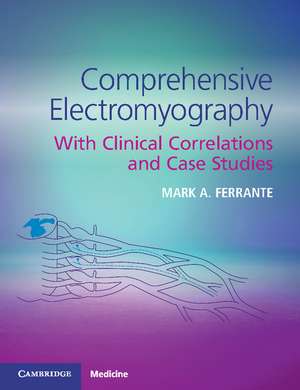
Comprehensive Electromyography
Autor Mark A. Ferranteen Limba Engleză Paperback – mar 2019
Observăm în Comprehensive Electromyography o abordare riguroasă și secvențială, menită să transforme o tehnică de diagnostic adesea intimidantă într-o competență clinică solidă. Notăm cu interes prezența celor 199 de ilustrații care fundamentează vizual partea tehnică, oferind repere clare pentru poziționarea electrozilor și interpretarea traseelor electrice. Lucrarea semnată de Mark A. Ferrante nu este doar un manual de proceduri, ci un ghid complet care integrează fizica electricității cu fiziologia joncțiunii neuromusculare, asigurând o înțelegere profundă a fenomenelor înregistrate. Reținem organizarea logică a volumului în patru părți distincte. Primele capitole pun bazele teoretice necesare, urmate de o analiză detaliată a studiilor de conducere nervoasă (NCS) și a electromiografiei cu ac (Needle EMG). Pe linia clinică a volumului Electrodiagnostic Medicine, dar cu accent pe integrarea pedagogică a cazurilor de studiu, această ediție publicată de Cambridge University Press reușește să ghideze cititorul de la semnalele electrice de bază până la localizarea precisă a leziunilor pe nevrax. Progresia conținutului este calculată pentru a deservi atât tehnicianul debutant, cât și neurologul care se pregătește pentru certificări, oferind în capitolele finale informații cruciale despre prognosticul și managementul leziunilor de nervi periferici. Spre deosebire de un ghid rapid precum EMG Primer, acest tratat aprofundează manifestările fiziopatologice, oferind anexe cu valori de referință corelate cu vârsta, indispensabile în practica zilnică de laborator.
Preț: 776.45 lei
Preț vechi: 817.32 lei
-5%
Carte tipărită la comandă
Livrare economică 24 noiembrie-08 decembrie
Specificații
ISBN-10: 1107562031
Pagini: 542
Ilustrații: 199 b/w illus.
Dimensiuni: 203 x 254 x 29 mm
Greutate: 1.15 kg
Editura: Cambridge University Press
Locul publicării:New York, United States
V-ar putea interesa
-
 A Sort of LifeGraham Greene-33%Preț: 55.44 lei83.31 lei
 -
 Gulf War and HealthInstitute Of Medicine-5%Preț: 286.21 lei301.28 lei
 -
 One Hundred Case Studies in EpilepsyDieter Schmidt-5%Preț: 597.90 lei629.37 lei
 -
 The Somatosensory System: Deciphering the Brain's Own Body ImageRandall J. Nelson-15%Preț: 545.18 lei641.38 lei
 -
 Preț: 467.54 lei
 -
 The Paroxysmal DisordersBettina Schmitz-5%Preț: 666.06 lei701.11 lei
 -
 EMG Lesion Localization and CharacterizationMark A. MD Ferrante-5%Preț: 652.72 lei687.08 lei
 -
 Keys to the KingdomKathleen L. HousleyPreț: 101.00 lei
 -
 Cognitive Impairment: Causes, Diagnosis & TreatmentMelanie L Landow-24%Preț: 1610.71 lei2106.36 lei
 -
 Hippocampus: Anatomy, Functions & NeurobiologyAmbroise Gärtner-24%Preț: 1527.18 lei1996.62 lei
 -
 Learning & Memory Developments & Intellectual DisabilitiesLucas C Eklund-23%Preț: 1619.82 lei2112.10 lei
 -
 -5%Preț: 1194.04 lei1256.89 lei
 -
 Jefferson Headache ManualWilliam B. Young-5%Preț: 477.36 lei502.47 lei
 -
 -15%Preț: 574.66 lei676.07 lei
 -
 -5%Preț: 651.79 lei686.09 lei
 -
 -5%Preț: 956.23 lei1006.56 lei
De ce să citești această carte
Recomandăm această lucrare oricărui rezident în neurologie sau medic de recuperare care dorește să stăpânească interpretarea EMG. Câștigul principal constă în corelarea directă între datele tehnice brute și diagnosticul clinic, facilitată de numeroasele studii de caz. Este o resursă esențială pentru pregătirea examenelor de specialitate, oferind rigoarea academică necesară pentru a evita erorile comune de interpretare în laboratorul de electrodiagnostic.