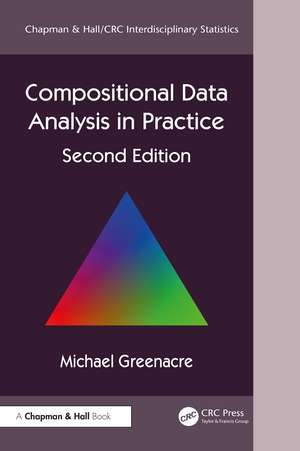
Compositional Data Analysis in Practice: Chapman & Hall/CRC Interdisciplinary Statistics
Autor Michael Greenacreen Limba Engleză Hardback – 23 dec 2026
~Trevor Hastie, The John A. Overdeck Professor, Professor of Statistics and Biomedical Data Science (emeritus), Stanford University, USA
“This book is a small gem that will find its place among those who are interested in learning about this important topic from a master of clarity and exposition…Graduate students and applied researchers, across the quantitative sciences who encounter proportional data, will find this an authoritative yet accessible guide.”
~Michael Friendly, York University, Canada
“This book is an inspiring text for applied scientists and graduate students with backgrounds in multivariate analysis and are interested in mastering the analysis of compositional data.”
~Jan Graffelman, Professor, Technical University of Catalonia, Spain
Compositional data – proportions, percentages, and any data that sum to a constant – appear across virtually every scientific discipline, from geochemistry and ecology to political science and genomics. This thoroughly revised and extended second edition continues to provide a simple and accessible treatment of compositional data analysis (CoDA) in a pedagogical format.
Key Features of the Second Edition:
- 60% more material than the first edition
- Additional chapters on weighting of compositional parts, the analysis of complete compositions, the analysis of shape, high-dimensional genomic compositions, as well as two more case studies
- Practical, example-driven approach, using 13 different data sets across different disciplines
- Unique eight-pages-per-chapter format to facilitate both self-study and teaching of the subject
- Revision of the easyCODA R package to include new features such as amalgamation clustering and variable selection in unsupervised and supervised learning
Din seria Chapman & Hall/CRC Interdisciplinary Statistics
- 15%
 Preț: 445.54 lei
 - 18%
 Preț: 927.70 lei
 - 15%
 Preț: 444.88 lei
 - 18%
 Preț: 1268.77 lei
 - 15%
 Preț: 442.39 lei
 - 15%
 Preț: 530.75 lei
 -
 Preț: 440.15 lei
 - 18%
 Preț: 826.24 lei
 - 18%
 Preț: 1118.04 lei
 - 18%
 Preț: 1154.01 lei
 -
 Preț: 476.07 lei
 -
 Preț: 485.38 lei
 - 15%
 Preț: 533.53 lei
 -
 Preț: 488.11 lei
 -
 Preț: 491.99 lei
 - 15%
 Preț: 598.40 lei
 - 15%
 Preț: 683.03 lei
 - 18%
 Preț: 1136.11 lei
 - 18%
 Preț: 795.19 lei
 - 15%
 Preț: 530.47 lei
 - 8%
 Preț: 435.91 lei
 -
 Preț: 435.44 lei
 - 15%
 Preț: 448.01 lei
 - 18%
 Preț: 1265.59 lei
 - 15%
 Preț: 654.30 lei
 -
 Preț: 447.94 lei
 -
 Preț: 489.07 lei
 - 5%
 Preț: 702.22 lei
 - 18%
 Preț: 694.18 lei
 -
 Preț: 470.55 lei
 - 5%
 Preț: 1083.88 lei
 - 18%
 Preț: 1282.48 lei
 - 15%
 Preț: 600.90 lei
 - 18%
 Preț: 1079.32 lei
Preț: 1082.56 lei
Preț vechi: 1405.93 lei
-23% Precomandă
Puncte Express: 1624
Carte nepublicată încă
Livrare prin curier în România Precomanda se expediază când titlul devine disponibil.
Transport gratuit pentru acest produs Plată online sau ramburs, în funcție de opțiunile comenzii.
Retur gratuit în 14 zile Comandă securizată și suport în română.
Doresc să fiu notificat când acest titlu va fi disponibil:
Se trimite...
Specificații
ISBN-13: 9781041230762
ISBN-10: 1041230761
Pagini: 208
Ilustrații: 170
Dimensiuni: 156 x 234 mm
Ediția:2
Editura: CRC Press
Colecția Chapman and Hall/CRC
Seria Chapman & Hall/CRC Interdisciplinary Statistics
ISBN-10: 1041230761
Pagini: 208
Ilustrații: 170
Dimensiuni: 156 x 234 mm
Ediția:2
Editura: CRC Press
Colecția Chapman and Hall/CRC
Seria Chapman & Hall/CRC Interdisciplinary Statistics
Public țintă
Academic, Postgraduate, and Professional ReferenceCuprins
1. What are compositional data, and why are they special?. 2. Geometry and visualization of compositional data. 3. Logratio transformations. 4. Properties and distributions of logratios. 5. Clustering of compositional data. 6. Dimension reduction using logratio analysis. 7. Regression models involving compositional data. 8. The zeros problem, with some solutions. 9. Variable selection for unsupervised and supervised learning. 10. To weight or not to weight. 11. The analysis of complete compositions. 12. The analysis of shape. 13. High-dimensional “omics” data. 14. Case study 1: Fatty acid compositions of marine amphipods. 15. Case study 2: Sedimentological modelling with compositional predictors. 16. Case study 3: Ecological modeling with compositional responses.
Notă biografică
Michael Greenacre is “Professor Talent Superior” in the Department of Economics and Business of the Universitat Pompeu Fabra, Barcelona, where he has worked for 31 years until his recent retirement. He has written over 100 research articles, as well as eight books, including three editions of Correspondence Analysis in Practice (1993, 2007, 2016), which has been translated into Spanish and Japanese. He has also edited four books with Jörg Blasius of Bonn University, on correspondence analysis and related methods. He continues to work and publish actively in correspondence analysis and compositional data analysis, in collaboration with researchers in several countries, in the fields of biochemistry, geochemistry, archaeology, genomics and ecology, with a recent new interest in sensometrics (statistics of sensory data). He is also a musician and composer, and has published two albums of his own compositions, “You, Woman” and “Below the Surface”, with the singer Gurdeep Stephens and guitarist Santi Careta, and has a popular YouTube channel of his satirical statistical songs.
Recenzii
“Michael Greenacre is a world expert on CoDA, having taking the mantle from his mentor and friend John Aitchison. After introducing the logratio transforms early in the book, they are used in a wide and interesting set of applications in subsequent chapters. By sticking to a strict eight-page limit per chapter, Greenacre is forced to write with clarity but sufficient detail to get the concepts across, always ending in a concise half page summary. A welcome appendix gives some additional details for those like me who “need to know”. This book would make for a wonderful one semester course in applied multivariate statistics, suitable for upper level undergraduates or masters students in data science.”
~Trevor Hastie, The John A. Overdeck Professor, Professor of Statistics and Biomedical Data Science (emeritus), Stanford University, USA
“This book is a small gem that will find its place among those who are interested in learning about this important topic from a master of clarity and exposition. It fills a real need: a principled, practical introduction built around logratios, which guarantee the subcompositional coherence that treating proportions as ordinary measurements cannot. Thirteen methodological chapters progress from fundamentals – what makes compositional data special, simplex geometry, logratio transformations – through clustering, dimension reduction, regression, variable selection, the zeros problem, and the surprising finding that for high-dimensional omics data, logratio transformation may not be necessary at all. Three integrative case studies from marine biology, sedimentology, and ecology then demonstrate the full workflow in practice. Key features include diverse real-data examples throughout, concise chapter-end summaries, a mathematical appendix, and a companion R package, ‘easyCODA’, released alongside the book. Graduate students and applied researchers across the quantitative sciences who encounter proportional data will find this an authoritative yet accessible guide.”
~Michael Friendly, York University, Canada
“This book is an excellent introduction to Compositional Data Analysis (CoDA). Aitchison’s main principles, permutation and scale invariance, subcompositional coherence, as well as simplex geometry, spurious correlations and ternary diagrams are well-explained. The mainstay of CoDA, the logratio transformations, are well-motivated and integrated into many multivariate methods, such as (constrained) principal component analysis, generalised linear models, cluster analysis, classification and regression trees and others. Theoretical statistical background, bibliography and computational details are provided in three appendices. The book has a very strong data-analytic focus, using data to motivate the conceptual development and illustrate methods; three chapters consist of data-analytic case studies. The computational appendix, based on the author’s R-package easyCODA,enables the reader to reproduce examples and analyse compositional data. The text covers many interesting applications ranging from geology to ecology, biochemistry, genomics and other fields. Distinctive features are the innovative use of weights in the compositional context, the extensive use of biplots to achieve dimension reduction and attractive visualisations, and particular choices of the author to deal with zeros and select convenient logratio transformations. The book is an inspiring text for applied scientists and graduate students with background in multivariate analysis and interested in mastering the analysis of compositional data.”
~Jan Graffelman, Professor, Technical University of Catalonia
“This new edition offers new insights in how to view and analyze compositional data. The section on Logratio Transformation has been completely re-written and provides a comprehensive and systematic review of the various logratio transformations that can be used. The chapters on Clustering of compositional data and Dimension reduction using logratio analysis offer new insights with examples including geochemical analysis and fish morphology. It also includes four new chapters: To weight or not to weight; The analysis of complete compositions; The analysis of shape and High-dimensional “omics” data. There are now three case studies; along with Appendices that include: the theory of compositional data analysis; an extended bibliography, including web resources; sources for datasets used in the book; a guide to the easyCODA software for compositional data analysis; a glossary of terms; and an Epilogue. Overall, this expanded edition offers an enhanced way of evaluating compositional data and reflects the recent developments in how compositional data are analyzed. As with the first edition, the second edition can be used at the undergraduate level as part of a course in data analysis. At the graduate level, for research studies, this book provides a comprehensive approach, providing insight for effective interpretation for a wide range of compositional data types.”
~ Eric Grunsky, Department of Earth and Environmental Sciences, University of Waterloo, Canada
“Compositional data show the proportions of the different parts or components of some whole and arise in many sciences, such as biology, geology or economics. Chemical composition of rock samples is just one example among many. The constraint that relative amounts or counts have a constant sum both simplifies and complicates their analysis. Modern approaches have grown from the insistence of John Aitchison that ratios for different parts are key and best analysed on logarithmic scale. Yet problems remain, notably the frequent occurrence of zeros. The ballooning recent literature has ranged from numerous applications to elaborate mathematical developments. Michael Greenacre's book in 2019 provided a concise but thorough and innovative guide to the most important ideas, connecting with complementary methods such as correspondence analysis. Expositions and examples were linked to general ideas on visualization, multivariate analysis, and modelling. Michael's second edition is now richer, with six new chapters and updating of material. This is where people with some grounding in statistics but new to the topic should start for a fresh but original overview.”
~Nicholas J. Cox, Durham University, UK
“This extended second edition includes six additional chapters to reflect current developments and new applications. As in the first edition, Michael uses a wide variety of examples to illustrate the various applications of compositional data analysis. It is a user-oriented practical guide to the analysis of data with the property of a constant sum, often 100%. I also appreciate that the main text includes only the formulas necessary for understanding the method; formal details are given in the appendix. The results are worked out step-by-step, making it clear what happens at each stage of the calculation. Anyone who wants to verify the calculations can use his R package easyCODA, which is documented in detail in the appendix. I personally enjoyed reading the book very much and believe there are many situations where compositional data analysis offers excellent opportunities for data analysis.”
- Jörg Blasius, University of Bonn, Germany
~Trevor Hastie, The John A. Overdeck Professor, Professor of Statistics and Biomedical Data Science (emeritus), Stanford University, USA
“This book is a small gem that will find its place among those who are interested in learning about this important topic from a master of clarity and exposition. It fills a real need: a principled, practical introduction built around logratios, which guarantee the subcompositional coherence that treating proportions as ordinary measurements cannot. Thirteen methodological chapters progress from fundamentals – what makes compositional data special, simplex geometry, logratio transformations – through clustering, dimension reduction, regression, variable selection, the zeros problem, and the surprising finding that for high-dimensional omics data, logratio transformation may not be necessary at all. Three integrative case studies from marine biology, sedimentology, and ecology then demonstrate the full workflow in practice. Key features include diverse real-data examples throughout, concise chapter-end summaries, a mathematical appendix, and a companion R package, ‘easyCODA’, released alongside the book. Graduate students and applied researchers across the quantitative sciences who encounter proportional data will find this an authoritative yet accessible guide.”
~Michael Friendly, York University, Canada
“This book is an excellent introduction to Compositional Data Analysis (CoDA). Aitchison’s main principles, permutation and scale invariance, subcompositional coherence, as well as simplex geometry, spurious correlations and ternary diagrams are well-explained. The mainstay of CoDA, the logratio transformations, are well-motivated and integrated into many multivariate methods, such as (constrained) principal component analysis, generalised linear models, cluster analysis, classification and regression trees and others. Theoretical statistical background, bibliography and computational details are provided in three appendices. The book has a very strong data-analytic focus, using data to motivate the conceptual development and illustrate methods; three chapters consist of data-analytic case studies. The computational appendix, based on the author’s R-package easyCODA,enables the reader to reproduce examples and analyse compositional data. The text covers many interesting applications ranging from geology to ecology, biochemistry, genomics and other fields. Distinctive features are the innovative use of weights in the compositional context, the extensive use of biplots to achieve dimension reduction and attractive visualisations, and particular choices of the author to deal with zeros and select convenient logratio transformations. The book is an inspiring text for applied scientists and graduate students with background in multivariate analysis and interested in mastering the analysis of compositional data.”
~Jan Graffelman, Professor, Technical University of Catalonia
“This new edition offers new insights in how to view and analyze compositional data. The section on Logratio Transformation has been completely re-written and provides a comprehensive and systematic review of the various logratio transformations that can be used. The chapters on Clustering of compositional data and Dimension reduction using logratio analysis offer new insights with examples including geochemical analysis and fish morphology. It also includes four new chapters: To weight or not to weight; The analysis of complete compositions; The analysis of shape and High-dimensional “omics” data. There are now three case studies; along with Appendices that include: the theory of compositional data analysis; an extended bibliography, including web resources; sources for datasets used in the book; a guide to the easyCODA software for compositional data analysis; a glossary of terms; and an Epilogue. Overall, this expanded edition offers an enhanced way of evaluating compositional data and reflects the recent developments in how compositional data are analyzed. As with the first edition, the second edition can be used at the undergraduate level as part of a course in data analysis. At the graduate level, for research studies, this book provides a comprehensive approach, providing insight for effective interpretation for a wide range of compositional data types.”
~ Eric Grunsky, Department of Earth and Environmental Sciences, University of Waterloo, Canada
“Compositional data show the proportions of the different parts or components of some whole and arise in many sciences, such as biology, geology or economics. Chemical composition of rock samples is just one example among many. The constraint that relative amounts or counts have a constant sum both simplifies and complicates their analysis. Modern approaches have grown from the insistence of John Aitchison that ratios for different parts are key and best analysed on logarithmic scale. Yet problems remain, notably the frequent occurrence of zeros. The ballooning recent literature has ranged from numerous applications to elaborate mathematical developments. Michael Greenacre's book in 2019 provided a concise but thorough and innovative guide to the most important ideas, connecting with complementary methods such as correspondence analysis. Expositions and examples were linked to general ideas on visualization, multivariate analysis, and modelling. Michael's second edition is now richer, with six new chapters and updating of material. This is where people with some grounding in statistics but new to the topic should start for a fresh but original overview.”
~Nicholas J. Cox, Durham University, UK
“This extended second edition includes six additional chapters to reflect current developments and new applications. As in the first edition, Michael uses a wide variety of examples to illustrate the various applications of compositional data analysis. It is a user-oriented practical guide to the analysis of data with the property of a constant sum, often 100%. I also appreciate that the main text includes only the formulas necessary for understanding the method; formal details are given in the appendix. The results are worked out step-by-step, making it clear what happens at each stage of the calculation. Anyone who wants to verify the calculations can use his R package easyCODA, which is documented in detail in the appendix. I personally enjoyed reading the book very much and believe there are many situations where compositional data analysis offers excellent opportunities for data analysis.”
- Jörg Blasius, University of Bonn, Germany
Descriere
This second edition of Compositional Data Analysis in Practice continues and broadens the aim of the first edition to provide a pedagogical, simple and transparent treatment of compositional data analysis (CoDA).