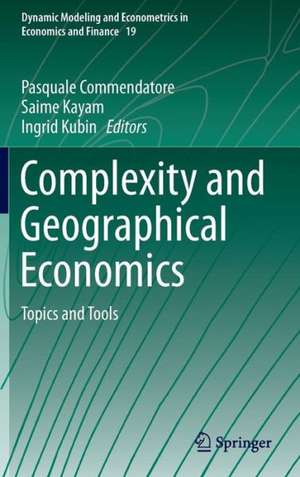
Complexity and Geographical Economics: Dynamic Modeling and Econometrics in Economics and Finance, cartea 19
Editat de Pasquale Commendatore, Saime Kayam, Ingrid Kubinen Limba Engleză Hardback – 19 mar 2015
Din seria Dynamic Modeling and Econometrics in Economics and Finance
- 18%
 Preț: 1753.72 lei
 - 18%
 Preț: 924.22 lei
 - 15%
 Preț: 611.97 lei
 - 15%
 Preț: 619.90 lei
 - 15%
 Preț: 612.23 lei
 - 15%
 Preț: 616.45 lei
 - 15%
 Preț: 628.48 lei
 - 15%
 Preț: 626.44 lei
 - 15%
 Preț: 623.59 lei
 - 15%
 Preț: 620.36 lei
 - 18%
 Preț: 910.28 lei
 - 15%
 Preț: 624.00 lei
 - 18%
 Preț: 1086.20 lei
 - 18%
 Preț: 1180.37 lei
 - 18%
 Preț: 860.84 lei
 - 18%
 Preț: 704.26 lei
 - 18%
 Preț: 909.08 lei
 - 18%
 Preț: 853.42 lei
 - 24%
 Preț: 912.18 lei
 - 18%
 Preț: 963.80 lei
 - 15%
 Preț: 609.53 lei
 -
 Preț: 438.88 lei
 - 15%
 Preț: 615.52 lei
 - 18%
 Preț: 910.11 lei
 - 15%
 Preț: 615.66 lei
 - 18%
 Preț: 909.98 lei
Preț: 629.70 lei
Preț vechi: 740.83 lei
-15%
Puncte Express: 945
Carte tipărită la comandă
Livrare economică 05-19 iunie
Specificații
ISBN-13: 9783319128047
ISBN-10: 3319128043
Pagini: 392
Ilustrații: XIV, 377 p. 50 illus.
Dimensiuni: 160 x 241 x 27 mm
Greutate: 0.75 kg
Ediția:2015
Editura: Springer
Colecția Dynamic Modeling and Econometrics in Economics and Finance
Seria Dynamic Modeling and Econometrics in Economics and Finance
Locul publicării:Cham, Switzerland
ISBN-10: 3319128043
Pagini: 392
Ilustrații: XIV, 377 p. 50 illus.
Dimensiuni: 160 x 241 x 27 mm
Greutate: 0.75 kg
Ediția:2015
Editura: Springer
Colecția Dynamic Modeling and Econometrics in Economics and Finance
Seria Dynamic Modeling and Econometrics in Economics and Finance
Locul publicării:Cham, Switzerland
V-ar putea interesa
-
 Playing for Real: A Text on Game TheoryKen Binmore-14%Preț: 778.57 lei905.30 lei
 -
 Strategic Interaction and MarketsJean J. Gabszewicz-34%Preț: 539.49 lei812.51 lei
 -
 Challenges in Geometry: for Mathematical Olympians Past and PresentChristopher J. Bradley-15%Preț: 303.00 lei355.53 lei
 -
 Evolution, Games, and Economic BehaviourFernando Vega-Redondo-25%Preț: 403.27 lei535.13 lei
 -
 The Extended Selfish GeneRichard Dawkins-19%Preț: 135.42 lei166.99 lei
 -
 Game Theory: A Very Short IntroductionKen Binmore-21%Preț: 53.88 lei68.03 lei
 -
 Foundations of Non-Cooperative Game TheoryKlaus Ritzberger-24%Preț: 487.93 lei642.56 lei
 -
 The Essential John NashJohn NashPreț: 276.08 lei
 -
 Theory of Games and Economic BehaviorJohn Von Neumann-14%Preț: 439.47 lei511.01 lei
 -
 State Space GridsTom Hollenstein-15%Preț: 671.52 lei790.02 lei
 -
 Networks Against TimeAnna NagurneyPreț: 332.22 lei
 -
 Mathematical Card Magic: Fifty-Two New EffectsColm MulcahyPreț: 405.25 lei
 -
 -8%Preț: 463.17 lei503.44 lei
 -
 Unexpected Expectations: The Curiosities of a Mathematical Crystal BallLeonard M. Wapner-18%Preț: 858.32 lei1046.73 lei
 -
 How Many Socks Make a Pair?Rob EastawayPreț: 67.88 lei
 -
 Set-valued OptimizationAkhtar A. Khan-15%Preț: 643.68 lei757.26 lei
Public țintă
ResearchCuprins
Introduction.- Part A. Economic Geography Modelling.- Part B. Institutions and Markets.- Part C. Industrial Interactions.
Textul de pe ultima copertă
The uneven geographical distribution of economic activities is a huge challenge worldwide and also for the European Union. In Krugman’s New Economic Geography economic systems have a simple spatial structure. This book shows that more sophisticated models should visualise the EU as an evolving trade network with a specific topology and different aggregation levels. At the highest level, economic geography models give a bird eye’s view of spatial dynamics. At a medium level, institutions shape the economy and the structure of (financial and labour) markets. At the lowest level, individual decisions interact with the economic, social and institutional environment; the focus is on firms’ decision on location and innovation. Such multilevel models exhibit complex dynamic patterns – path dependence, cumulative causation, hysteresis – on a network structure; and specific analytic tools are necessary for studying strategic interaction, heterogeneity and nonlinearities.
Caracteristici
Reviews the state of the art in several fields of geographical economics and spatial economic analysis Presents the interdisciplinary work of an EU funded research network with a special focus on combining different approaches to complex systems analysis in geographical economics Shows how to apply specific tools of analysis (such as agent based modelling, network analysis, game theory, and econometrics) to geographical spatial economic analysis