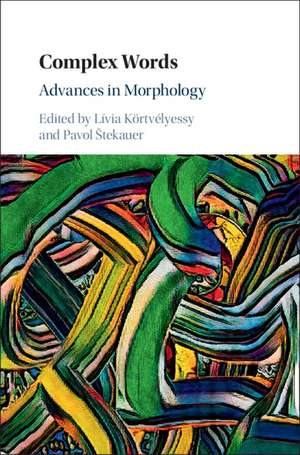
Complex Words
Editat de Lívia Körtvélyessy, Pavol Stekaueren Limba Engleză Paperback – 6 apr 2023
Preț: 218.68 lei
Puncte Express: 328
Carte disponibilă
Livrare economică 06-20 mai
Livrare express 22-28 aprilie pentru 33.60 lei
Specificații
ISBN-13: 9781108748377
ISBN-10: 1108748376
Pagini: 398
Ilustrații: 22 b/w illus. 22 tables
Dimensiuni: 156 x 229 x 25 mm
Greutate: 0.57 kg
Editura: Cambridge University Press
Locul publicării:Cambridge, United Kingdom
ISBN-10: 1108748376
Pagini: 398
Ilustrații: 22 b/w illus. 22 tables
Dimensiuni: 156 x 229 x 25 mm
Greutate: 0.57 kg
Editura: Cambridge University Press
Locul publicării:Cambridge, United Kingdom
Cuprins
Introduction: advances in morphology: a summary Jan Don and Martin Everaert; Part I. Lexico-Semantic Aspects of Complex Words: 1. Formal semantics and the problem of nominalizations Rochelle Lieber; 2. Semantically subtractive morphology Stephen Anderson; 3. -less and –free Mark Aronoff; 4. Instrument Nouns in -one in Latin and Romance Franz Rainer; 5. Prominence in noun-to-verb conversion Heike Baeskow; 6. On Spanish dvandva and its restrictions Antonio Fábregas; Part II. Structure of Complex Words: 7. Estonian case inflection made simple. A case study in word and paradigm morphology with linear discriminative learning Yu-Ying Chuang, Kaidi Lõo, James P. Blevins, and R. Harald Baayen; 8. Uninflectedness: uninflecting, uninflectable, and uninflected words, or the complexity of the simplex Andrew Spencer; 9. Complex exponents Gregory Stump; 10. Derivational patterns in proto-basque word structure Juliette Blevins; 11. The complexity of greek verbal morphology: the case of prefixed verbs Artemis Alexiadou; 12. Affixoids, an intriguing intermediate category Angela Ralli; Part III. Corpus-Based Case Studies: 13. Competition between synthetic nn compounds and nn.GEN phrasal nouns in polish: semantic niches, hapax legomena and low-level construction schemas Bozena Cetnarowska; 14. An s is an s', or is it? Plural and genitive-plural are not homophonous Ingo Plag, Sonia Ben Hedia, Arne Lohmann, and Julia Zimmermann; 15. The role of word-formation families and subfamilies in the organisation of German diminutive compounds Wolfgang U. Dressler, Sonja Schwaiger, and Jutta Ransmayr; 16. Semantic patterns in noun-to-verb conversion in English Salvador Valera; 17. Onomatopoeia: on the crossroads of sound symbolism and word-formation Lívia Körtvélyessy, and Pavol Štekauer; 18. Dingsbums and thingy: placeholders for names in German and other languages Petra M. Vogel.
Recenzii
'By uniting the world's top morphologists in a single volume, this book offers an exclusive insight into how current theories tackle some of the most challenging – and exciting – aspects of complex words. A comprehensive and accessible account of the latest advances in morphology that is set to become a modern classic.' Réka Benczes, Corvinus University of Budapest
Descriere
Drawing on innovative research, the book reveals the wealth and breadth of the study of word-formation, both theoretically and empirically.