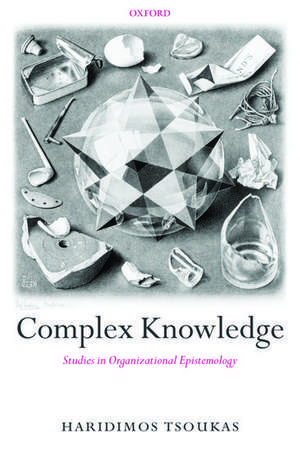
Complex Knowledge: Studies in Organizational Epistemology
Autor Haridimos Tsoukasen Limba Engleză Paperback – 2 dec 2004
Preț: 533.11 lei
Preț vechi: 629.21 lei
-15%
Puncte Express: 800
Carte tipărită la comandă
Livrare economică 14-19 august
Livrare prin curier în România Termenul estimat este afișat lângă disponibilitate.
Transport gratuit pentru acest produs Plată online sau ramburs, în funcție de opțiunile comenzii.
Retur gratuit în 14 zile Comandă securizată și suport în română.
Specificații
ISBN-13: 9780199275588
ISBN-10: 0199275580
Pagini: 428
Dimensiuni: 157 x 232 x 24 mm
Greutate: 0.61 kg
Editura: OUP OXFORD
Colecția OUP Oxford
Locul publicării:Oxford, United Kingdom
ISBN-10: 0199275580
Pagini: 428
Dimensiuni: 157 x 232 x 24 mm
Greutate: 0.61 kg
Editura: OUP OXFORD
Colecția OUP Oxford
Locul publicării:Oxford, United Kingdom
V-ar putea interesa
-
 The Significance of Philosophical ScepticismBarry StroudPreț: 355.29 lei
 -
 -31%Preț: 375.97 lei542.66 lei
 -
 An Enquiry concerning Human UnderstandingDavid HumePreț: 260.54 lei
 -
 Tracking Truth: Knowledge, Evidence, and ScienceSherrilyn Roush-10%Preț: 318.79 lei354.67 lei
 -
 -31%Preț: 401.56 lei580.49 lei
 -
 Causing ActionsPaul M. Pietroski-9%Preț: 326.40 lei359.37 lei
 -
 Contextualism in Philosophy: Knowledge, Meaning, and TruthGerhard Preyer-19%Preț: 391.65 lei484.44 lei
 -
 Bayesian EpistemologyLuc Bovens-18%Preț: 358.19 lei438.12 lei
 -
 The Oxford Handbook of Organization TheoryHaridimos Tsoukas-29%Preț: 402.32 lei569.64 lei
 -
 -11%Preț: 407.96 lei458.39 lei
 -
 Constructing Identity in and around OrganizationsMajken Schultz-13%Preț: 351.08 lei402.84 lei
 -
 Three Dialogues on KnowledgeFeyerabendPreț: 238.23 lei
 -
 Creativity of ActionHans JoasPreț: 264.41 lei
 -
 ComplexitiesAnnemarie MolPreț: 242.50 lei
 -
 A Guide Through the Theory of KnowledgeAdam MortonPreț: 280.77 lei
 -
 EpistemologyErnest SosaPreț: 264.97 lei
Recenzii
Complex Knowledge is a thought-provoking, insightful, and deeply engaging exploration of the nature of knowledge in and about organizations. Not only does it offer a compelling critique of contemporary ways of understanding organizational knowledge, but it articulates a powerful alternative vocabulary grounded in such notions as situated practice, enactment, mutual constitution, improvisation, temporality, and creativity. Most importantly, it forces us - as researchers and practitioners - to take seriously the inherent reflexivity of our ongoing actions in the world.
Complex Knowledge shows just how important and rich is the emerging insight that organizations are systems of knowledge. Hari Tsoukas's deep, accessible probing of ways in which organizations construct, process, and justify their knowledge is a defining moment in organizational scholarship. It vaults the idea of organizational knowing to the top of the stack of explanations that work. An extraordinary mind is at work in this marvellous volume!
Providing a comprehensive collection of Prof. Tsoukas' work, this book is an eye-opener for anyone who studies knowledge in organizations. Prof. Tsoukas demonstrates with clarity and brilliance, that knowledge is a complex construct that gives rise to new ways of understanding the very phenomenon of organizing. Highly recommended!
The long conceptual journey undertaken in the organizational sciences from a simple robotized view of man - a cog in a machine - to something more intelligent, more complex, and altogether more human, has been a long one. The studies described in Hari Tsoukas' exciting new book shows us that we may at last be nearing the end of the journey. The new world of organizations is one of complexity and change rather than one of order and stability - one that pays homage to Heraclitus rather than to Parmenides. In this dynamic and evolving setting knowledge is at a premium as never before. But what kind of knowledge? Tsoukas' exploration of this question leads him to link issues organizational epistemology to the new theories of complexity. Tsoukas' book will be essential reading for those wishing to understand where the new science of organizations is heading for in the twenty-first century.
Complex Knowledge shows just how important and rich is the emerging insight that organizations are systems of knowledge. Hari Tsoukas's deep, accessible probing of ways in which organizations construct, process, and justify their knowledge is a defining moment in organizational scholarship. It vaults the idea of organizational knowing to the top of the stack of explanations that work. An extraordinary mind is at work in this marvellous volume!
Providing a comprehensive collection of Prof. Tsoukas' work, this book is an eye-opener for anyone who studies knowledge in organizations. Prof. Tsoukas demonstrates with clarity and brilliance, that knowledge is a complex construct that gives rise to new ways of understanding the very phenomenon of organizing. Highly recommended!
The long conceptual journey undertaken in the organizational sciences from a simple robotized view of man - a cog in a machine - to something more intelligent, more complex, and altogether more human, has been a long one. The studies described in Hari Tsoukas' exciting new book shows us that we may at last be nearing the end of the journey. The new world of organizations is one of complexity and change rather than one of order and stability - one that pays homage to Heraclitus rather than to Parmenides. In this dynamic and evolving setting knowledge is at a premium as never before. But what kind of knowledge? Tsoukas' exploration of this question leads him to link issues organizational epistemology to the new theories of complexity. Tsoukas' book will be essential reading for those wishing to understand where the new science of organizations is heading for in the twenty-first century.
Notă biografică
Haridimos Tsoukas is the George D. Mavros Research Professor of Organization and Management at ALBA in Greece, and Professor of Organization Studies, University of Warwick, UK. Previous positions held include Lecturer at Warwick Business School (1990-5), and Associate Professor at the University of Cyprus.