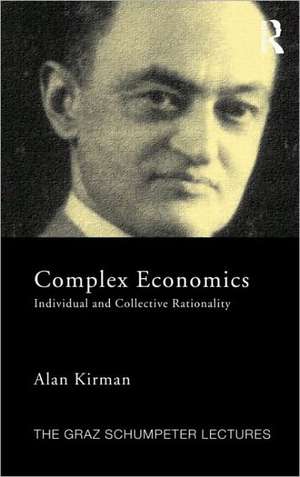
Complex Economics: Individual and Collective Rationality: The Graz Schumpeter Lectures
Autor Alan Kirmanen Limba Engleză Hardback – 29 iul 2010
The economy should be considered as a complex adaptive system in which the agents constantly react to, influence and are influenced by, the other individuals in the economy. In such systems which are familiar from statistical physics and biology for example, the behaviour of the aggregate cannot be deduced from the behaviour of the average, or "representative" individual. Just as the organised activity of an ants’ nest cannot be understood from the behaviour of a "representative ant" so macroeconomic phenomena should not be assimilated to those associated with the "representative agent". This book provides examples where this can clearly be seen. The examples range from Schelling’s model of segregation, to contributions to public goods, the evolution of buyer seller relations in fish markets, to financial models based on the foraging behaviour of ants.
The message of the book is that coordination rather than efficiency is the central problem in economics. How do the myriads of individual choices and decisions come to be coordinated? How does the economy or a market, "self organise" and how does this sometimes result in major upheavals, or to use the phrase from physics, "phase transitions"? The sort of system described in this book is not in equilibrium in the standard sense, it is constantly changing and moving from state to state and its very structure is always being modified. The economy is not a ship sailing on a well-defined trajectory which occasionally gets knocked off course. It is more like the slime described in the book "emergence", constantly reorganising itself so as to slide collectively in directions which are neither understood nor necessarily desired by its components.






Preț: 1256.21 lei
Preț vechi: 1531.97 lei
-18%
Puncte Express: 1884
Carte tipărită la comandă
Livrare economică 07-21 noiembrie
Livrare prin curier în România Termenul estimat este afișat lângă disponibilitate.
Transport gratuit pentru acest produs Plată online sau ramburs, în funcție de opțiunile comenzii.
Retur gratuit în 14 zile Comandă securizată și suport în română.
Specificații
ISBN-13: 9780415568555
ISBN-10: 0415568552
Pagini: 256
Ilustrații: 47 b/w images, 21 color images, 1 table, 47 line drawings and 21 color line drawings
Dimensiuni: 156 x 234 x 20 mm
Greutate: 0.66 kg
Ediția:1
Editura: Taylor & Francis
Colecția Routledge
Seria The Graz Schumpeter Lectures
Locul publicării:Oxford, United Kingdom
ISBN-10: 0415568552
Pagini: 256
Ilustrații: 47 b/w images, 21 color images, 1 table, 47 line drawings and 21 color line drawings
Dimensiuni: 156 x 234 x 20 mm
Greutate: 0.66 kg
Ediția:1
Editura: Taylor & Francis
Colecția Routledge
Seria The Graz Schumpeter Lectures
Locul publicării:Oxford, United Kingdom
V-ar putea interesa
-
 Fifty Major EconomistsSteven Pressman-18%Preț: 1114.85 lei1359.57 lei
 -
 Boycottage et sabottageIbn Al-Qoutiyah Al-QortobiPreț: 72.65 lei
 -
 Budget des dépenses de l'exercice...Charles-Jean-Baptiste SimoutrePreț: 79.84 lei
 -
 Éléments d'économie politique (7e édition)Émile de LaveleyePreț: 169.83 lei
 -
 Preț: 222.94 lei
 -
 Preț: 80.19 lei
 -
 Psychologie économique. Tome 1Gabriel TardePreț: 192.73 lei
 -
 Prospectus d'un nouveau Dictionnaire de commerceAndré MorelletPreț: 207.51 lei
 -
 Le bon sens dans les doctrines morales et politiques Tome 2Ambroise ClémentPreț: 269.92 lei
 -
 Économie sociale. Tome 2Agathon De PotterPreț: 146.35 lei
 -
 Épargne et capital, Du meilleur emploi de la richesseAlfred JourdanPreț: 223.07 lei
 -
 La petite industrie contemporaineVictor BrantsPreț: 138.53 lei
 -
 Les grèvesLéon de SeilhacPreț: 146.01 lei
 -
 Traité d'économie socialeAnge GuépinPreț: 101.63 lei
 -
 Nouveau traité d'économie sociale Tome 1Charles DunoyerPreț: 230.65 lei
 -
 Preț: 216.15 lei
 -
 The Economy as a Complex Spatial SystemPasquale CommendatorePreț: 407.68 lei
 -
 Economics with Heterogeneous Interacting AgentsAlan Kirman-15%Preț: 618.64 lei727.80 lei
 -
 -18%Preț: 729.94 lei890.16 lei
Public țintă
Postgraduate and UndergraduateCuprins
1. Introduction 2. The Structure of Interaction 3. Fish Markets: An Example of the Emergence of Aggregate Coordination 4. Financial Markets: Bubbles, Herds and Crashes 5. Public Goods: A coordination problem 6. Segregation: Schelling’s Model 7. Conclusion
Notă biografică
Alan Kirman is Professor Emeritus at l’Université d’Aix-Marseille lll and l’Ecole des Hautes Etudes en Sciences Sociales, France.
Recenzii
‘What a refreshing read! Alan Kirman draws on his immense experience of how real people trade, from the Marseille and Ancona fish markets to experiments on public goods games, to propose an approach to economics centred on interaction between individuals and its consequences for aggregate behaviour. This book is essential reading in the quest for new economic thinking’.
- Prof. Robert MacKay, University of Warwick, UK
- Prof. Robert MacKay, University of Warwick, UK
Descriere
The economic crisis is also a crisis for economic theory. Most analyses of the evolution of the crisis invoke three themes, contagion, networks and trust, yet none of these play a major role in standard macroeconomic models. In this book Kirman argues for a theory in which these aspects are central.