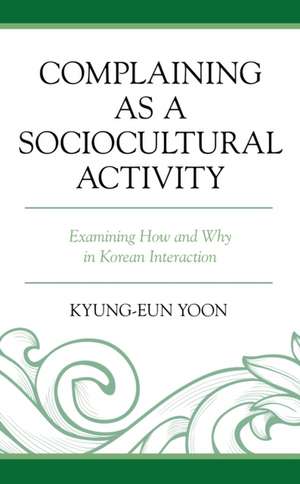
Complaining as a Sociocultural Activity: Examining How and Why in Korean Interaction
Autor Kyung-Eun Yoonen Limba Engleză Paperback – 18 aug 2022
Preț: 254.62 lei
Preț vechi: 349.45 lei
-27%
Puncte Express: 382
Carte tipărită la comandă
Livrare economică 30 noiembrie-14 decembrie
Livrare prin curier în România Termenul estimat este afișat lângă disponibilitate.
Transport gratuit de la 400.00 lei Plată online sau ramburs, în funcție de opțiunile comenzii.
Retur gratuit în 14 zile Comandă securizată și suport în română.
Specificații
ISBN-13: 9781793604729
ISBN-10: 179360472X
Pagini: 170
Ilustrații: 88 tables; 3 charts;
Dimensiuni: 151 x 228 x 14 mm
Greutate: 0.26 kg
Editura: Bloomsbury Publishing
Colecția Lexington Books
Locul publicării:New York, United States
ISBN-10: 179360472X
Pagini: 170
Ilustrații: 88 tables; 3 charts;
Dimensiuni: 151 x 228 x 14 mm
Greutate: 0.26 kg
Editura: Bloomsbury Publishing
Colecția Lexington Books
Locul publicării:New York, United States
Cuprins
List of Figures
Transcription Conventions
Acknowledgments
Chapter 1: Introduction
Chapter 2: Formulating Complainability
Chapter 3: Linguistic Resources in Complaints
Chapter 4: Organization of Complaining Activity
Chapter 5: Social Organization in Complaining Activity
Chapter 6: Concluding Remarks
Bibliography
Transcription Conventions
Acknowledgments
Chapter 1: Introduction
Chapter 2: Formulating Complainability
Chapter 3: Linguistic Resources in Complaints
Chapter 4: Organization of Complaining Activity
Chapter 5: Social Organization in Complaining Activity
Chapter 6: Concluding Remarks
Bibliography
Recenzii
On the one hand, this book provides authentic materials and insightful discussions of social norms, which can be tailored to instructions and activities in the Korean language classroom. On the other hand, its detailed analysis bridges linguistic forms, social norms, and social identities, the nexus of which is increasingly being attended to in pragmatics research. Therefore, the book is recommended reading and a useful resource for both researchers and Korean language educators.
Complaining as a Sociocultural Activity: Examining How and Why in Korean Interaction
details with precision and insight the intricate network of psychological, interactional, and linguistic features that underlie complaints in Korean. With data culled from a variety of naturally occurring oral and written discourse, including spontaneous conversation (face-to-face and telephonic), online reviews, blogs, and social media posts, Yoon synthesizes the robust and complex discursive patterns of complaining and puts forward a systematically thorough analysis of the interactional phenomenon. Most importantly, the book centers on Korean discourse and keenly elucidates such issues as social identity and membership in the multifaceted, spontaneous, and dialogic activity of complaining.
Commendably written by an expert, this is the first book-length study that investigates the communicative act of complaining in Korean, using Conversational Analysis (CA). As a very welcome contribution to Korean linguistics, pragmatics, and interactional linguistics studies, it unfolds the complex interplay between grammar and social interaction in Korean cultural contexts. It will certainly serve as a valuable resource for Korean applied linguists and researchers and also as great supplementary reading for advanced undergraduate and/or graduate courses in Korean linguistics.
Complaining as a Sociocultural Activity: Examining How and Why in Korean Interaction
details with precision and insight the intricate network of psychological, interactional, and linguistic features that underlie complaints in Korean. With data culled from a variety of naturally occurring oral and written discourse, including spontaneous conversation (face-to-face and telephonic), online reviews, blogs, and social media posts, Yoon synthesizes the robust and complex discursive patterns of complaining and puts forward a systematically thorough analysis of the interactional phenomenon. Most importantly, the book centers on Korean discourse and keenly elucidates such issues as social identity and membership in the multifaceted, spontaneous, and dialogic activity of complaining.
Commendably written by an expert, this is the first book-length study that investigates the communicative act of complaining in Korean, using Conversational Analysis (CA). As a very welcome contribution to Korean linguistics, pragmatics, and interactional linguistics studies, it unfolds the complex interplay between grammar and social interaction in Korean cultural contexts. It will certainly serve as a valuable resource for Korean applied linguists and researchers and also as great supplementary reading for advanced undergraduate and/or graduate courses in Korean linguistics.