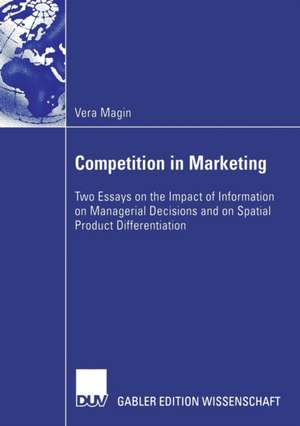
Competition in Marketing
Autor Vera Maginen Limba Engleză Paperback – 26 iul 2006
Preț: 381.15 lei
Puncte Express: 572
Carte tipărită la comandă
Livrare economică 09-23 decembrie
Livrare prin curier în România Termenul estimat este afișat lângă disponibilitate.
Transport gratuit de la 400.00 lei Plată online sau ramburs, în funcție de opțiunile comenzii.
Retur gratuit în 14 zile Comandă securizată și suport în română.
Specificații
ISBN-13: 9783835004320
ISBN-10: 3835004328
Pagini: 164
Ilustrații: XVII, 145 p. 30 illus.
Dimensiuni: 148 x 210 x 10 mm
Greutate: 0.22 kg
Ediția:2006
Editura: Deutscher Universitätsverlag
Locul publicării:Wiesbaden, Germany
ISBN-10: 3835004328
Pagini: 164
Ilustrații: XVII, 145 p. 30 illus.
Dimensiuni: 148 x 210 x 10 mm
Greutate: 0.22 kg
Ediția:2006
Editura: Deutscher Universitätsverlag
Locul publicării:Wiesbaden, Germany
V-ar putea interesa
-
 Consumption Matters: A Psychological PerspectiveCathrine Jansson-Boyd-25%Preț: 246.75 lei330.11 lei
 -
 Brand AvatarKenneth A LoparoPreț: 509.53 lei
 -
 Harry PotterS. GuneliusPreț: 405.92 lei
 -
 The New Role of Regional ManagementB. Ambos-15%Preț: 667.33 lei785.10 lei
 -
 Luxury OnlineUché OkonkwoPreț: 520.86 lei
 -
 From Products to ServicesLaurie YoungPreț: 467.48 lei
 -
 What's the Secret?John R DijuliusPreț: 171.76 lei
 -
 Preț: 201.85 lei
 -
 Preț: 243.26 lei
 -
 Preț: 78.63 lei
 -
 The Psychology of SellingBrian TracyPreț: 106.99 lei
 -
 Revolutionize Your Customer ExperienceColin ShawPreț: 475.59 lei
 -
 Hands-On Social Marketing: A Step-by-Step Guide to Designing Change for GoodNedra Kline Weinreich-26%Preț: 835.08 lei1128.48 lei
 -
 The 25 Sales Habits of Highly Successful SalespeopleStephan SchiffmanPreț: 60.53 lei
Public țintă
ResearchCuprins
Essay I: Managerial Over-Acting.- Essay II: Spatial Product Differentiation.
Notă biografică
Dr. Vera Magin promovierte bei Univ.-Prof. Dr. Oliver P. Heil am Lehrstuhl für Marketing der Universität Mainz. Sie forschte zudem als Research Scholar an der University of Florida, Gainesville (USA). Ihre Dissertation wurde von Nobelpreisträger Prof. Dr. Dr. h.c. mult. Reinhard Selten als Zweitgutachter betreut.
Textul de pe ultima copertă
The importance of information to support managerial decision making has been widely acknowledged, but only little research has been done on the overall impact of such information. In her first essay Vera Magin uses primary experimental data to explore the effects of information on marketing decisions, performance, and competition. The results indicate that better informed firms offer more products, achieve a higher primary demand, and exhaust customer preferences to a higher degree. Surprisingly and more importantly, information impacts on performance are non-significant. This phenomenon is termed "managerial over-acting". Managerial over-acting introduces a new concept to the marketing discipline.
The degree of product differentiation of a market is reflective of its competitive intensity. For the case of spatial markets, however, the marketing discipline does not provide a valid measure of product differentiation. In her second essay the author discusses several approaches to measure product differentiation in spatial contexts. In doing so, she refers to the measurement of diversity and also applies methods from disciplines like spatial statistics, forestry, and geography.
The degree of product differentiation of a market is reflective of its competitive intensity. For the case of spatial markets, however, the marketing discipline does not provide a valid measure of product differentiation. In her second essay the author discusses several approaches to measure product differentiation in spatial contexts. In doing so, she refers to the measurement of diversity and also applies methods from disciplines like spatial statistics, forestry, and geography.