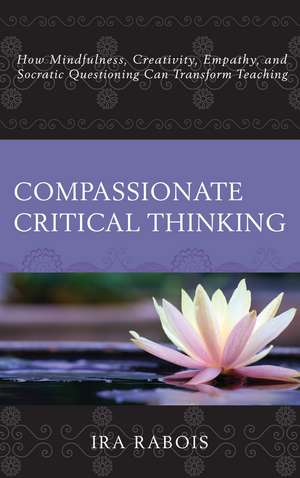
Compassionate Critical Thinking: How Mindfulness, Creativity, Empathy, and Socratic Questioning Can Transform Teaching
Autor Ira Raboisen Limba Engleză Hardback – 14 oct 2016
When students feel a lack of meaning and purpose in their school lives, they resist learning. Using a Socratic style of inquiry, Rabois changes the classroom dynamic to encourage self-reflection, insight, and empathy. Vignettes capture dialogue between teacher and students to illustrate how mindfulness practices elicit essential questions which stimulate inquiry and direct discovery. What bigger mystery is there, what more interesting and relevant story, than the story of one's own mind and heart and how they relate us to the world?
Preț: 351.00 lei
Preț vechi: 425.02 lei
-17%
Puncte Express: 527
Carte tipărită la comandă
Livrare economică 04-18 decembrie
Livrare prin curier în România Termenul estimat este afișat lângă disponibilitate.
Transport gratuit de la 400.00 lei Plată online sau ramburs, în funcție de opțiunile comenzii.
Retur gratuit în 14 zile Comandă securizată și suport în română.
Specificații
ISBN-13: 9781475828818
ISBN-10: 1475828810
Pagini: 146
Dimensiuni: 159 x 236 x 15 mm
Greutate: 0.34 kg
Editura: Bloomsbury Publishing
Colecția Rowman & Littlefield
Locul publicării:New York, United States
ISBN-10: 1475828810
Pagini: 146
Dimensiuni: 159 x 236 x 15 mm
Greutate: 0.34 kg
Editura: Bloomsbury Publishing
Colecția Rowman & Littlefield
Locul publicării:New York, United States
Cuprins
Foreword
Preface
Mindfulness, Creativity and Natural Thinking
Heart, Empathy and Mindfulness
Socratic Questioning and Compassionate Thinking
Integrating Mindfulness into Your Classroom
Mindfulness as Practice for Teachers
Introduction
How the Book is Organized
Notes on the Inclusion of Student Voices in the Book
Chapter 1: Begin with Mindfulness
What is Mindfulness? How Do You Practice It?
Why Practice? Different Uses and Forms of Practice
Mindful Speech
The Hero's Journey
Using Imagination and Visualization to Teach
Chapter 2: How Does the Brain Shape Experience?
The Geography of the Brain
The Emotional Areas of the Brain and How To Pay Attention Emotional Pathways and What We Pay Attention To
Chapter 3: Emotion and the Quality of Your Mental State
A Philosophical and Buddhist Inquiry into Suffering
What Is Anger?
Should I or Shouldn't I? Anger and Kindness.
Joy and Fear.
Understanding and Letting Go of Anxiety
Greed and Human History
Chapter 4: Emotions of Opening and Approach
What is Empathy and Compassion?
What is Love?
What Attracts One Person To Another?
Chapter 5: Compassionate Critical Thinking is a Process Of Mindful Questioning
Questioning and Beginning the Process of Critical Thinking
How Does Inner Silence Assist Thinking?
The Role of Self-Reflection in Compassionate Critical Thinking
Conclusion
Acknowledgments
Appendix: Further Resources
About the Author
Index
Preface
Mindfulness, Creativity and Natural Thinking
Heart, Empathy and Mindfulness
Socratic Questioning and Compassionate Thinking
Integrating Mindfulness into Your Classroom
Mindfulness as Practice for Teachers
Introduction
How the Book is Organized
Notes on the Inclusion of Student Voices in the Book
Chapter 1: Begin with Mindfulness
What is Mindfulness? How Do You Practice It?
Why Practice? Different Uses and Forms of Practice
Mindful Speech
The Hero's Journey
Using Imagination and Visualization to Teach
Chapter 2: How Does the Brain Shape Experience?
The Geography of the Brain
The Emotional Areas of the Brain and How To Pay Attention Emotional Pathways and What We Pay Attention To
Chapter 3: Emotion and the Quality of Your Mental State
A Philosophical and Buddhist Inquiry into Suffering
What Is Anger?
Should I or Shouldn't I? Anger and Kindness.
Joy and Fear.
Understanding and Letting Go of Anxiety
Greed and Human History
Chapter 4: Emotions of Opening and Approach
What is Empathy and Compassion?
What is Love?
What Attracts One Person To Another?
Chapter 5: Compassionate Critical Thinking is a Process Of Mindful Questioning
Questioning and Beginning the Process of Critical Thinking
How Does Inner Silence Assist Thinking?
The Role of Self-Reflection in Compassionate Critical Thinking
Conclusion
Acknowledgments
Appendix: Further Resources
About the Author
Index
Recenzii
Impressively written, organized and presented, Compassionate Critical Thinking is especially recommended for college and university library Teacher Education collections in general, and student teacher supplemental studies reading lists in particular.
Compassionate Critical Thinking: How Mindfulness, Creativity, Empathy, and Socratic Questioning Can Transform Teachingis based on Ira Rabois' thirty-year career teaching English, philosophy, history, and psychology to high school students. Rabois includes six types of practices in his teaching: Mindfulness, Concentration, Visualization, Inquiry, Compassion and Empathy, and Group Dialogue and Questioning.. This combination of practices fosters greater awareness of the students' own lives and how they think and feel. In turn, this deepens the interpersonal connection between teacher and students, and also deepens the students' understanding of academic content and how it is relevant to their lives.. In this instructional approach, the teacher's role is to foster a safe, supportive community for youth not only to increase their knowledge but also to develop the wisdom that will help them live a meaningful life. Recommended.
Rabois' innovative approach places students at the center of learning, encouraging deep thinking about themselves and the world around them. A timely antidote to conventional education - and stultified thinking in general.
Dialogue has often been an important part of the [Buddhist/spiritual] path, but it does not always receive the attention it deserves. Ira Rabois' book, Compassionate Critical Thinking, shows the way to do it, and what it can mean for those who engage in such conversations sincerely and openly. This is what education should be about.
Ira Rabois has written a straightforward and nuanced guide for anyone who wants to blend emotional honesty with the craft of teaching, based on 27 years of reflecting on his
own experiments and discoveries as a teacher. Full of illuminating stories, suggestions, and insights, Compassionate Critical Thinking will demonstrate to educators, parents, and administrators that attending to students' emotional responses to classroom materials can lead them to think more critically. This book shows how to do justice to the emotional complexity of teaching and learning.
Ira Rabois - a 21st century renaissance man - has taught karate, philosophy, psychology, English, Social Studies, and drama to secondary school students for over three decades. Drawing on this wealth of experience - and using illustrative vignettes of his students' voices - he takes us on a journey, showing how he has combined mindfulness meditation, creativity, empathy, and Socratic questioning to engage young people in a rich, collaborative learning process he calls Compassionate Critical Thinking.
I am excited to recommend Ira Rabois' new book, Compassionate Critical Thinking. As an adolescent psychotherapist, my work focuses in part on assisting patients to gain insight into their internal world, to come to understand their autonomous selves and to be able to articulate this understanding to others rather than simply to act them out. The practices outlined in this book wonderfully integrate the education and psychotherapy processes. They are extremely important, effective, and fitting for enabling a young person to both gain better self-awareness and grounding, and to better focus on the learning process.
I fell in love with Ira Rabois' Compassionate Critical Thinking on the first page. As a master teacher of heart and mind, Rabois encourages his students to understand and express their inherent wisdom. Trusting that each child has an important viewpoint and perspective, he guides classroom discussions that lead to self-understanding, clear critical thinking, and compassionate awareness. Any teacher who reads this book and uses its methods will find new inspiration for their students and for themselves.
Reading this book strongly affirms the role of relationship, both to self and others, in the learning process. Rabois provides a clear path for using mindfulness in the classroom to foster empathy and genuine connection with the material being explored together in class, empowering both students and teacher. The book guides the reader through a process of helping students learn more about themselves and their own learning processes as they make meaningful personal connections to class material.
Compassionate Critical Thinking: How Mindfulness, Creativity, Empathy, and Socratic Questioning Can Transform Teachingis based on Ira Rabois' thirty-year career teaching English, philosophy, history, and psychology to high school students. Rabois includes six types of practices in his teaching: Mindfulness, Concentration, Visualization, Inquiry, Compassion and Empathy, and Group Dialogue and Questioning.. This combination of practices fosters greater awareness of the students' own lives and how they think and feel. In turn, this deepens the interpersonal connection between teacher and students, and also deepens the students' understanding of academic content and how it is relevant to their lives.. In this instructional approach, the teacher's role is to foster a safe, supportive community for youth not only to increase their knowledge but also to develop the wisdom that will help them live a meaningful life. Recommended.
Rabois' innovative approach places students at the center of learning, encouraging deep thinking about themselves and the world around them. A timely antidote to conventional education - and stultified thinking in general.
Dialogue has often been an important part of the [Buddhist/spiritual] path, but it does not always receive the attention it deserves. Ira Rabois' book, Compassionate Critical Thinking, shows the way to do it, and what it can mean for those who engage in such conversations sincerely and openly. This is what education should be about.
Ira Rabois has written a straightforward and nuanced guide for anyone who wants to blend emotional honesty with the craft of teaching, based on 27 years of reflecting on his
own experiments and discoveries as a teacher. Full of illuminating stories, suggestions, and insights, Compassionate Critical Thinking will demonstrate to educators, parents, and administrators that attending to students' emotional responses to classroom materials can lead them to think more critically. This book shows how to do justice to the emotional complexity of teaching and learning.
Ira Rabois - a 21st century renaissance man - has taught karate, philosophy, psychology, English, Social Studies, and drama to secondary school students for over three decades. Drawing on this wealth of experience - and using illustrative vignettes of his students' voices - he takes us on a journey, showing how he has combined mindfulness meditation, creativity, empathy, and Socratic questioning to engage young people in a rich, collaborative learning process he calls Compassionate Critical Thinking.
I am excited to recommend Ira Rabois' new book, Compassionate Critical Thinking. As an adolescent psychotherapist, my work focuses in part on assisting patients to gain insight into their internal world, to come to understand their autonomous selves and to be able to articulate this understanding to others rather than simply to act them out. The practices outlined in this book wonderfully integrate the education and psychotherapy processes. They are extremely important, effective, and fitting for enabling a young person to both gain better self-awareness and grounding, and to better focus on the learning process.
I fell in love with Ira Rabois' Compassionate Critical Thinking on the first page. As a master teacher of heart and mind, Rabois encourages his students to understand and express their inherent wisdom. Trusting that each child has an important viewpoint and perspective, he guides classroom discussions that lead to self-understanding, clear critical thinking, and compassionate awareness. Any teacher who reads this book and uses its methods will find new inspiration for their students and for themselves.
Reading this book strongly affirms the role of relationship, both to self and others, in the learning process. Rabois provides a clear path for using mindfulness in the classroom to foster empathy and genuine connection with the material being explored together in class, empowering both students and teacher. The book guides the reader through a process of helping students learn more about themselves and their own learning processes as they make meaningful personal connections to class material.