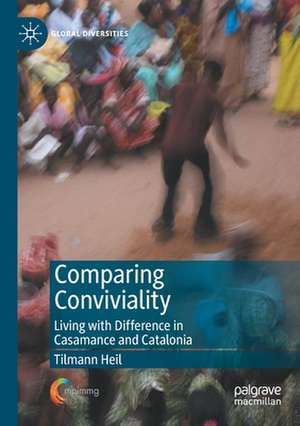
Comparing Conviviality: Global Diversities
Autor Tilmann Heilen Limba Engleză Paperback – 20 iun 2021
Heil brings together longstanding histories, political projects, and everyday practices of living with difference. With a focus on neighbourhood life in Casamance, Senegal, and Catalonia, Spain - two equally complex regions - Comparing Conviviality depicts how Senegalese people skillfully negotiate and translate the intricacies of difference and power. In these lived African and European worlds, conviviality is ever temporary and changing.
This book offers a textured, realist, yet hopeful understanding of difference, social change, power, and respect. It will be invaluable to students and scholars of African, migration, and diversity studies across anthropology, sociology, geography, political sciences, and law.
| Toate formatele și edițiile | Preț | Express |
|---|---|---|
| Paperback (1) | 563.82 lei 6-8 săpt. | |
| Springer International Publishing – 20 iun 2021 | 563.82 lei 6-8 săpt. | |
| Hardback (1) | 573.22 lei 6-8 săpt. | |
| Springer International Publishing – 19 iun 2020 | 573.22 lei 6-8 săpt. |
Din seria Global Diversities
-
 Preț: 376.90 lei
 - 15%
 Preț: 505.94 lei
 -
 Preț: 375.81 lei
 - 15%
 Preț: 563.96 lei
 -
 Preț: 220.90 lei
 - 15%
 Preț: 618.50 lei
 -
 Preț: 368.79 lei
 - 18%
 Preț: 754.53 lei
 - 18%
 Preț: 1077.83 lei
 - 15%
 Preț: 565.82 lei
 - 18%
 Preț: 703.58 lei
 - 15%
 Preț: 671.63 lei
 -
 Preț: 401.43 lei
 -
 Preț: 369.53 lei
 - 15%
 Preț: 458.96 lei
 -
 Preț: 368.43 lei
 - 18%
 Preț: 746.51 lei
 - 18%
 Preț: 749.22 lei
 - 15%
 Preț: 611.57 lei
 -
 Preț: 344.27 lei
 - 18%
 Preț: 909.51 lei
 - 15%
 Preț: 610.50 lei
Preț: 563.82 lei
Preț vechi: 663.32 lei
-15%
Puncte Express: 846
Preț estimativ în valută:
99.70€ • 114.33$ • 86.17£
99.70€ • 114.33$ • 86.17£
Carte tipărită la comandă
Livrare economică 28 aprilie-12 mai
Specificații
ISBN-13: 9783030347192
ISBN-10: 3030347192
Pagini: 376
Ilustrații: XXV, 349 p. 36 illus., 10 illus. in color.
Dimensiuni: 148 x 210 x 21 mm
Greutate: 0.49 kg
Ediția:1st edition 2020
Editura: Springer International Publishing
Seria Global Diversities
Locul publicării:Cham, Switzerland
ISBN-10: 3030347192
Pagini: 376
Ilustrații: XXV, 349 p. 36 illus., 10 illus. in color.
Dimensiuni: 148 x 210 x 21 mm
Greutate: 0.49 kg
Ediția:1st edition 2020
Editura: Springer International Publishing
Seria Global Diversities
Locul publicării:Cham, Switzerland
Cuprins
Part 1. Setting the Stage.- Chapter 1. Living with Difference Otherwise.- Chapter 2. Configurations, Representations and Migrations. - Part 2. Observing Conviviality.- Chapter 3. Everyday Neighbourhood Encounters. - Chapter 4. Staged and Sensuous. - Part 3. Challenging Conviviality.- Chapter 5. Aspiring to be Modern.- Chapter 6. Power Dynamics in Migration. - Part 4. Revisiting Conviviality.- Chapter 7. Basic Practices of Conviviality.- Epilogue.
Notă biografică
Tilmann Heil is FWO [PEGASUS]² Marie Sklodowska-Curie Fellow at KU Leuven, Belgium,and is also affiliated to the National Museum (PPGAS) of the Universidade Federal do Rio de Janeiro, Brazil.
Textul de pe ultima copertă
In a world where difference is often seen as a threat or challenge, Comparing Conviviality explores how people actually live in diverse societies. Based on a long-term ethnography of West Africans in both Senegal and Spain, this book proposes that conviviality is a commitment to difference, across ethnicities, languages, religions, and practices.
Heil brings together longstanding histories, political projects, and everyday practices of living with difference. With a focus on neighbourhood life in Casamance, Senegal, and Catalonia, Spain - two equally complex regions - Comparing Conviviality depicts how Senegalese people skillfully negotiate and translate the intricacies of difference and power. In these lived African and European worlds, conviviality is ever temporary and changing.
This book offers a textured, realist, yet hopeful understanding of difference, social change, power, and respect. It will be invaluable to students and scholars of African, migration, and diversity studies across anthropology, sociology, geography, political sciences, and law.
Caracteristici
Observes that practices of belonging as well as ways of living with difference are fragile constructs that have a serious impact on everyday sociality Includes a wide-ranging and critical review of theoretical and historical literature together with detailed accounts focused on practices of conviviality in public spaces Contains a specific attention to linguistic interaction