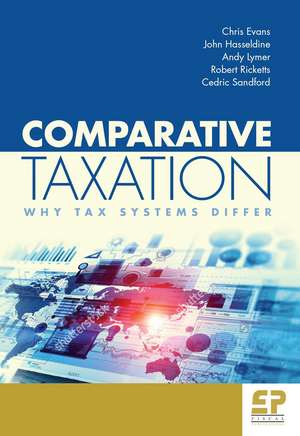
Comparative Taxation: Why tax systems differ
Autor Prof. Chris Evans, Prof. John Hasseldine, Prof. Andy Lymer, Prof. Robert Ricketts, Cedric Sandforden Limba Engleză Hardback – sep 2017
Readers will include anyone interested in how tax systems are formed, how they operate in practice, and how they are reformed.
An ideal text for academic study at the intermediate or advanced levels
This text explores and answers questions including:
- Why are the tax systems of developing and developed countries converging and how do they still differ?
- Why is the property tax the most widely used tax for local government?
- Why has income become the predominant tax base in developed countries?
- Do we need corporate income taxes?
- Why are wealth taxes relatively under-utilised in all countries?
- Why have so many countries adopted a VAT as their general sales tax?
- How do taxes help governments to deliver environmental objectives?
- Can we avoid complexity in tax system design or are we stuck with it if we want effective taxes?
- Why do taxpayers comply, or not comply, with their tax obligations?
- Where should we go next in designing tax systems for the 21st century?
Preț: 789.88 lei
Preț vechi: 868.00 lei
-9%
Puncte Express: 1185
Carte tipărită la comandă
Livrare economică 05-19 decembrie
Livrare prin curier în România Termenul estimat este afișat lângă disponibilitate.
Transport gratuit pentru acest produs Plată online sau ramburs, în funcție de opțiunile comenzii.
Retur gratuit în 14 zile Comandă securizată și suport în română.
Specificații
ISBN-13: 9781906201371
ISBN-10: 1906201374
Pagini: 358
Dimensiuni: 170 x 244 x 21 mm
Greutate: 0.8 kg
Editura: Fiscal Publications
Colecția Fiscal Publications
Locul publicării:Malvern, United Kingdom
ISBN-10: 1906201374
Pagini: 358
Dimensiuni: 170 x 244 x 21 mm
Greutate: 0.8 kg
Editura: Fiscal Publications
Colecția Fiscal Publications
Locul publicării:Malvern, United Kingdom
V-ar putea interesa
-
 -27%Preț: 764.51 lei1047.27 lei
 -
 Preț: 411.91 lei
 -
 Workouts in Intermediate MicroeconomicsHal R VarianPreț: 350.25 lei
 -
 The Capital Budgeting Decision: Economic Analysis of Investment ProjectsHarold Bierman, Jr.-18%Preț: 1626.90 lei1984.03 lei
 -
 Professional English in Use FinanceIan MacKenziePreț: 129.00 lei
 -
 Export & Import - Winning in the Global MarketplaceLeif HolmvallPreț: 283.77 lei
 -
 Global PaymentsCarol Coye BensonPreț: 222.65 lei
 -
 Preț: 233.14 lei
 -
 Supply Chain Metrics That MatterLora M CecerePreț: 423.40 lei
 -
 The Bitcoin StandardSaifedean AmmousPreț: 185.26 lei
 -
 DeFi and the Future of FinanceAshwin RamachandranPreț: 152.48 lei
 -
 The Cultural Dimension of Global BusinessGary P. Ferraro-9%Preț: 626.97 lei688.98 lei
 -
 Technology and Innovation for MarketingEleonora PantanoPreț: 444.59 lei
 -
 The Global Business Culture GuideLothar KatzPreț: 180.79 lei
 -
 -8%Preț: 617.09 lei670.75 lei
 -
 Sustainable InnovationAnshu Saxena Arora-15%Preț: 408.90 lei481.06 lei
Recenzii
..". almost everyone, from the proverbial person in the street to the most expert analyst, can learn something new from the discussion in this book about how and why taxes are structured and how they function in different contexts" --Richard Bird - Emeritus Professor of Economics, University of Toronto, Canada
"This is a most welcome, practical and pragmatic guide to tax systems around the world accessible to anyone with a basic interest in tax matters.
The book is a highly useful introductory text for students starting to explore the how s and why s of tax policy and tax administration. It sketches the tax structures in developed and developing countries, examines income, wealth and consumption taxes in considerable detail, and deals with key aspects of tax policy-making and tax administration.
In a most lucid manner, the authors have committed their considerable experience to paper of working in and for a wide range of diverse countries, governments and organizations.
--Sijbren Cnossen - Professor bij Erasmus School of Economics
"This is a most welcome, practical and pragmatic guide to tax systems around the world accessible to anyone with a basic interest in tax matters.
The book is a highly useful introductory text for students starting to explore the how s and why s of tax policy and tax administration. It sketches the tax structures in developed and developing countries, examines income, wealth and consumption taxes in considerable detail, and deals with key aspects of tax policy-making and tax administration.
In a most lucid manner, the authors have committed their considerable experience to paper of working in and for a wide range of diverse countries, governments and organizations.
--Sijbren Cnossen - Professor bij Erasmus School of Economics