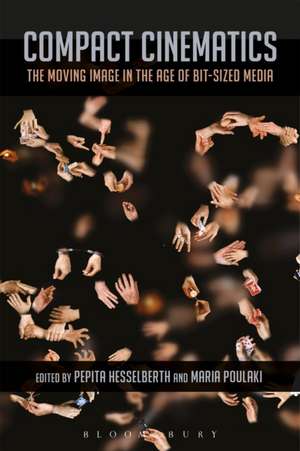
Compact Cinematics: The Moving Image in the Age of Bit-Sized Media
Editat de Pepita Hesselberth, Maria Poulakien Limba Engleză Hardback – 26 ian 2017
Short films or micro-narratives, cinematic pieces or units re-assembled into image archives and looping themes, challenge the concepts that have traditionally been used to understand cinematic experience, like linear causality, sequentiality, and closure, and call attention to complex and modular forms of cinematic expression and perception. Such forms, in turn, seem to meet the requirements of digital convergence, which has pushed the development of more compact and mobile hardware for the display and use of audiovisual content on laptops, smartphones, and tablets. Meanwhile, contemporary economies of digital content acquisition, filing, and sharing equally require the shrinking of cinematic content for it to be recorded, played, projected, distributed, and installed with ease and speed. In this process, cinematic experience is shortened and condensed as well, so as to fit the late-capitalist attention economy.
The essays in this volume ask what this changed technical, socio-economic and political situation entails for the aesthetics and experience of contemporary cinematics, and call attention to different concepts, theories and tools at our disposal to analyze these changes.
Preț: 836.62 lei
Preț vechi: 1243.30 lei
-33%
Puncte Express: 1255
Carte tipărită la comandă
Livrare economică 21 noiembrie-05 decembrie
Livrare prin curier în România Termenul estimat este afișat lângă disponibilitate.
Transport gratuit pentru acest produs Plată online sau ramburs, în funcție de opțiunile comenzii.
Retur gratuit în 14 zile Comandă securizată și suport în română.
Specificații
ISBN-13: 9781501322266
ISBN-10: 1501322265
Pagini: 256
Ilustrații: 50 bw illus
Dimensiuni: 160 x 232 x 20 mm
Greutate: 0.56 kg
Editura: Bloomsbury Publishing
Colecția Bloomsbury Academic
Locul publicării:New York, United States
ISBN-10: 1501322265
Pagini: 256
Ilustrații: 50 bw illus
Dimensiuni: 160 x 232 x 20 mm
Greutate: 0.56 kg
Editura: Bloomsbury Publishing
Colecția Bloomsbury Academic
Locul publicării:New York, United States
V-ar putea interesa
-
 Sampling MediaDavid Laderman-23%Preț: 249.85 lei326.16 lei
 -
 The Sting ManRobert W. GreenePreț: 114.01 lei
 -
 The English Patient: ScreenplayAnthony Minghella-7%Preț: 109.21 lei117.29 lei
 -
 -25%Preț: 92.88 lei123.86 lei
 -
 -26%Preț: 89.87 lei121.42 lei
 -
 Found Footage Horror Films: Fear and the Appearance of RealityAlexandra Heller-NicholasPreț: 227.12 lei
 -
 A Companion to Literature, Film, and AdaptationDeborah CartmellPreț: 367.20 lei
 -
 -25%Preț: 82.10 lei109.01 lei
Cuprins
Introduction Compact Cinematics: Screen, Capture, Attention // Pepita Hesselberth (Leiden University, The Netherlands) & Maria Poulaki (University of Surrey, UK)
Part 1 [Short] Minimal Narratives
1. Countdown to Zero: Compressing Cinema Time // Tom Gunning (The University of Chicago, US)
2. On Conflict in Short Film Storytelling // Richard Raskin (Aarhus University, Denmark)
3. Accelerated Gestures: Play Time in Agnès Varda's Cléo de 5 à 7 // Peter Verstraten (Leiden University, The Netherlands)
4. Lynch on the Run: The Proximity of Trauma in the Short Film // Todd McGowan (The University of Vermont, USA)
Part 2 [Condensed] Polyphonic Archives
5. The Ethics of Repair: Re-Animating the Archive // Sean Cubitt (Goldsmiths, University of London, UK)
6. Long Story Short // Natalie Bookchin (Rutgers, USA)
7. Skip Intro? Short Video Intros as a Reflexive Threshold in the Interactive Documentary// Tina M. Bastajian (Webster University the Netherlands, The Netherlands)
8. The Viewser as Curator: The Online Film Festival Platform // Geli Mademli (University of Amsterdam, The Netherlands)
Part 3 [Compressed] Pleasure & Productivity
9. The Contingent Spectator // Francesco Casetti (Yale University, USA)
10. Speed Watching, Efficiency, and the New Temporalities of Digital Spectatorship // Neta Alexander (The New York University Tisch School of the Arts, USA)
11. Visual Pleasure and GIFs // Anna McCarthy (The New York University Tisch School of the Arts, USA)
12. Solitary Screens: On the Recurrence and Consumption of Images // Pasi Väliaho (Goldsmiths, University of London, UK)
Part 4 [Miniature] Mobile Cinematics
13. Archaeology of Mobile Film: Blink, Bluvend and the Pocket Short // Kim Louise Walden (University of Hertfordshire, UK)
14. Children's Little Thumb Films or "Films-Poucets" // Wanda Strauven (Goethe-Universität Frankfurt, Germany) and Alexandra Schneider (University in Mainz, Germany)
15. Of Flip Books & Funny Animals: Chris Ware's Quimby the Mouse // Yasco Horsman (Leiden University, The Netherlands)
16. Mobile Cinematics // Maria Engberg (Malmö University, Sweden) and Jay David Bolter (Georgia Institute of Technology, USA)
Part 5 [Compacted] Urban Ecologies
17. Screening Smart Cities: Managing Data, Views, and Vertigo // Gillian Rose (The Open University, UK)
18. Of Compactness: Life with Media Façade Screens // Ulrik Ekman (University of Copenhagen, Denmark)
19. Codified Space: Cinematic Recodings of Urban Reality // Justin Ascott (Norwich University of the Arts, UK)
Part 1 [Short] Minimal Narratives
1. Countdown to Zero: Compressing Cinema Time // Tom Gunning (The University of Chicago, US)
2. On Conflict in Short Film Storytelling // Richard Raskin (Aarhus University, Denmark)
3. Accelerated Gestures: Play Time in Agnès Varda's Cléo de 5 à 7 // Peter Verstraten (Leiden University, The Netherlands)
4. Lynch on the Run: The Proximity of Trauma in the Short Film // Todd McGowan (The University of Vermont, USA)
Part 2 [Condensed] Polyphonic Archives
5. The Ethics of Repair: Re-Animating the Archive // Sean Cubitt (Goldsmiths, University of London, UK)
6. Long Story Short // Natalie Bookchin (Rutgers, USA)
7. Skip Intro? Short Video Intros as a Reflexive Threshold in the Interactive Documentary// Tina M. Bastajian (Webster University the Netherlands, The Netherlands)
8. The Viewser as Curator: The Online Film Festival Platform // Geli Mademli (University of Amsterdam, The Netherlands)
Part 3 [Compressed] Pleasure & Productivity
9. The Contingent Spectator // Francesco Casetti (Yale University, USA)
10. Speed Watching, Efficiency, and the New Temporalities of Digital Spectatorship // Neta Alexander (The New York University Tisch School of the Arts, USA)
11. Visual Pleasure and GIFs // Anna McCarthy (The New York University Tisch School of the Arts, USA)
12. Solitary Screens: On the Recurrence and Consumption of Images // Pasi Väliaho (Goldsmiths, University of London, UK)
Part 4 [Miniature] Mobile Cinematics
13. Archaeology of Mobile Film: Blink, Bluvend and the Pocket Short // Kim Louise Walden (University of Hertfordshire, UK)
14. Children's Little Thumb Films or "Films-Poucets" // Wanda Strauven (Goethe-Universität Frankfurt, Germany) and Alexandra Schneider (University in Mainz, Germany)
15. Of Flip Books & Funny Animals: Chris Ware's Quimby the Mouse // Yasco Horsman (Leiden University, The Netherlands)
16. Mobile Cinematics // Maria Engberg (Malmö University, Sweden) and Jay David Bolter (Georgia Institute of Technology, USA)
Part 5 [Compacted] Urban Ecologies
17. Screening Smart Cities: Managing Data, Views, and Vertigo // Gillian Rose (The Open University, UK)
18. Of Compactness: Life with Media Façade Screens // Ulrik Ekman (University of Copenhagen, Denmark)
19. Codified Space: Cinematic Recodings of Urban Reality // Justin Ascott (Norwich University of the Arts, UK)
Recenzii
[T]he book features excellent articles of interest to scholars working on specific aspects of screen and visual cultures.
[T]he book's attention to the generally neglected ecology of short-form work that is so prevalent today, along with its insistence on a broad historical context that refuses to neglect the past as we examine the present and look to the future, make it vital; (.) the attempts to name and frame a shifting context underscore how complex the changes are.
Compact Cinematics is a rich well of provocative thought on both media and its role in our lives, historically and presently ... A stimulating text and, read in whole, it will not fail to ignite passion for further research in nearly everyone who reads it ... Those interested in the topic at every level would benefit from this text.
A necessary read for media and moving image scholars and practitioners.
Hesselberth and Poulaki have assembled some of the most exciting thinkers in the field, with essays both from emerging and established voices, to rethink the concepts of compactness, fragmentation and the short in visual culture. The result is an extremely rich collection, spanning film, television and digital media studies, and one that offers ways new ways to think through the compression of twenty-first century media.
Compact Cinematics is a bold collection of essays by leading film and media theorists who depart from the notion of object-oriented study, refocusing debate around processes, habits and textures. The range of approaches delivers a fittingly multi-angled view of the current mediascape in which intensity resides in the miniature and the fragment, images are both commanding and adhesive, and human attention is a premium capture.
Compact Cinematics: The Moving Image in the Age of Bit-Sized Media is a stimulating text and, read in whole, it will not fail to ignite passion for further research in nearly everyone who reads it. The text's own exploration of what 'compact cinema' entails, expounded on in seven of the chapters, is enlightening to consider and expands our view of contemporary media.
[T]he book's attention to the generally neglected ecology of short-form work that is so prevalent today, along with its insistence on a broad historical context that refuses to neglect the past as we examine the present and look to the future, make it vital; (.) the attempts to name and frame a shifting context underscore how complex the changes are.
Compact Cinematics is a rich well of provocative thought on both media and its role in our lives, historically and presently ... A stimulating text and, read in whole, it will not fail to ignite passion for further research in nearly everyone who reads it ... Those interested in the topic at every level would benefit from this text.
A necessary read for media and moving image scholars and practitioners.
Hesselberth and Poulaki have assembled some of the most exciting thinkers in the field, with essays both from emerging and established voices, to rethink the concepts of compactness, fragmentation and the short in visual culture. The result is an extremely rich collection, spanning film, television and digital media studies, and one that offers ways new ways to think through the compression of twenty-first century media.
Compact Cinematics is a bold collection of essays by leading film and media theorists who depart from the notion of object-oriented study, refocusing debate around processes, habits and textures. The range of approaches delivers a fittingly multi-angled view of the current mediascape in which intensity resides in the miniature and the fragment, images are both commanding and adhesive, and human attention is a premium capture.
Compact Cinematics: The Moving Image in the Age of Bit-Sized Media is a stimulating text and, read in whole, it will not fail to ignite passion for further research in nearly everyone who reads it. The text's own exploration of what 'compact cinema' entails, expounded on in seven of the chapters, is enlightening to consider and expands our view of contemporary media.