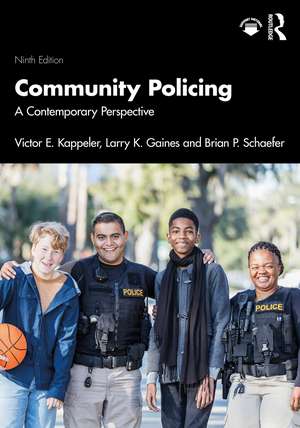
Community Policing: A Contemporary Perspective
Autor Victor E. Kappeler, Larry K. Gaines, Brian P. Schaeferen Limba Engleză Paperback – 16 mai 2025
The book extends the road map presented by Robert Trojanowicz, the father of community policing, and brings it into contemporary focus. The text has been revised throughout to include the most current developments in the field, including discussions of the 2020 protests and subsequent calls for police reform, and the rapid development of alternative responses for behavioral health and other non-criminal 911 calls. “Spotlight on Community Policing Practice” features throughout the text focus on real-life community policing programs in various cities as well as problem-solving case studies. Also assisting the reader in understanding the material are Learning Objectives, Key Terms, and Discussion Questions, in addition to numerous links to resources outside the text.
An excellent resource for any undergraduate policing or law enforcement curriculum, this textbook is also suitable for introducing graduate students to the principles of community policing.
Preț: 733.00 lei
Preț vechi: 862.35 lei
-15%
Puncte Express: 1100
Carte tipărită la comandă
Livrare economică 07-21 decembrie
Livrare prin curier în România Termenul estimat este afișat lângă disponibilitate.
Transport gratuit pentru acest produs Plată online sau ramburs, în funcție de opțiunile comenzii.
Retur gratuit în 14 zile Comandă securizată și suport în română.
Specificații
ISBN-13: 9781032505275
ISBN-10: 1032505273
Pagini: 570
Ilustrații: 86
Dimensiuni: 178 x 254 x 30 mm
Greutate: 1.32 kg
Ediția:9
Editura: Taylor & Francis
Colecția Routledge
Locul publicării:Oxford, United Kingdom
ISBN-10: 1032505273
Pagini: 570
Ilustrații: 86
Dimensiuni: 178 x 254 x 30 mm
Greutate: 1.32 kg
Ediția:9
Editura: Taylor & Francis
Colecția Routledge
Locul publicării:Oxford, United Kingdom
Public țintă
UndergraduateCuprins
Chapter 1 The Idea of Community Policing
Chapter 2 A History of Communities and Policing
Chapter 3 The Changing Meaning of Community
Chapter 4 The Police and Community Perception
Chapter 5 Managing and Implementing Community Policing
Chapter 6 Community Policing and Crime
Chapter 7 Community Policing and Fear of Crime
Chapter 8 Problem Solving and Policing Problem Spaces
Chapter 9 Community Crime Prevention
Chapter 10 Community Policing and Firearm Violence
Chapter 11 Community Policing and Behavioral Health
Chapter 12 Toward a New Breed of Police Officer
Chapter 13 Community Policing at the Crossroads
Chapter 2 A History of Communities and Policing
Chapter 3 The Changing Meaning of Community
Chapter 4 The Police and Community Perception
Chapter 5 Managing and Implementing Community Policing
Chapter 6 Community Policing and Crime
Chapter 7 Community Policing and Fear of Crime
Chapter 8 Problem Solving and Policing Problem Spaces
Chapter 9 Community Crime Prevention
Chapter 10 Community Policing and Firearm Violence
Chapter 11 Community Policing and Behavioral Health
Chapter 12 Toward a New Breed of Police Officer
Chapter 13 Community Policing at the Crossroads
Recenzii
“I use this book specifically to try to show [students] material outside of their box and the importance of connecting with the community and not just to enforce the laws. The book helps all students to see the importance of this type of policing and especially Chapter 12 (Toward a New Breed of Police Officer). The material allows me to incorporate the police personality and the issues they face.”
Dr. J. Anita Black Director of Criminal Justice Graduate Program, Lincoln Memorial University
“Whether you are a professor, student, or long-serving practitioner, this book offers a comprehensive and thought-provoking overview of community policing’s origin, its evolution, its purpose, and how it differs from traditional policing. When I teach community policing, I want students to understand that Community Policing is a philosophy, not a tactic and that this philosophy in not only for line officers but instead it should permeate the entire department. I also want students to understand that community police officers can function to help their communities work through their problems and offer a spectrum of solutions based on their training, expertise, and education. This book directly supports these teaching goals with its thorough and accessible explanation of the philosophy of community policing and its explanation of specific evidence-based strategies and tactics that support the Community Policing philosophy.
Community Policing: A Contemporary Perspective provides a strong conceptual foundation and relevant resources that help students understand the linkages between community policing’s philosophy and strategies as well as the ability of community policing to build community trust and support effective police-community partnerships.”
Tom “Tad” Hughes, JD, PhD Professor & Chair, Department of Criminal Justice, University of Louisville
Dr. J. Anita Black Director of Criminal Justice Graduate Program, Lincoln Memorial University
“Whether you are a professor, student, or long-serving practitioner, this book offers a comprehensive and thought-provoking overview of community policing’s origin, its evolution, its purpose, and how it differs from traditional policing. When I teach community policing, I want students to understand that Community Policing is a philosophy, not a tactic and that this philosophy in not only for line officers but instead it should permeate the entire department. I also want students to understand that community police officers can function to help their communities work through their problems and offer a spectrum of solutions based on their training, expertise, and education. This book directly supports these teaching goals with its thorough and accessible explanation of the philosophy of community policing and its explanation of specific evidence-based strategies and tactics that support the Community Policing philosophy.
Community Policing: A Contemporary Perspective provides a strong conceptual foundation and relevant resources that help students understand the linkages between community policing’s philosophy and strategies as well as the ability of community policing to build community trust and support effective police-community partnerships.”
Tom “Tad” Hughes, JD, PhD Professor & Chair, Department of Criminal Justice, University of Louisville
Notă biografică
Victor E. Kappeler is Foundation Professor and Dean Emeritus of the College of Justice and Safety at Eastern Kentucky University. He is recognized as a leading scholar in such fields as policing, media and crime, the social construction of crime, and police misconduct and civil liability. Dr. Kappeler is well published in professional areas of policing and criminology. Among many other honors, Kappeler received the 2006 Cabinet for Justice and Public Safety Award for Academic Excellence, the 2005 Outstanding Criminal Justice Alumnus Award from Sam Houston State University, where he earned his doctoral degree, and the Lifetime Achievement Award from the American Society of Criminology’s Division on Critical Criminology.
Larry K. Gaines is Emeritus Professor in the Criminal Justice Department at California State University, San Bernardino. He served as the Executive Director of the Kentucky Association of Chiefs of Police for 14 years and has consulted with a variety of police agencies in Kentucky, Ohio, Tennessee, Georgia, and California. Dr. Gaines has served as Secretary, Treasurer, and President of the Academy of Criminal Justice Sciences. He has received many awards, including the Founders Award from the Academy of Criminal Justice Sciences, the Outstanding Educator Award from the Southern Criminal Justice Association, and the Outstanding Service Award from the Police Section of the Academy of Criminal Justice Sciences. In 2001, he served as a member of the California POST Committee that developed police training curricula for racial profiling.
Brian P. Schaefer is Associate Professor in the Department of Health Promotion and Behavioral Sciences in the School of Public Health and Information Sciences at the University of Louisville. He has collaborated with a variety of police agencies in Kentucky and Indiana on problem-oriented policing, body-worn camera implementation, cybercrime investigations, and behavioral health alternative response planning and implementation. He currently serves as the Interim Director of the Commonwealth Scholar at the Commonwealth Institute of Kentucky (University of Louisville). He is the recipient of the Educational Excellence Award in Research at Indiana State University.
Larry K. Gaines is Emeritus Professor in the Criminal Justice Department at California State University, San Bernardino. He served as the Executive Director of the Kentucky Association of Chiefs of Police for 14 years and has consulted with a variety of police agencies in Kentucky, Ohio, Tennessee, Georgia, and California. Dr. Gaines has served as Secretary, Treasurer, and President of the Academy of Criminal Justice Sciences. He has received many awards, including the Founders Award from the Academy of Criminal Justice Sciences, the Outstanding Educator Award from the Southern Criminal Justice Association, and the Outstanding Service Award from the Police Section of the Academy of Criminal Justice Sciences. In 2001, he served as a member of the California POST Committee that developed police training curricula for racial profiling.
Brian P. Schaefer is Associate Professor in the Department of Health Promotion and Behavioral Sciences in the School of Public Health and Information Sciences at the University of Louisville. He has collaborated with a variety of police agencies in Kentucky and Indiana on problem-oriented policing, body-worn camera implementation, cybercrime investigations, and behavioral health alternative response planning and implementation. He currently serves as the Interim Director of the Commonwealth Scholar at the Commonwealth Institute of Kentucky (University of Louisville). He is the recipient of the Educational Excellence Award in Research at Indiana State University.
Descriere
This book provides comprehensive coverage of community policing, the philosophy and organizational strategy that expands the traditional police mandate of fighting crime to include forming partnerships with citizenry that endorse mutual support and participation.