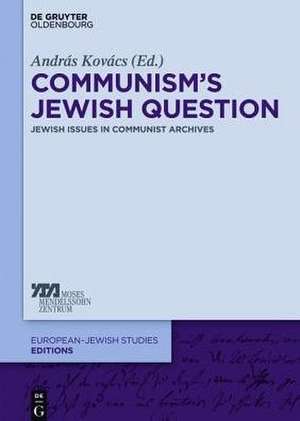
Communism’s Jewish Question: Jewish Issues in Communist Archives: Europäisch-jüdische Studien – Editionen, cartea 3
Editat de András Kovácsen Mixed media product – 14 feb 2016


Preț: 942.07 lei
Preț vechi: 1290.51 lei
-27% Precomandă
Puncte Express: 1413
Carte nepublicată încă
Livrare prin curier în România Precomanda se expediază când titlul devine disponibil.
Transport gratuit pentru acest produs Plată online sau ramburs, în funcție de opțiunile comenzii.
Retur gratuit în 14 zile Comandă securizată și suport în română.
Doresc să fiu notificat când acest titlu va fi disponibil:
Se trimite...
Specificații
ISBN-13: 9783110411607
ISBN-10: 3110411601
Pagini: 300
Ilustrații: Includes a print version and an ebook
Dimensiuni: 155 x 230 mm
Ediția:
Editura: De Gruyter Oldenbourg
Seria Europäisch-jüdische Studien – Editionen
Locul publicării:Berlin
ISBN-10: 3110411601
Pagini: 300
Ilustrații: Includes a print version and an ebook
Dimensiuni: 155 x 230 mm
Ediția:
Editura: De Gruyter Oldenbourg
Seria Europäisch-jüdische Studien – Editionen
Locul publicării:Berlin
Notă biografică
András Kovacs, Central European University, Budapest.
Descriere
Descriere de la o altă ediție sau format:
In the last two decades a large amount of previously secret documents on Jewish issues emerged from the newly opened Communist archives. The selection of these papers published in the volume and stemming mostly from Hungarian archives will shed light on a period of Jewish history that is largely ignored because much of the current scholarship treats the Shoah as the end of Jewish history in the region. The documents introduced and commented by the editor of the volume, András Kovács, will give insight into the conditions and constraints under which the Jewish communities, first of all, the largest Jewish community of the region, the Hungarian one had to survive in the time of the post-Stalinist Communist dictatorship. They may shed light on the ways how “Jewish policy” of the Soviet bloc countries was coordinated and orchestrated from Moscow and by the single countries. The archival material will prove that the ruling communist parties were restlessly preoccupied with the “Jewish question.” This preoccupation, which kept the whole issue alive in the decades of communist rule, explains to a great extent its open reemergence in the time of transition and in the post-communist period.
In the last two decades a large amount of previously secret documents on Jewish issues emerged from the newly opened Communist archives. The selection of these papers published in the volume and stemming mostly from Hungarian archives will shed light on a period of Jewish history that is largely ignored because much of the current scholarship treats the Shoah as the end of Jewish history in the region. The documents introduced and commented by the editor of the volume, András Kovács, will give insight into the conditions and constraints under which the Jewish communities, first of all, the largest Jewish community of the region, the Hungarian one had to survive in the time of the post-Stalinist Communist dictatorship. They may shed light on the ways how “Jewish policy” of the Soviet bloc countries was coordinated and orchestrated from Moscow and by the single countries. The archival material will prove that the ruling communist parties were restlessly preoccupied with the “Jewish question.” This preoccupation, which kept the whole issue alive in the decades of communist rule, explains to a great extent its open reemergence in the time of transition and in the post-communist period.