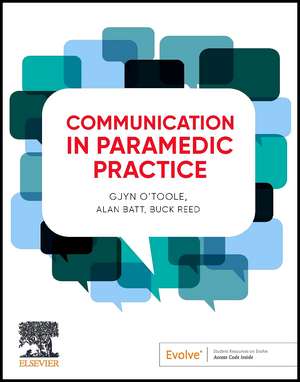
Communication in Paramedic Practice
Autor Gjyn O'Tooleen Limba Engleză Paperback – 26 sep 2023
This new book fills that gap. Communication in Paramedic Practice is designed as a primer on the importance for paramedics of communicating well, and how to achieve this in real life. It encourages self-reflection on your own communication style, and covers important considerations such as listening, managing distress, being culturally responsive and non-verbal communication.
Written by experts in this field, and full of relevant examples and opportunities to practise, this book will help you communicate comfortably and confidently for better patient outcomes, increased workplace safety and more efficient transfer of information
Preț: 354.29 lei
Preț vechi: 504.02 lei
-30%
Puncte Express: 531
Carte disponibilă
Livrare economică 21 octombrie-04 noiembrie
Livrare express 14-20 octombrie pentru 170.87 lei
Livrare prin curier în România Termenul estimat este afișat lângă disponibilitate.
Transport gratuit de la 400.00 lei Plată online sau ramburs, în funcție de opțiunile comenzii.
Retur gratuit în 14 zile Comandă securizată și suport în română.
Specificații
ISBN-13: 9780729544443
ISBN-10: 0729544443
Pagini: 260
Dimensiuni: 216 x 276 x 15 mm
Greutate: 0.66 kg
Editura: Elsevier
ISBN-10: 0729544443
Pagini: 260
Dimensiuni: 216 x 276 x 15 mm
Greutate: 0.66 kg
Editura: Elsevier
V-ar putea interesa
-
 Physician Communication: Connecting with Patients, Peers, and the PublicTerry L. Schraeder-23%Preț: 302.59 lei392.20 lei
 -
 -21%Preț: 327.94 lei415.82 lei
 -
 Interpersonal Relationships: Professional Communication Skills for NursesKathleen Underman Boggs-24%Preț: 419.51 lei554.56 lei
 -
 Paramedic Principles and Practice in the UKAidan Ward-27%Preț: 500.20 lei685.08 lei
 -
 Communication in Midwifery: Theory and PracticeTania Staras-30%Preț: 213.77 lei304.95 lei
 -
 -30%Preț: 235.51 lei334.86 lei
 -
 Effective Communication Skills for Health ProfessionalsPhilip Burnard-5%Preț: 471.47 lei496.29 lei
 -
 -30%Preț: 217.49 lei310.23 lei
 -
 Medical Ethics, Law and Communication at a GlancePatrick DaveyPreț: 325.65 lei
 -
 Clinical Communication Skills for MedicineMargaret Lloyd-5%Preț: 245.10 lei258.00 lei
 -
 Study Skills for ParamedicsHelen Cobb-24%Preț: 135.89 lei177.89 lei
 -
 Communication Skills for PhysiotherapistsVincent Kortleve-30%Preț: 216.68 lei309.57 lei
 -
 Mental Health and Mental Illness in Paramedic PracticeLouise Roberts-29%Preț: 366.64 lei515.23 lei
 -
 Stories in Health CommunicationGjyn O'Toole-33%Preț: 251.89 lei374.56 lei
 -
 -28%Preț: 315.13 lei440.19 lei
 -
 The Paramedic Revision GuideDavid W. Thom-5%Preț: 382.13 lei402.24 lei
 -
 Fundamentals of Paramedic PracticeSam Willis-5%Preț: 336.93 lei354.67 lei
 -
 -5%Preț: 209.59 lei220.62 lei
 -
 How To Talk To Absolutely AnyoneMark RhodesPreț: 90.04 lei
 -
 -5%Preț: 264.28 lei278.19 lei
Cuprins
SECTION 1: THE SIGNIFICANCE OF EFFECTIVE INTERPERSONAL COMMUNICATION FOR THE PARAMEDIC
1. Effective communciation for paramedics: A model to guide communication (p.2)
2. The overarching goal of communication for paramedic healthcare professionals: Person-centred effective care (p.10)
3. The goal of accomodating all aspects of the 'Person/s' for paramedic communication (p.17)
4. The specific goals of communication for paramedics: 1. Introductions and providing information (p.26)
5. The specific goals of communication for paramedics: 2. Questioning, comforting and confronting (p.33)
6. The specific goals of communication for paramedic practitioners: 3. Effective conclusions of interactions and services: negotiating closure (p.40)
SECTION 2: ACHIEVING EFFECTIVE COMMUNICATION BY DEVELOPING AWARENESS WITHIN THE PARAMEDIC
7. Awareness of and the need for reflective practice in paramedics (p.48)
8. Awareness of self to enhance communication for paramedics (p.58)
9. Awareness of how personal assumptions affect communication (p.67)
10 . Awareness of the effects of non-verbal communication for paramedics )p.74)
11. Awareness of listening to facilitate Person/s-centred communication (p.83)
12. Awareness of management of environments affecting communication (p.90)
SECTION 3; MANAGING THE REALITIES OF COMMUNICATION AS A PARAMEDIC
13. Holistic communication contributing to holistic paramedic care (p.100)
14. Managing conflict and distress for the paramedic when communicating (p.109)
15. Culturally responsive communication in paramedic care (p.117)
16. Communicating with indigenous people as a paramedic (p.128)
17. Misunderstanding and communication for the paramedic (p.141)
18. Ethical communication in paramedic care (p.149)
19. Paramedic communicating to ensure interdisciplinary care (p.158)
20. Telecommunication or telehealth: The seen, but non-in-the-room paramedic (p.167)
21. Documentation : 'One-way' paramedic communication (p.176)
22. Social media or 'not present in person' communication and the paramedic (p.186)
SECTION 4: SCENARIOS TO GUIDE COMMUNICATION: OPPORTUNITIES FOR PARAMEDICS TO PRACTISE COMMUNICATING EFFECTIVELY WITH THE 'PERSON'S'
23. Person/s experiencing strong negative emotions (p.199)
24. Person/s experiencing particular roles and aspects of life in their circumstances (p.207)
25. Person/s requesting paramedic assistance perceived as a waste-of-time call (p.214)
26. Person/s experiencing particular conditions (p.220)
27. Person/s in particular contexts (p.228)
Glossay (p.235)
Index (p.238)
1. Effective communciation for paramedics: A model to guide communication (p.2)
2. The overarching goal of communication for paramedic healthcare professionals: Person-centred effective care (p.10)
3. The goal of accomodating all aspects of the 'Person/s' for paramedic communication (p.17)
4. The specific goals of communication for paramedics: 1. Introductions and providing information (p.26)
5. The specific goals of communication for paramedics: 2. Questioning, comforting and confronting (p.33)
6. The specific goals of communication for paramedic practitioners: 3. Effective conclusions of interactions and services: negotiating closure (p.40)
SECTION 2: ACHIEVING EFFECTIVE COMMUNICATION BY DEVELOPING AWARENESS WITHIN THE PARAMEDIC
7. Awareness of and the need for reflective practice in paramedics (p.48)
8. Awareness of self to enhance communication for paramedics (p.58)
9. Awareness of how personal assumptions affect communication (p.67)
10 . Awareness of the effects of non-verbal communication for paramedics )p.74)
11. Awareness of listening to facilitate Person/s-centred communication (p.83)
12. Awareness of management of environments affecting communication (p.90)
SECTION 3; MANAGING THE REALITIES OF COMMUNICATION AS A PARAMEDIC
13. Holistic communication contributing to holistic paramedic care (p.100)
14. Managing conflict and distress for the paramedic when communicating (p.109)
15. Culturally responsive communication in paramedic care (p.117)
16. Communicating with indigenous people as a paramedic (p.128)
17. Misunderstanding and communication for the paramedic (p.141)
18. Ethical communication in paramedic care (p.149)
19. Paramedic communicating to ensure interdisciplinary care (p.158)
20. Telecommunication or telehealth: The seen, but non-in-the-room paramedic (p.167)
21. Documentation : 'One-way' paramedic communication (p.176)
22. Social media or 'not present in person' communication and the paramedic (p.186)
SECTION 4: SCENARIOS TO GUIDE COMMUNICATION: OPPORTUNITIES FOR PARAMEDICS TO PRACTISE COMMUNICATING EFFECTIVELY WITH THE 'PERSON'S'
23. Person/s experiencing strong negative emotions (p.199)
24. Person/s experiencing particular roles and aspects of life in their circumstances (p.207)
25. Person/s requesting paramedic assistance perceived as a waste-of-time call (p.214)
26. Person/s experiencing particular conditions (p.220)
27. Person/s in particular contexts (p.228)
Glossay (p.235)
Index (p.238)