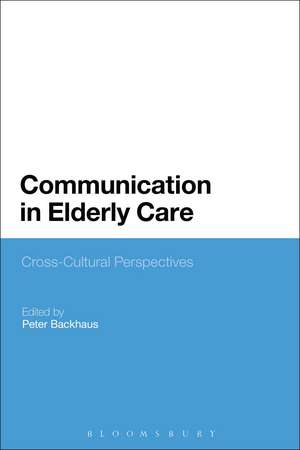
Communication in Elderly Care: Cross-Cultural Perspectives
Editat de Lecturer Peter Backhausen Limba Engleză Paperback – 31 ian 2013
The small body of available research points to eldercare communication taking place with its own specific conditions and contexts. Often, there is the presence of various mental/physical ailments on the part of the care receivers, scarcity of time, resources and/or flexibility on the part of the care givers, and a mutual necessity of providing/receiving assistance with intimate personal activities.
The book combines theory and practice, with linguistically informed analysis of real-life interaction in eldercare settings across the world. Each chapter closes with a "Practical Recommendations" section that contains suggestions on how communication in eldercare can be improved. This book is an important and timely publication that will appeal to researchers and carers alike.
Preț: 278.18 lei
Preț vechi: 353.09 lei
-21%
Puncte Express: 417
Carte tipărită la comandă
Livrare economică 05-19 decembrie
Livrare prin curier în România Termenul estimat este afișat lângă disponibilitate.
Transport gratuit de la 400.00 lei Plată online sau ramburs, în funcție de opțiunile comenzii.
Retur gratuit în 14 zile Comandă securizată și suport în română.
Specificații
ISBN-13: 9781623566821
ISBN-10: 1623566827
Pagini: 256
Ilustrații: black & white illustrations
Dimensiuni: 152 x 232 x 16 mm
Greutate: 0.36 kg
Editura: Bloomsbury Publishing
Colecția Bloomsbury Academic
Locul publicării:London, United Kingdom
ISBN-10: 1623566827
Pagini: 256
Ilustrații: black & white illustrations
Dimensiuni: 152 x 232 x 16 mm
Greutate: 0.36 kg
Editura: Bloomsbury Publishing
Colecția Bloomsbury Academic
Locul publicării:London, United Kingdom
V-ar putea interesa
-
 -18%Preț: 261.15 lei317.46 lei
 -
 -5%Preț: 321.80 lei338.74 lei
 -
 Dementia StudiesAnthea Innes-15%Preț: 617.02 lei725.91 lei
 -
 -26%Preț: 177.16 lei239.64 lei
 -
 -25%Preț: 242.86 lei322.02 lei
 -
 -24%Preț: 266.09 lei348.55 lei
 -
 -5%Preț: 152.80 lei160.85 lei
 -
 Social Work, Social Policy and Older PeopleRobert JohnsPreț: 372.31 lei
 -
 -26%Preț: 175.84 lei238.79 lei
 -
 -25%Preț: 182.36 lei244.07 lei
 -
 Reminiscence and Life Story Work: A Practice GuideFaith Gibson-25%Preț: 206.07 lei274.78 lei
 -
 -20%Preț: 117.16 lei145.94 lei
 -
 The Psychology of Ageing: An IntroductionIan Stuart-Hamilton-22%Preț: 290.78 lei372.15 lei
 -
 -25%Preț: 200.77 lei269.39 lei
Cuprins
Preface Nikolas Coupland
1. Introduction, Peter Backhaus
2. Elderspeak in Institutional Care, Kristine N. Williams
3. Dementia Care Communication in Residential Facilities: Intersections of Training and Research, Boyd H. Davis and Mary K. Smith
4. Creating a Positive Communication Environment in Long Term Care Settings, Rosemary Lubinski
5. Care of People with Alzheimer's Disease in New Zealand, Margaret Maclagan and Annabel Grant
6. Roles, Relations and the Loss of Autonomy in Caretaking of the Elderly in Denmark, Trine Heinemann
7. A German Case Study on Communication in Migrant-in-the-Family Eldercare, Hilke Engfer
8. Institutional Role Play in a Japanese Eldercare Facility, Peter Backhaus
9. What Peer Conversations Suggest for Communication in Elderly Care, Yoshiko Matsumoto
10. Art, Alzheimer's Disease, and Discourse: Talk in Response to Museum Paintings, Heidi Hamilton
11. Using Narrative Arts to Foster Personhood in Dementia Ellen B. Ryan and Lori Schindel Martin
1. Introduction, Peter Backhaus
2. Elderspeak in Institutional Care, Kristine N. Williams
3. Dementia Care Communication in Residential Facilities: Intersections of Training and Research, Boyd H. Davis and Mary K. Smith
4. Creating a Positive Communication Environment in Long Term Care Settings, Rosemary Lubinski
5. Care of People with Alzheimer's Disease in New Zealand, Margaret Maclagan and Annabel Grant
6. Roles, Relations and the Loss of Autonomy in Caretaking of the Elderly in Denmark, Trine Heinemann
7. A German Case Study on Communication in Migrant-in-the-Family Eldercare, Hilke Engfer
8. Institutional Role Play in a Japanese Eldercare Facility, Peter Backhaus
9. What Peer Conversations Suggest for Communication in Elderly Care, Yoshiko Matsumoto
10. Art, Alzheimer's Disease, and Discourse: Talk in Response to Museum Paintings, Heidi Hamilton
11. Using Narrative Arts to Foster Personhood in Dementia Ellen B. Ryan and Lori Schindel Martin
Recenzii
'Age has been recognized in Sociolinguistic research as one of the crucial social variables early on; for as we grow old we change our speech behaviour. Therefore, communication across age cohorts is not always without hitches. This is of particular relevance in the context of elderly care. Yet, the particular challenges of communication between caregiver and usually much older care recipient have rarely been studied, let alone addressed in care courses. The present volume fills a real gap. Based on empirical research in seven countries, it offers insights about how language use in care giving settings is patterned and how it can be improved.'
"Backhaus provides essential reading for those wishing to care responsibly for as well as study older people. Yet this absorbing collection also harbors potential insights and transformable practices for all of us who care for others who are enduring problems and issues, irrespective of their age. This volume is a rich testament to the under-appreciated, yet incontestable, fact that caring is a complex communicative process."
Reviewed in German Journal - Japan Markt.
The chapters are written by authors from around the world and so whilst offering a variety of methodological approaches they also bring with them perspectives from different social and cultural contexts. This is a real strength of the book. [...] This book will be useful for educators who are interested in the intricacies of communication with older people and the 'action' of communication strategies, to researchers who are interested in linguistics as well as to students of gerontology who have a particular interest in communication.
"Backhaus provides essential reading for those wishing to care responsibly for as well as study older people. Yet this absorbing collection also harbors potential insights and transformable practices for all of us who care for others who are enduring problems and issues, irrespective of their age. This volume is a rich testament to the under-appreciated, yet incontestable, fact that caring is a complex communicative process."
Reviewed in German Journal - Japan Markt.
The chapters are written by authors from around the world and so whilst offering a variety of methodological approaches they also bring with them perspectives from different social and cultural contexts. This is a real strength of the book. [...] This book will be useful for educators who are interested in the intricacies of communication with older people and the 'action' of communication strategies, to researchers who are interested in linguistics as well as to students of gerontology who have a particular interest in communication.