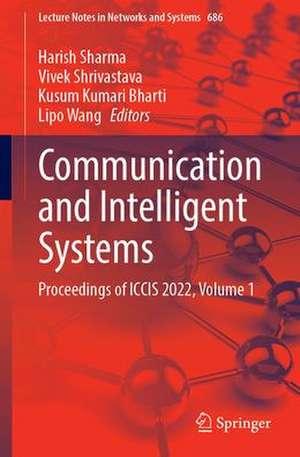
Communication and Intelligent Systems
Editat de Harish Sharma, Vivek Shrivastava, Kusum Kumari Bharti, Lipo Wangen Limba Engleză Paperback – 25 iul 2023
Volumul Communication and Intelligent Systems se adresează cercetătorilor, inginerilor și studenților la nivel postuniversitar care posedă deja o bază solidă în algoritmi de învățare automată și arhitecturi de rețea. Această lucrare tehnică presupune familiaritatea cititorului cu protocoalele de comunicare și fundamentele inteligenței artificiale, oferind în schimb o perspectivă riguroasă asupra implementărilor de ultimă oră din 2022.
Remarcăm o structură echilibrată între teorie și aplicație practică. Lucrarea este organizată tematic, pornind de la optimizarea acoperirii în rețelele de senzori mobili și avansând spre soluții complexe de securitate, cum ar fi utilizarea SDN pentru combaterea atacurilor DDoS în mediile IoT. Ca și Shahid Mumtaz în Proceedings of the Second International Conference on Computing, Communication, Security and Intelligent Systems, editorii distilează experiența reală din mediul academic și industrial în principii acționabile, punând un accent deosebit pe interoperabilitatea sistemelor inteligente.
Apreciem în mod special diversitatea studiilor de caz prezentate în cuprins: de la utilizarea YOLOv3 și DeepSORT pentru detecția umană, până la analize bio-informatice pentru livrarea macromoleculelor. Această abordare multidisciplinară demonstrează versatilitatea IA în domenii conexe. În contextul operei editorului Harish Sharma, acest volum continuă direcția stabilită în Recent Trends in Communication and Intelligent Systems, însă cu un focus sporit pe securitatea post-cuantică și infrastructurile de tip Smart City, reflectând evoluția rapidă a domeniului din ultimii ani.
Preț: 1420.11 lei
Preț vechi: 1775.13 lei
-20%
Carte disponibilă
Livrare economică 16-30 noiembrie
Specificații
ISBN-10: 981992099X
Pagini: 756
Ilustrații: XXII, 729 p. 313 illus., 253 illus. in color.
Dimensiuni: 155 x 235 x 38 mm
Greutate: 1.26 kg
Ediția:1st ed. 2023
Editura: Springer
Locul publicării:Singapore, Singapore
V-ar putea interesa
-
 Advances in Electronics, Computer, Physical and Chemical SciencesSaiyed Salim Sayeed-15%Preț: 443.43 lei521.69 lei
 -
 Advances in AI for Cloud, Edge, and Mobile Computing ApplicationsShrikaant Kulkarni-20%Preț: 1296.62 lei1620.78 lei
 -
 Web, Artificial Intelligence and Network ApplicationsLeonard Barolli-20%Preț: 1255.62 lei1569.53 lei
 -
 Advances in Intelligent Computing and CommunicationMihir Narayan Mohanty-20%Preț: 1024.23 lei1280.29 lei
 -
 Third Congress on Intelligent SystemsSandeep Kumar-20%Preț: 1484.80 lei1856.00 lei
 -
 Communication and Intelligent SystemsHarish Sharma-20%Preț: 1385.71 lei1732.14 lei
 -
 Intelligent InformaticsSankar K. Pal-18%Preț: 1449.57 lei1767.76 lei
 -
 AI Applications in Cyber Security and Communication NetworksChaminda Hewage-20%Preț: 1466.35 lei1832.94 lei
 -
 Innovative Computing and CommunicationsAboul Ella Hassanien-24%Preț: 1282.63 lei1687.67 lei
 -
 -20%Preț: 1648.37 lei2060.47 lei
 -
 ICT for Intelligent SystemsJyoti Choudrie-20%Preț: 1413.59 lei1766.98 lei
 -
 Recent Trends in Communication and Intelligent SystemsAditya Kumar Singh Pundir-24%Preț: 1182.85 lei1556.38 lei
 -
 Intelligent Computing and CommunicationM. Seetha-20%Preț: 1446.57 lei1808.22 lei
 -
 -20%Preț: 1587.94 lei1984.94 lei
 -
 Intelligent Systems for Smart CitiesAnand J. Kulkarni-20%Preț: 837.05 lei1046.32 lei
 -
 Proceedings of Second International Conference on Intelligent SystemJoão Manuel R. S. Tavares-24%Preț: 1325.22 lei1743.71 lei
 -
 Fourth Congress on Intelligent SystemsSandeep Kumar-20%Preț: 1331.31 lei1664.13 lei
 -
 Fourth Congress on Intelligent SystemsSandeep Kumar-20%Preț: 1210.67 lei1513.33 lei
 -
 ICT: Smart Systems and TechnologiesM. Shamim Kaiser-18%Preț: 1332.70 lei1625.24 lei
 -
 -18%Preț: 1179.90 lei1438.89 lei
De ce să citești această carte
Această carte este o resursă tehnică esențială pentru specialiștii care doresc să înțeleagă convergența dintre IoT și inteligența artificială. Cititorul câștigă acces la metodologii validate de cercetare și seturi de date open-source pentru aplicații diverse, de la monitorizarea pacienților la agricultura de precizie. Este un ghid practic pentru implementarea tehnologiilor de ultimă oră într-un peisaj digital tot mai complex.
Despre autor
Harish Sharma este un cercetător activ și editor specializat în sisteme inteligente și tehnologii de comunicare. Experiența sa este consolidată prin coordonarea mai multor conferințe internaționale de prestigiu, precum ICCIS și ICRTCIS. Alături de co-editorii Vivek Shrivastava, Kusum Kumari Bharti și Lipo Wang, acesta contribuie la diseminarea rezultatelor cercetării avansate prin intermediul editurii Springer. Activitatea sa editorială se concentrează pe integrarea soft computing-ului și a algoritmilor evolutivi în rezolvarea problemelor complexe de inginerie, fiind un nume recunoscut în comunitatea academică pentru volumele publicate în seria Lecture Notes in Networks and Systems.
Descriere scurtă
Cuprins
Notă biografică
Dr. Vivek Shrivastava has approx. 20 years of diversified experience of scholarship of teaching and learning, accreditation, research, industrial, and academic leadership in India, China, and USA. Presently, he is holding the position of Dean Research & Consultancy at National Institute of Technology Delhi. Prior to his academic assignments, he has worked as System Reliability Engineer at SanDisk Semiconductors Shanghai, China, and USA. Dr. Shrivastava has significant industrial experience of collaborating with industry and government organizations at SanDisk Semiconductors and has made significant contribution to the design development of memory products. He has contributed to the development and delivery of Five-Year Integrated B.Tech. and M.Tech. programs (Electrical Engineering) and master’s program (Power Systems) at Gautam Buddha University, Greater Noida. He has extensive experience academic administration in various capacities of Dean (Research & Consultancy), Dean (Student Welfare), Faculty In-Charge (Training & Placement), Faculty In-Charge (Library), Nodal Officer (Academics, TEQIP-III), Nodal Officer RUSA, and Expert in various committees in AICTE, UGC, etc. Dr. Shrivastava has carried out research and consultancy and attracted significant funding projects from the Ministry of Human Resources & Development, Government of India, and Board of Research in Nuclear Science (BRNS), subsidiary organization of Bhabha Atomic Research Organization. Dr. Shrivastava has published over 80 journal articles, presented papers at conferences, and has published several chapters in books. He has supervised 05 Ph.D. and 16 master’s students and is currently supervising several Ph.D. students. His diversified research interests are in the areas of reliability engineering, renewableenergy, and conventional power systems which include Wind, Photovoltaic (PV), Hybrid Power Systems, Distributed Generation, Grid Integration of Renewable Energy, Power Systems Analysis, and Smart Grid. Dr. Shrivastava is Editor/Associate Editor of the journals like International Journal of Swarm Intelligence (IJSI) and International Journal of System Assurance Engineering and Management. He is Fellow of the Institution of Engineers (India) and Senior Member of the Institute of Electrical and Electronics Engineers (IEEE).
Dr. Kusum Bharti is Assistant Professor at PDPM IIITDM Jabalpur. Dr. Bharti has obtained her Ph.D. in Computer Science & Engineering from ABV-IIITM, Gwalior. She has guided 06 M.Tech. students and is presently guiding 02 Ph.D. students and 05 M.Tech. students. She has published more than 12 journal and conference papers in the area of text clustering, data mining, online social network, and soft computing. She has been Active Member of many organizing committees of various conferences, workshops, and faculty development programs. Her research areas include Machine Learning, Data Mining, Machine Translation, Online Social Network, and Soft Computing.
Dr. Lipo Wang received the bachelor’s degree from National University of Defense Technology (China) and Ph.D. from Louisiana State University (USA). He is presently on Faculty at the School of Electrical and Electronic Engineering, Nanyang Technological University, Singapore. His research interest is artificial intelligence with applications to image/video processing, biomedical engineering, and data mining. He has 330+ publications, a US patent in neural networks, and a patent in systems. He has co-authored 2 monographs and (co-)edited 15 books. He has 8,000+ Google Scholar citations, with H-index 43. He was Keynote Speaker for 36 international conferences. He is/was Associate Editor/Editorial Board Member of 30 international journals, including 4 IEEE Transactions, and Guest Editor for 10 journal special issues. He was Member of the Board of Governors of the International Neural Network Society, IEEE Computational Intelligence Society (CIS), and the IEEE Biometrics Council. He served as CIS Vice President for Technical Activities and Chair of Emergent Technologies Technical Committee, as well as Chair of Education Committee of the IEEE Engineering in Medicine and Biology Society (EMBS). He was President of the Asia-Pacific Neural Network Assembly (APNNA) and received the APNNA Excellent Service Award. He was Founding Chair of both the EMBS Singapore Chapter and the CIS Singapore Chapter. He serves/served as Chair/Committee Member of over 200 international conferences.