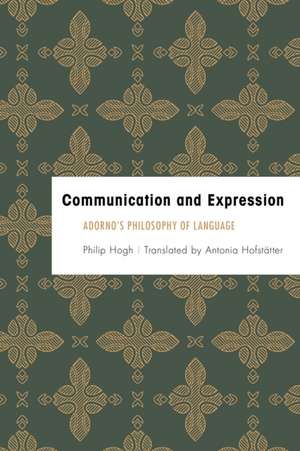
Communication and Expression: Adorno's Philosophy of Language: Founding Critical Theory
Autor Philip Hogh Traducere de Antonia Hofstätteren Limba Engleză Paperback – 24 dec 2016

Preț: 367.22 lei
Preț vechi: 483.79 lei
-24%
Puncte Express: 551
Carte tipărită la comandă
Livrare economică 30 noiembrie-14 decembrie
Livrare prin curier în România Termenul estimat este afișat lângă disponibilitate.
Transport gratuit de la 400.00 lei Plată online sau ramburs, în funcție de opțiunile comenzii.
Retur gratuit în 14 zile Comandă securizată și suport în română.
Specificații
ISBN-13: 9781783487288
ISBN-10: 1783487283
Pagini: 288
Dimensiuni: 152 x 229 x 21 mm
Greutate: 0.41 kg
Editura: Bloomsbury Publishing
Colecția Rowman & Littlefield
Seria Founding Critical Theory
Locul publicării:New York, United States
ISBN-10: 1783487283
Pagini: 288
Dimensiuni: 152 x 229 x 21 mm
Greutate: 0.41 kg
Editura: Bloomsbury Publishing
Colecția Rowman & Littlefield
Seria Founding Critical Theory
Locul publicării:New York, United States
V-ar putea interesa
-
 Freedom EvolvesDaniel C. Dennett-30%Preț: 65.71 lei93.81 lei
 -
 -18%Preț: 88.76 lei108.50 lei
 -
 Collected PapersGareth Evans-28%Preț: 349.25 lei484.26 lei
 -
 Frege and Other PhilosophersMichael Dummett-19%Preț: 331.49 lei409.01 lei
 -
 Sensory QualitiesAusten Clark-28%Preț: 358.77 lei500.70 lei
 -
 -29%Preț: 515.33 lei722.75 lei
 -
 -21%Preț: 293.24 lei370.22 lei
 -
 Truth and Meaning: Essays in SemanticsGareth Evans-28%Preț: 492.57 lei687.71 lei
 -
 Points of ViewA. W. Moore-29%Preț: 437.60 lei612.05 lei
 -
 Putting Logic in its Place: Formal Constraints on Rational BeliefDavid Christensen-18%Preț: 367.40 lei447.35 lei
 -
 -28%Preț: 364.77 lei504.21 lei
 -
 Truth, Rationality, and Pragmatism: Themes from PeirceChristopher Hookway-28%Preț: 400.09 lei557.49 lei
 -
 A Philosophical Guide to ConditionalsJonathan Bennett-28%Preț: 356.64 lei494.02 lei
 -
 A History of Philosophy in America: 1720-2000Bruce Kuklick-19%Preț: 369.12 lei455.77 lei
 -
 The Philosophy of Mathematics TodayMatthias Schirn-27%Preț: 416.82 lei572.70 lei
 -
 -28%Preț: 412.45 lei574.36 lei
 -
 Understanding PicturesDominic Lopes-19%Preț: 351.47 lei435.71 lei
 -
 Agamben and Indifference: A Critical OverviewWilliam Watkin-22%Preț: 347.23 lei444.73 lei
Cuprins
1. Introduction / 2. A Natural History of Language as Second Nature / 3. A Theory of the Name / 4. Outlines of a Theory of Meaning / 5. Communication / Bibliography / Index
Recenzii
If for no other reason, this reconstruction of Theodor Adorno's philosophy of language is important because there is no other volume that does so. According to Hogh (Carl von Ossietzky Univ. of Oldenburg, Germany), this is in part due to Adorno's nonsystematic treatment of the subject and in part because of the received opinion in critical theory that Jürgen Habermas has set the agenda when it comes to language. Habermas takes a rather negative and limiting view of Adorno's work on language. Hogh seeks to engage Adorno afresh, bracketing Habermas's judgment. But that is not the only reason Hogh's book is important. It is a first-rate work that admirably grapples with Adorno's thought, focusing on his emphasis of language's historical dimension and "its social critical conception of language criticism," as Hogh writes in the introduction. The author discusses the subject in chapters on topics one might expect in discussion of the philosophy of language: the natural history of language as second nature, theory of the name, theory of meaning, and communication. The book concludes with a brief chapter on Adorno's philosophy of language today. This is an invaluable resource for anyone interested in Adorno's philosophy of language or in his thought more generally. Summing Up: Highly recommended. Upper-division undergraduates through faculty.
An elegant and erudite examination. Learned in the European and American philosophical discussions, Hogh considers the claims of Adorno's philosophy of language with acumen and insight. But he also puts on the table the question what it means to have a philosophy of language when the on-going possibility of communication and expression is considered one of the most urgent problems of the day.
In this lucid, meticulously argued, and compelling reconstruction of Adorno's philosophy of language, Philip Hogh has but us all in his debt. Hogh not only demonstrates how the fundamental features of Adorno's critical theory either already possess or can be given a linguistic rendering, but his account brings Adorno's philosophy of language into critical conversation with the leading edge of contemporary work in the area. An invaluable contribution to both Adorno studies and the philosophy of language generally.
An elegant and erudite examination. Learned in the European and American philosophical discussions, Hogh considers the claims of Adorno's philosophy of language with acumen and insight. But he also puts on the table the question what it means to have a philosophy of language when the on-going possibility of communication and expression is considered one of the most urgent problems of the day.
In this lucid, meticulously argued, and compelling reconstruction of Adorno's philosophy of language, Philip Hogh has but us all in his debt. Hogh not only demonstrates how the fundamental features of Adorno's critical theory either already possess or can be given a linguistic rendering, but his account brings Adorno's philosophy of language into critical conversation with the leading edge of contemporary work in the area. An invaluable contribution to both Adorno studies and the philosophy of language generally.
Notă biografică
Philip Hogh teaches philosophy at the Carl von Ossietzky University Oldenburg, Germany, where he is also a member of the Adorno Research Centre.