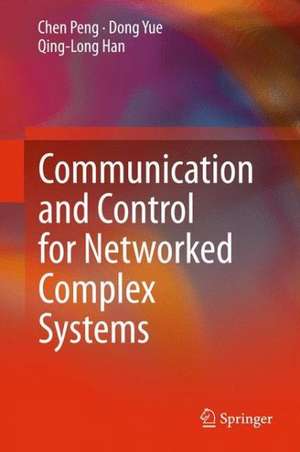
Communication and Control for Networked Complex Systems
Autor Chen Peng, Dong Yue, Qing-Long Hanen Limba Engleză Hardback – 21 apr 2015
Preț: 401.71 lei
Puncte Express: 603
Carte tipărită la comandă
Livrare economică 07-21 decembrie
Livrare prin curier în România Termenul estimat este afișat lângă disponibilitate.
Transport gratuit pentru acest produs Plată online sau ramburs, în funcție de opțiunile comenzii.
Retur gratuit în 14 zile Comandă securizată și suport în română.
Specificații
ISBN-13: 9783662468128
ISBN-10: 3662468123
Pagini: 184
Ilustrații: XIV, 168 p. 44 illus.
Dimensiuni: 160 x 241 x 16 mm
Greutate: 0.4 kg
Ediția:2015
Editura: Springer
Locul publicării:Berlin, Heidelberg, Germany
ISBN-10: 3662468123
Pagini: 184
Ilustrații: XIV, 168 p. 44 illus.
Dimensiuni: 160 x 241 x 16 mm
Greutate: 0.4 kg
Ediția:2015
Editura: Springer
Locul publicării:Berlin, Heidelberg, Germany
V-ar putea interesa
-
 From Calculus to Chaos: An Introduction to DynamicsDavid Acheson-28%Preț: 366.53 lei510.68 lei
-
 Elementary Fluid DynamicsD. J. Acheson-24%Preț: 563.52 lei743.61 lei
-
 -9%Preț: 1104.58 lei1213.83 lei
-
 Dynamic Stability of StructuresWei-Chau Xie-11%Preț: 428.56 lei481.53 lei
-
 Concepts in Submarine DesignRoy Burcher-8%Preț: 475.40 lei516.74 lei
-
 Sliding Mode Control and ObservationYuri Shtessel-54%Preț: 385.06 lei840.94 lei
-
 -23%Preț: 460.59 lei598.18 lei
-
 -27%Preț: 881.27 lei1207.22 lei
-
 Formulas for Dynamics, Acoustics and VibrationRobert D Blevins-9%Preț: 912.85 lei1003.13 lei
-
 -27%Preț: 841.56 lei1152.82 lei
-
 Engineering Vibroacoustic AnalysisStephen A Hambric-9%Preț: 917.94 lei1008.72 lei
-
 Time Series with Mixed SpectraTa-Hsin Li-18%Preț: 1282.73 lei1564.30 lei
-
 Vibration Simulation Using MATLAB and ANSYSMichael R. Hatch-18%Preț: 1501.85 lei1831.52 lei
-
 THEORY & PRACTICE OF HYDRODYNAMIC..(V20)Chakrabarti Subrata KPreț: 401.20 lei
Public țintă
ResearchCuprins
Introduction.- Preliminaries: modeling, communication scheme and lemmas for NCSs.-
Part I Communication-delay-distribution-dependent method NCSs.- Delay distribution dependent control for networked linear control systems.- Delay distribution dependent control for networked Takagi-Sugeno fuzzy systems.- Decentralized control for IP-based large-scale systems.-
Part II Necessary communication based method for control design of NCSs.-
H¥ filtering for NCSs with an adaptive event-triggering communication.- Co-design of event-triggered communication scheme and H¥ controller for NCSs.- Self-triggered sampling scheme for NCSs.- A mixed sampling scheme for wireless networked control systems.- Event-triggered control for networked Takagi-Sugeno fuzzy systems.
Recenzii
“This book presents recent developments in the stabilization of Networked Control Systems (NCSs) subject to communication constraints … . The book is well structured and clearly written. … the text is primarily recommended for readers experienced in NCS design and time-delay system analysis.” (Przemysław Ignaciuk, Mathematical Reviews, November, 2015)
“This book is devoted to the study of Networked Control Systems (NCSs), systems i.e., which implement their control functionalities over communication networks. … it is well addressed to control, communication and network engineers, as well as university students in the relevant scientific disciplines.” (Christina Diakaki, zbMATH 1319.93002, 2015)
“This book is devoted to the study of Networked Control Systems (NCSs), systems i.e., which implement their control functionalities over communication networks. … it is well addressed to control, communication and network engineers, as well as university students in the relevant scientific disciplines.” (Christina Diakaki, zbMATH 1319.93002, 2015)
Textul de pe ultima copertă
This book reports on the latest advances in the study of Networked Control Systems (NCSs). It highlights novel research concepts on NCSs; the analysis and synthesis of NCSs with special attention to their networked character; self- and event-triggered communication schemes for conserving limited network resources; and communication and control co-design for improving the efficiency of NCSs. The book will be of interest to university researchers, control and network engineers, and graduate students in the control engineering, communication and network sciences interested in learning the core principles, methods, algorithms and applications of NCSs.
Caracteristici
Pays special attention to the networked character of NCSs Includes methods to help readers conserve limited bandwidth Offers an in-depth examination of communication and control co-design not available in any other book Includes supplementary material: sn.pub/extras
Notă biografică
Professor Yu-Long Wang received the B.Sc. degree in Computer Science and Technology from Liaocheng University, Liaocheng, China, in 2000, and the M.Sc. and Ph.D. degrees in Control Science and Engineering from Northeastern University, Shenyang, China, in 2006 and 2008, respectively. He was Postdoctoral Research Fellow and Research Fellow at Central Queensland University, North Rockhampton, QLD, Australia, an Academic Visitor at the University of Adelaide, Adelaide, SA, Australia, and Professor at Jiangsu University of Science and Technology, Zhenjiang, Jiangsu, China. In 2017, he was appointed as an Eastern Scholar by the Municipal Commission of Education, Shanghai, China, and joined Shanghai University, Shanghai, China, where he is currently Professor.
Professor Wang has been conducting research in the area of networked control systems and motion control of unmanned marine vehicles. He has authored or co-authored more than one hundred (100) fully refereed high quality articles in prestigious journals and leading conferences, where one (1) article in Automatica (one of the top journals in the control field) and twenty (20) regular articles in the most prestigious IEEE Transactions. He received the 2021 IEEE International Conference on Recent Advances in Systems Science and Engineering Best Paper Award and the 2021 International Conference on Life System Modeling and Simulation Best Student Paper Award. He has been Principal Investigator of more than 20 projects granted by National Key R&D Program of China, National Science Foundation of China, and so on.
Professor Wang has served as Co-chair of IEEE IES Technical Committee on Network-Based Control Systems and Application; Associate Editor of 2 international journals including "International Journal of Fuzzy Systems," "ICIC Express Letters, Part B: Applications"; Youth Associate Editor of the international journal "Advances in Manufacturing"; Guest Editor of Neurocomputing, "Special issue on deep learning in distributed and networked complex systems," and Guest Editor of Electronics, "Special Issue on Recent Progresses and Applications in Automatic Intelligent Control"; Co-chair of the Special Session "Network-based Control Systems and Their Applications," The 46th Annual Conference of the IEEE Industrial Electronics Society, 2020; Chair of the Special Session "Network-based Control Systems and Their Applications," The 45th Annual Conference of the IEEE Industrial Electronics Society, 2019; Workshop/Tutorial Chair of the 2018 Australian and New Zealand Control Conference, 2018; Chair of the Special Session "Networked Control and Its Applications," The 44th Annual Conference of the IEEE Industrial Electronics Society, 2018; Co-chair of the Technical Track "Control Systems and Applications," The 27th IEEE International Symposium on Industrial Electronics, 2018; Chair of the Special Session "Network-Based Control, Filtering and Their Applications," The 27th IEEE International Symposium on Industrial Electronics, 2018; and Co-chair of the Special Session "Control and Filtering of Distributed Networked Systems," The 43rd Annual Conference of the IEEE Industrial Electronics Society, 2017. He is also Member of IEEE.
Professor Qing-Long Han is Pro Vice-chancellor (Research Quality) and Distinguished Professor at Swinburne University of Technology, Melbourne, Australia. He held various academic and management positions at Griffith University and Central Queensland University, Australia. He received the Ph.D. degree in Control Engineering from East China University of Science and Technology in 1997.
Professor Han has been conducting research in the areas of networked control systems, cyber-physical systems, time-delay systems, multi-agent systems, smart grids, offshore structure, unmanned surface vehicles, cybersecurity, and neural networks. Since 2001, as of 11 December 2022, he has authored or co-authored four hundred and fourteen (414) fully refereed high quali