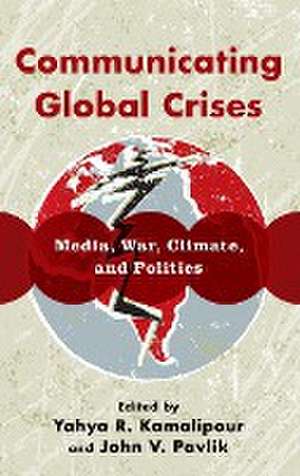
Communicating Global Crises: Media, War, Climate, and Politics
Editat de Yahya R. Kamalipour, John V. Pavliken Limba Engleză Hardback – 15 aug 2023
Preț: 553.52 lei
Preț vechi: 817.78 lei
-32%
Puncte Express: 830
Carte tipărită la comandă
Livrare economică 30 noiembrie-14 decembrie
Livrare prin curier în România Termenul estimat este afișat lângă disponibilitate.
Transport gratuit pentru acest produs Plată online sau ramburs, în funcție de opțiunile comenzii.
Retur gratuit în 14 zile Comandă securizată și suport în română.
Specificații
ISBN-13: 9781538181843
ISBN-10: 1538181843
Pagini: 304
Ilustrații: 2 b/w illustrations; 14 tables;
Dimensiuni: 158 x 238 x 23 mm
Greutate: 0.62 kg
Editura: Bloomsbury Publishing
Colecția Rowman & Littlefield
Locul publicării:New York, United States
ISBN-10: 1538181843
Pagini: 304
Ilustrații: 2 b/w illustrations; 14 tables;
Dimensiuni: 158 x 238 x 23 mm
Greutate: 0.62 kg
Editura: Bloomsbury Publishing
Colecția Rowman & Littlefield
Locul publicării:New York, United States
V-ar putea interesa
-
 Journalism & New MediaJohn PavlikPreț: 241.65 lei
 -
 Media in the Digital AgeJohn PavlikPreț: 281.54 lei
 -
 -23%Preț: 676.38 lei878.42 lei
 -
 The U.S. Media and the Middle East: Image and PerceptionYahya R. Kamalipour-25%Preț: 249.73 lei331.73 lei
 -
 Religion, Law, and Freedom: A Global PerspectiveYahya R. Kamalipour-30%Preț: 473.70 lei675.09 lei
 -
 Experiencing Public Relations: International VoicesElizabeth BridgenPreț: 407.04 lei
 -
 -34%Preț: 598.51 lei912.99 lei
 -
 Global Media Perceptions of the United States: The Trump EffectYahya R. Kamalipour-26%Preț: 282.84 lei381.55 lei
 -
 Preț: 203.37 lei
 -
 Preț: 207.75 lei
 -
 El fenómeno UruguayMaria DolzPreț: 225.05 lei
 -
 Uso del periódico Ecos del Parque en el ámbito educativoSofia SiffrediPreț: 223.59 lei
Descriere
In view of the tumultuous, conflictual, and divisive global environment; Russia's military attack on Ukraine; and anti-government uprisings in Iran and elsewhere, this timely book explores the crucial roles that media, war, religion, and politics play in impacting people and forming public opinion around the world.
Prominent and accomplished experts in media, communication, politics, journalism, international relations, global studies, and cultural studies around the globe come together to present a vital resource for all decision-makers at local, national, and international levels. Multicultural and multidisciplinary contributors methodically research, assess, write, and present their findings through a variety of content and discourse analysis.
This significant collaborative book provides a valuable and much-needed global discourse and analysis of our increasingly divided nations and world. In this eclectic and multidisciplinary volume, contributors focus on various issues including the rise of nationalism, militarism, fake news, climate crisis, media corporations, economic inequalities, inequality, refugee crisis, cultural representations, social media, human interactions, information warfare, propaganda, and emergence of a new world order.
Prominent and accomplished experts in media, communication, politics, journalism, international relations, global studies, and cultural studies around the globe come together to present a vital resource for all decision-makers at local, national, and international levels. Multicultural and multidisciplinary contributors methodically research, assess, write, and present their findings through a variety of content and discourse analysis.
This significant collaborative book provides a valuable and much-needed global discourse and analysis of our increasingly divided nations and world. In this eclectic and multidisciplinary volume, contributors focus on various issues including the rise of nationalism, militarism, fake news, climate crisis, media corporations, economic inequalities, inequality, refugee crisis, cultural representations, social media, human interactions, information warfare, propaganda, and emergence of a new world order.
Cuprins
Introduction
Yahya R. Kamalipour, North Carolina A&T State University
John V. Pavlik, Rutgers, the State University of New Jersey
Part I. The Global Context
1. Contemporary Geopolitics, War, and Media: A Historical Context
Lee B. Artz, Purdue University Northwest
Part II. Political Ideologies
2. Revisiting the Clash of Civilizations' Debate: What has Changed 30 Years Later?
Raymond Taras, Tulane University
Part III. Social Media and Politics
3. Censorship, Social Media Corporations, and their Connections with US Foreign Policy Think Tanks
David J. Park, Florida International University
4. The World Leaders on Social Media
Alexander Laskin, Quinnipiac University
Part IV. Media and Propaganda
5. Propaganda: Disinformation, Misinformation, Fake News, and Manipulation
Marina Vujnovic, Monmouth University, and Dean Kruckeberg, University of North Carolina Charlotte
Part V. Media and Conflicts
6. Russia, Ukraine, and the Court of Public Opinion
Richard Gershon, Western Michigan University
7. Reporting Global Conflicts and the Politics of Representation: Global South Versus Global North News Frames
Maha Bashri, United Arab Emirates University
Part VI: Woman, Life, Freedom: The 2022 Uprisings in Iran
8. "Say Her Name, Mahsa Amini!": An Overview of the Woman, Life, Freedom Movement in Iran
Negin Hosseini Goodrich, Purdue University
Part VII. Media and Representation
9. The Stereotypical Portrayal of Islam in the Western Press: An Islamophobic Perspective
Syed Abdul Siraj and Hina Nawaz, Bahria University
10. Image of Russia in American Media
Nadezhda L. Greydina, Diplomatic Academy of the Ministry of Foreign Affairs of the Russian Federation
Part VIII: Climate Crisis
11. Local Crises, Global Catastrophes: Climate Catastrophe as "Elemental Media"
Hart Cohen, Myra Gurney, Western Sydney University and Antonio Castillo, RMIT University
12. Climate Change, Clean Energy, and Ideas of Social Change: Ideology of a Renewables-Only Future
Scott L. Montgomery, University of Washington, Seattle
Part IX: International Agreements and Treaties
13. NATO's Future: Will the Ukrainian Conflict Revitalize NATO for the Long Term
Richard E. Rupp, Purdue University Northwest
Part X: Global Information Warfare
14. Cybercrime, Cyberterrorism, and Information Warfare: Threats to Democracy, Governance, and National Security
Robin Maria Valeri and Binneh S. Minteh, Salem State University
Index
About the Editors and Contributors
Yahya R. Kamalipour, North Carolina A&T State University
John V. Pavlik, Rutgers, the State University of New Jersey
Part I. The Global Context
1. Contemporary Geopolitics, War, and Media: A Historical Context
Lee B. Artz, Purdue University Northwest
Part II. Political Ideologies
2. Revisiting the Clash of Civilizations' Debate: What has Changed 30 Years Later?
Raymond Taras, Tulane University
Part III. Social Media and Politics
3. Censorship, Social Media Corporations, and their Connections with US Foreign Policy Think Tanks
David J. Park, Florida International University
4. The World Leaders on Social Media
Alexander Laskin, Quinnipiac University
Part IV. Media and Propaganda
5. Propaganda: Disinformation, Misinformation, Fake News, and Manipulation
Marina Vujnovic, Monmouth University, and Dean Kruckeberg, University of North Carolina Charlotte
Part V. Media and Conflicts
6. Russia, Ukraine, and the Court of Public Opinion
Richard Gershon, Western Michigan University
7. Reporting Global Conflicts and the Politics of Representation: Global South Versus Global North News Frames
Maha Bashri, United Arab Emirates University
Part VI: Woman, Life, Freedom: The 2022 Uprisings in Iran
8. "Say Her Name, Mahsa Amini!": An Overview of the Woman, Life, Freedom Movement in Iran
Negin Hosseini Goodrich, Purdue University
Part VII. Media and Representation
9. The Stereotypical Portrayal of Islam in the Western Press: An Islamophobic Perspective
Syed Abdul Siraj and Hina Nawaz, Bahria University
10. Image of Russia in American Media
Nadezhda L. Greydina, Diplomatic Academy of the Ministry of Foreign Affairs of the Russian Federation
Part VIII: Climate Crisis
11. Local Crises, Global Catastrophes: Climate Catastrophe as "Elemental Media"
Hart Cohen, Myra Gurney, Western Sydney University and Antonio Castillo, RMIT University
12. Climate Change, Clean Energy, and Ideas of Social Change: Ideology of a Renewables-Only Future
Scott L. Montgomery, University of Washington, Seattle
Part IX: International Agreements and Treaties
13. NATO's Future: Will the Ukrainian Conflict Revitalize NATO for the Long Term
Richard E. Rupp, Purdue University Northwest
Part X: Global Information Warfare
14. Cybercrime, Cyberterrorism, and Information Warfare: Threats to Democracy, Governance, and National Security
Robin Maria Valeri and Binneh S. Minteh, Salem State University
Index
About the Editors and Contributors
Recenzii
Undoubtedly, the book constitutes a rich resource for understanding issues dominating the current international debate. Ranging from the lingering tensions of the Cold War, shaping dynamics of unipolarity versus multipolarity and the roles of dominant states, to the advancements in information and communication technologies with their emergent political voices and cybersecurity challenges, it brings together a spectrum of perspectives useful in various contexts.
Kamalipour and Pavlik's excellent collection reminds us how in our digital environment it is up to all of us to tell stories that connect, rather than divide-especially when our news media keep driving us apart.
One of the key challenges for communication research is to capture the intensely image-driven interconnected cultural environment that defines our modern existence. Communicating Global Crises revisits sophisticated theoretical frameworks and provides a roadmap for navigating profound global crises and helping create a harmonious environment for people and communities around the world.
We live in an era of existential global crises, ideological polarization, and cultural clashes. Central to understanding the current moment is the complex interplay among elites, publics, and a digital media environment that can be simultaneously informative and inflammatory, mobilizing and silencing, democratizing and authoritarian. Bringing together an impressive group of international scholars, Kamalipour and Pavlik's Communicating Global Crises sheds significant light on this interplay and its potential for contributing to-or working against-a more just and inclusive future.
Communicating Global Crises combines valuable case studies of the role of the media in ongoing conflicts like Ukraine, Russia and Iran with more general assessments of infowars, mediated climate crises and other communicated conflicts. The editors must be applauded for assembling a real global team of authors that combine Western with non-Western academic perspectives in a most timely manner.
Kamalipour and Pavlik's excellent collection reminds us how in our digital environment it is up to all of us to tell stories that connect, rather than divide-especially when our news media keep driving us apart.
One of the key challenges for communication research is to capture the intensely image-driven interconnected cultural environment that defines our modern existence. Communicating Global Crises revisits sophisticated theoretical frameworks and provides a roadmap for navigating profound global crises and helping create a harmonious environment for people and communities around the world.
We live in an era of existential global crises, ideological polarization, and cultural clashes. Central to understanding the current moment is the complex interplay among elites, publics, and a digital media environment that can be simultaneously informative and inflammatory, mobilizing and silencing, democratizing and authoritarian. Bringing together an impressive group of international scholars, Kamalipour and Pavlik's Communicating Global Crises sheds significant light on this interplay and its potential for contributing to-or working against-a more just and inclusive future.
Communicating Global Crises combines valuable case studies of the role of the media in ongoing conflicts like Ukraine, Russia and Iran with more general assessments of infowars, mediated climate crises and other communicated conflicts. The editors must be applauded for assembling a real global team of authors that combine Western with non-Western academic perspectives in a most timely manner.