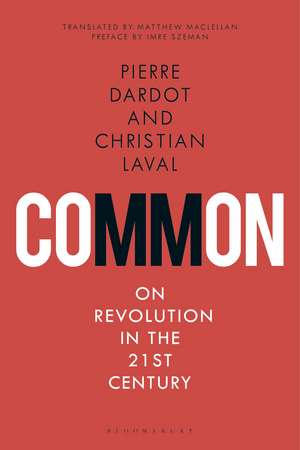
Common: On Revolution in the 21st Century
Autor Pierre Dardot, Christian Laval Traducere de Matthew MacLellan Prefață de Dr. Imre Szemanen Limba Engleză Paperback – 24 ian 2019
In this exhaustive account, Pierre Dardot and Christian Laval show how the common has become the defining principle of alternative political movements in the 21st century. In societies deeply shaped by neoliberal rationality, the common is increasingly invoked as the operative concept of practical struggles creating new forms of democratic governance. In a feat of analytic clarity, Dardot and Laval dissect and synthesize a vast repository on the concept of the commons, from the fields of philosophy, political theory, economics, legal theory, history, theology, and sociology.
Instead of conceptualizing the common as an essence of man or as inherent in nature, the thread developed by Dardot and Laval traces the active lives of human beings: only a practical activity of commoning can decide what will be shared in common and what rules will govern the common's citizen-subjects. This re-articulation of the common calls for nothing less than the institutional transformation of society by society: it calls for a revolution.
Preț: 215.24 lei
Preț vechi: 280.97 lei
-23%
Puncte Express: 323
Carte disponibilă
Livrare economică 07-21 noiembrie
Livrare express 24-30 octombrie pentru 112.10 lei
Livrare prin curier în România Termenul estimat este afișat lângă disponibilitate.
Transport gratuit de la 400.00 lei Plată online sau ramburs, în funcție de opțiunile comenzii.
Retur gratuit în 14 zile Comandă securizată și suport în română.
Specificații
ISBN-13: 9781350021211
ISBN-10: 1350021210
Pagini: 496
Dimensiuni: 160 x 234 x 28 mm
Greutate: 0.74 kg
Editura: Bloomsbury Publishing
Colecția Bloomsbury Academic
Locul publicării:London, United Kingdom
ISBN-10: 1350021210
Pagini: 496
Dimensiuni: 160 x 234 x 28 mm
Greutate: 0.74 kg
Editura: Bloomsbury Publishing
Colecția Bloomsbury Academic
Locul publicării:London, United Kingdom
V-ar putea interesa
-
 Plunder of the CommonsGuy Standing-18%Preț: 64.95 lei79.49 lei
 -
 Friends in Common: Radical Friendship and Everyday SolidaritiesLaura C. ForsterPreț: 134.92 lei
 -
 Preț: 137.09 lei
 -
 Preț: 102.97 lei
 -
 Free, Fair, and AliveDavid BollierPreț: 172.88 lei
 -
 The Politics of Urban Potentiality: Spatial Patterns of Emancipatory CommoningProfessor Stavros Stavrides-20%Preț: 160.65 lei201.21 lei
 -
 Commons and Public Partnership: Legitimizing a Commons Political SphereDr Torange Khonsari-33%Preț: 552.38 lei820.12 lei
 -
 Developing Consciousness for the Post-Capitalist CommonsDr Gregory Wilpert-17%Preț: 157.13 lei190.10 lei
 -
 Developing Consciousness for the Post-Capitalist CommonsDr Gregory Wilpert-27%Preț: 444.83 lei606.79 lei
 -
 The Common and Counter-Hegemonic PoliticsAlexandros Kioupkiolis-11%Preț: 163.38 lei183.90 lei
 -
 The CommonAntonio NegriPreț: 156.54 lei
 -
 The Refusalist InternationalMikkel Bolt RasmussenPreț: 83.68 lei
 -
 The Dispossessed: The Working Classes and Their In stinct For SurvivalChristophe GuilluyPreț: 127.46 lei
 -
 Preț: 157.44 lei
 -
 -19%Preț: 109.52 lei135.70 lei
 -
 The Future of RevolutionJasper BernesPreț: 130.16 lei
 -
 Anthropocene CommunismPaul GuillibertPreț: 130.39 lei
 -
 Now, the People! Revolution in the Twenty-First CenturyJean-Luc MelenchonPreț: 165.28 lei
 -
 Contested CommonsKatrina NavickasPreț: 180.32 lei
 -
 The Age of ExtractionTim WuPreț: 107.56 lei
Cuprins
Introduction:
The Common: A Political Principle
Chapter 1: Archaeology of the Common
PART 1: The Emergence of the Common
Chapter 2: The Communist Burden; or Communism Against the Common
Chapter 3: The Great Appropriation and the Return of the "Commons"
Chapter 4: Critiquing the Political Economy of the Commons
Chapter 5: Common, Rents, and Capital
PART 2: Law and Institution of the Common
Chapter 6: The Law of Property and the Unappropriable
Chapter 7: Law of the Common and "Common Law"
Chapter 8: The "Customary Law of Poverty"
Chapter 9: The Workers' Common: Between Custom and Institution
Chapter 10: Instituent Praxis
PART 3: Nine Political Propositions
Postscript on the Revolution of the 21st Century
Index
The Common: A Political Principle
Chapter 1: Archaeology of the Common
PART 1: The Emergence of the Common
Chapter 2: The Communist Burden; or Communism Against the Common
Chapter 3: The Great Appropriation and the Return of the "Commons"
Chapter 4: Critiquing the Political Economy of the Commons
Chapter 5: Common, Rents, and Capital
PART 2: Law and Institution of the Common
Chapter 6: The Law of Property and the Unappropriable
Chapter 7: Law of the Common and "Common Law"
Chapter 8: The "Customary Law of Poverty"
Chapter 9: The Workers' Common: Between Custom and Institution
Chapter 10: Instituent Praxis
PART 3: Nine Political Propositions
Postscript on the Revolution of the 21st Century
Index
Recenzii
If we accept the authors' repeated contention that our present and future are profoundly bleak, we must equally recognize that a new way of engaging our present and future in common is required. This new way of engaging is precisely what Dardot and Laval offer under the name the common-the political principle that informs the collaborative, deliberative activity whereby new customs and institutions may be formed to transcend the social and political conditions threatening humanity and our world itself.
The common has emerged as a key concept in 21st century struggles for justice. Dardot and Laval not only explain why, they also inspire us to build and strengthen commoning movements. An important intervention.
In the past few years, movements across the planet have fought bravely for the re-appropriation of plundered and privatized goods, while revitalizing the critique of property, understood as the legal form structuring our political economy and everyday life. Common is a sweeping, erudite and combative attempt to draw the theoretical balance-sheet of these movements and critiques, to anatomize their spontaneous philosophies, and to transform 'common' into a political principle for a new model of revolutionary politics that could break through the impasses of contemporary radical thought and practice. An indispensable contribution to one of the central debates of our time.
What do you do after you have written one of the most devastating criticisms of neoliberal reason? Dardot and Laval's answer is to turn to the exact opposite to neoliberalism's reduction of nature to private property and society to competition, to the common. The common is framed here not as something lost in precapitalist mists, or something that only appears sporadically in moments of revolt, but as that which must be instituted and created by practices. There are no shortages of criticisms of the existing order, but Common is the rare book that takes the next step, not just imagining a new world, but showing us the conditions for its creation.
After their massive tome on Karl Marx, Pierre Dardot and Christian Laval strike again, this time with an even more wide-ranging militant investigation into the common. Combining long-term legal and conceptual history with classical and present-day political theory, they invite us to leave behind the habitual focus on either the tragic story of the enclosure of the commons or the heroic example of the Paris Commune and instead argue for an all-encompassing understanding of the common as the pivotal ground for a future politics. This is a must-read for each and everyone interested in the shared practice of instituting new forms of life in common.
This new and exciting translation of Dardot's and Laval's Common: On Revolution in the 21st Century is the best account of the communal idea available in contemporary theory and criticism. Philosophically rich and archeologically exhaustive, it stands as a founding text in the growing field of commons studies that will appeal to a wide variety of teachers, scholars, and activists who share a commitment to exploring a new reason of the common in everyday activities and practices.
The common has emerged as a key concept in 21st century struggles for justice. Dardot and Laval not only explain why, they also inspire us to build and strengthen commoning movements. An important intervention.
In the past few years, movements across the planet have fought bravely for the re-appropriation of plundered and privatized goods, while revitalizing the critique of property, understood as the legal form structuring our political economy and everyday life. Common is a sweeping, erudite and combative attempt to draw the theoretical balance-sheet of these movements and critiques, to anatomize their spontaneous philosophies, and to transform 'common' into a political principle for a new model of revolutionary politics that could break through the impasses of contemporary radical thought and practice. An indispensable contribution to one of the central debates of our time.
What do you do after you have written one of the most devastating criticisms of neoliberal reason? Dardot and Laval's answer is to turn to the exact opposite to neoliberalism's reduction of nature to private property and society to competition, to the common. The common is framed here not as something lost in precapitalist mists, or something that only appears sporadically in moments of revolt, but as that which must be instituted and created by practices. There are no shortages of criticisms of the existing order, but Common is the rare book that takes the next step, not just imagining a new world, but showing us the conditions for its creation.
After their massive tome on Karl Marx, Pierre Dardot and Christian Laval strike again, this time with an even more wide-ranging militant investigation into the common. Combining long-term legal and conceptual history with classical and present-day political theory, they invite us to leave behind the habitual focus on either the tragic story of the enclosure of the commons or the heroic example of the Paris Commune and instead argue for an all-encompassing understanding of the common as the pivotal ground for a future politics. This is a must-read for each and everyone interested in the shared practice of instituting new forms of life in common.
This new and exciting translation of Dardot's and Laval's Common: On Revolution in the 21st Century is the best account of the communal idea available in contemporary theory and criticism. Philosophically rich and archeologically exhaustive, it stands as a founding text in the growing field of commons studies that will appeal to a wide variety of teachers, scholars, and activists who share a commitment to exploring a new reason of the common in everyday activities and practices.