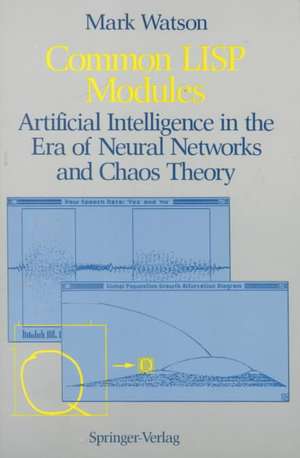
Common LISP Modules
Autor Mark Watsonen Limba Engleză Paperback – 17 iul 1991
Preț: 345.28 lei
Preț vechi: 431.60 lei
-20%
Puncte Express: 518
Carte tipărită la comandă
Livrare economică 27 noiembrie-11 decembrie
Livrare prin curier în România Termenul estimat este afișat lângă disponibilitate.
Transport gratuit de la 400.00 lei Plată online sau ramburs, în funcție de opțiunile comenzii.
Retur gratuit în 14 zile Comandă securizată și suport în română.
Specificații
ISBN-13: 9780387976143
ISBN-10: 0387976140
Pagini: 216
Ilustrații: 207 p. 3 illus.
Dimensiuni: 155 x 235 x 12 mm
Greutate: 0.34 kg
Ediția:1991
Editura: Springer
Locul publicării:New York, NY, United States
ISBN-10: 0387976140
Pagini: 216
Ilustrații: 207 p. 3 illus.
Dimensiuni: 155 x 235 x 12 mm
Greutate: 0.34 kg
Ediția:1991
Editura: Springer
Locul publicării:New York, NY, United States
V-ar putea interesa
-
 The C++ Programming LanguageBjarne Stroustrup-20%Preț: 507.21 lei634.02 lei
 -
 Python Programming for BiologyTim J. Stevens-20%Preț: 460.01 lei575.01 lei
 -
 Linda Ronstadt: Rock's First Female SuperstarMark WatsonPreț: 116.13 lei
 -
 Beginning Programming with C++ For DummiesStephen R. Davis-20%Preț: 173.62 lei217.02 lei
 -
 -15%Preț: 425.72 lei500.84 lei
 -
 -18%Preț: 1307.68 lei1594.73 lei
 -
 Pro ASP.NET Web API SecurityBadrinarayanan Lakshmiraghavan-20%Preț: 525.86 lei657.33 lei
 -
 -20%Preț: 230.97 lei288.71 lei
 -
 -20%Preț: 394.09 lei492.62 lei
 -
 -20%Preț: 156.43 lei195.54 lei
 -
 SAS Programming and Data Visualization TechniquesPhilip R. Holland-20%Preț: 253.14 lei316.42 lei
 -
 Embedded Software Development with CKai Qian-20%Preț: 574.78 lei718.48 lei
 -
 Functional Programming in ScalaRunar Bjarnason-20%Preț: 340.60 lei425.75 lei
 -
 Python Programming for BeginnersJoseph Joyner-20%Preț: 53.61 lei67.02 lei
 -
 Murachs C# 2012Joel Murach-28%Preț: 359.74 lei496.79 lei
 -
 Programming LanguagesFernando Magno Quintao Pereira-20%Preț: 260.74 lei325.93 lei
 -
 Programming Languages and SystemsJacques Garrigue-20%Preț: 332.81 lei416.02 lei
 -
 Rewriting Logic and Its ApplicationsSantiago Escobar-20%Preț: 322.59 lei403.23 lei
 -
 Software Engineering and Formal MethodsCarlos Canal-20%Preț: 342.29 lei427.86 lei
Public țintă
Professional/practitionerDescriere
While creativity plays an important role in the advancement of computer science, great ideas are built on a foundation of practical experience and knowledge. This book presents programming techniques which will be useful in both AI projects and more conventional software engineering endeavors. My primary goal is to enter tain, to introduce new technologies and to provide reusable software modules for the computer programmer who enjoys using programs as models for solutions to hard and interesting problems. If this book succeeds in entertaining, then it will certainly also educate. I selected the example application areas covered here for their difficulty and have provided both program examples for specific applications and (I hope) the method ology and spirit required to master problems for which there is no obvious solution. I developed the example programs on a Macintosh ™ using the Macintosh Common LISP ™ development system capturing screen images while the example programs were executing. To ensure portability to all Common LISP environments, I have provided a portable graphics library in Chapter 2. All programs in this book are copyrighted by Mark Watson. They can be freely used in any free or commercial software systems if the following notice appears in the fine print of the program's documentation: "This program contains software written by Mark Watson." No royalties are required. The program miniatures contained in this book may not be distributed by posting in source code form on public information networks, or in printed form without my written permission.
Cuprins
1: Introduction and Device Independent Graphics.- 1. Introduction.- 2. Basic Software Tools: Machine-Independent Graphics.- 2: Artificial Neural Networks.- 3. The Substrates of Intelligence, a Neural Network Primer.- 4. Pattern Recognition Using Hopfield Neural Networks.- 5. Speech Recognition Using Neural Networks.- 6. Recognition of Handwritten Characters.- 7. Adaptive Neural Networks.- 3: Natural Language Processing.- 8. Representing Natural Language as LISP Data Structures and LISP Code.- 9. Natural Language Interface to a Library Database.- 4: Expert-Systems.- 10. Expert-Systems.- 5: Search.- 11. Heuristic Network Search Algorithms.- 12. A Chess-Playing Program.- 6: Chaos Theory.- 13. Introduction to Chaos Theory.- 14. Fractal Images.- Annotated Bibliography.