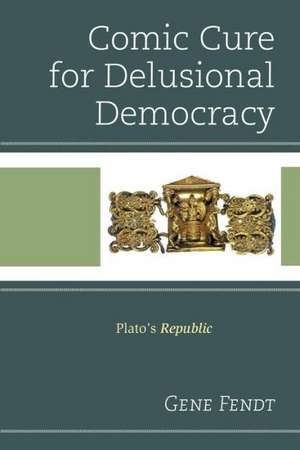
Comic Cure for Delusional Democracy: Plato's Republic
Autor Gene Fendten Limba Engleză Hardback – 16 iul 2014
Preț: 729.81 lei
Preț vechi: 1148.93 lei
-36%
Puncte Express: 1095
Carte tipărită la comandă
Livrare economică 18 noiembrie-02 decembrie
Livrare prin curier în România Termenul estimat este afișat lângă disponibilitate.
Transport gratuit pentru acest produs Plată online sau ramburs, în funcție de opțiunile comenzii.
Retur gratuit în 14 zile Comandă securizată și suport în română.
Specificații
ISBN-13: 9780739193907
ISBN-10: 0739193902
Pagini: 289
Ilustrații: 2 BW Illustrations, 1 Table
Dimensiuni: 161 x 237 x 25 mm
Greutate: 0.59 kg
Editura: Bloomsbury Publishing
Colecția Lexington Books
Locul publicării:New York, United States
ISBN-10: 0739193902
Pagini: 289
Ilustrații: 2 BW Illustrations, 1 Table
Dimensiuni: 161 x 237 x 25 mm
Greutate: 0.59 kg
Editura: Bloomsbury Publishing
Colecția Lexington Books
Locul publicării:New York, United States
V-ar putea interesa
-
 The Nature of ThingsLucretiusPreț: 89.90 lei
 -
 Protagoras and MenoPlato-32%Preț: 62.66 lei92.15 lei
 -
 Discourses and Selected WritingsEpictetus-19%Preț: 64.39 lei79.27 lei
 -
 Timaeus and CritiasPlato-32%Preț: 62.35 lei91.94 lei
 -
 Timaeus and CritiasPlato-20%Preț: 63.23 lei78.59 lei
 -
 A Guide to the Good Life: The Ancient Art of Stoic JoyWilliam B Irvine-39%Preț: 99.50 lei164.27 lei
 -
 Aristotle: Political PhilosophyRichard Kraut-27%Preț: 367.94 lei506.07 lei
 -
 The Nature of the GodsCicero-19%Preț: 69.05 lei85.74 lei
 -
 On Obligations: De OfficiisCicero-19%Preț: 63.55 lei78.81 lei
 -
 -21%Preț: 511.04 lei650.85 lei
 -
 -21%Preț: 398.35 lei506.80 lei
 -
 Time for Aristotle: Physics IV. 10-14Ursula Coope-22%Preț: 369.76 lei471.69 lei
 -
 Remembering Socrates: Philosophical EssaysLindsay Judson-21%Preț: 351.91 lei447.47 lei
 -
 MeditationsMarcus AureliusPreț: 33.79 lei
 -
 RhetoricAristotlePreț: 54.59 lei
 -
 The Meditations of Marcus AureliusMarcus AureliusPreț: 202.72 lei
 -
 The Essential Marcus AureliusJacob NeedlemanPreț: 78.71 lei
Descriere
This book shows how the discussion of Platos' Republic is a comic mimetic cure for civic and psychic delusion. Plato creates such pharmaka, or noble lies, for reasons enunciated by Socrates within the discussion, but this indicates Plato must think his readers are in the position of needing the catharses such fictions produce. Socrates' interlocutors must be like us. Since cities are like souls, and souls come to be as they are through mimesis of desires, dreams, actions and thought patterns in the city, we should expect that political theorizing often suffers from madness as well. It does. Gene Fendt shows how contemporary political (and psychological) theory still suffers from the same delusion Socrates' interlocutors reveal in their discussion: a dream of autarchia called possessive individualism. Plato has good reason to think that only a mimetic, rather than a rational and philosophical, cure can work. Against many standard readings, Comic Cure for Delusional Democracy shows that the Republic itself is a defense of poetry; that kallipolis cannot be the best city and is not Socrates' ideal; that there are six forms of regime, not five; and that the true philosopher should not be unhappy to go back down into Plato's cave.
Cuprins
Introduction: Plato's Mimetic Art: The Power of the Mimetic, the Complexity of Plato's Art
Chapter One: The Madman at the Door: Delusion and Mimetic Art in Republic and Modernity
Chapter Two: Psyche's Pharmacy
Chapter Three: Enlarging Homer: An Aristophanic Sex Comedy
Chapter Four: Out of the Cave: The divided line as pharmaceutical outline of the Republic
Interlude: Of analogy, tri-partition, and logical and poetic form
Chapter Five: From Mathematics to Social Science: The Six Geometries of Regime in Republic
Chapter Six: Polymorphous Perversity: Desires, delusions and catharses of Republic's characters
Coda and Prelude: The Liturgical Catharsis of Republic
Chapter One: The Madman at the Door: Delusion and Mimetic Art in Republic and Modernity
Chapter Two: Psyche's Pharmacy
Chapter Three: Enlarging Homer: An Aristophanic Sex Comedy
Chapter Four: Out of the Cave: The divided line as pharmaceutical outline of the Republic
Interlude: Of analogy, tri-partition, and logical and poetic form
Chapter Five: From Mathematics to Social Science: The Six Geometries of Regime in Republic
Chapter Six: Polymorphous Perversity: Desires, delusions and catharses of Republic's characters
Coda and Prelude: The Liturgical Catharsis of Republic
Recenzii
Gene Fendt's book is a rereading and rethinking of the relation between our passions and our reason in the light of poetic nature of Plato's Republic. It is a book that searches for and sees the unity of the great Platonic work along with the inner relations that exist between city and soul. The 'missing' city of Fendt's argument is, perhaps, indicated in his introductory dedication: Ad majoren civitatis dei gloriam, with its overtones of both Augustine and Ignatius.
Fendt offers a fresh reading of the Republic that allows Plato to speak in his own terms-mimetic, dramatic, imagistic, ironic, comedic, and above all therapeutic-rather than imposing an alien, "analytic" problematic on the text. The book unites philosophical insights and verbal sparklers in a manner true to the spirit of Plato himself.
In this compellingly readable new study, Gene Fendt shows that Plato is well aware that we cannot, as human beings, ever leave the psychic or political cave, nor ever have done with rhetorical persuasive power and the sway of poetic mimesis. Rather, if our cities and souls are to be cured, they must be touched in their force and desire by the wind of the intellect. Fendt's compelling and decisive argument has powerful implications for the re-reading of our western legacy.
Many pages of the book are impressive in showing the familiarity of many long-lasting conversations about the Republic.
Fendt offers a fresh reading of the Republic that allows Plato to speak in his own terms-mimetic, dramatic, imagistic, ironic, comedic, and above all therapeutic-rather than imposing an alien, "analytic" problematic on the text. The book unites philosophical insights and verbal sparklers in a manner true to the spirit of Plato himself.
In this compellingly readable new study, Gene Fendt shows that Plato is well aware that we cannot, as human beings, ever leave the psychic or political cave, nor ever have done with rhetorical persuasive power and the sway of poetic mimesis. Rather, if our cities and souls are to be cured, they must be touched in their force and desire by the wind of the intellect. Fendt's compelling and decisive argument has powerful implications for the re-reading of our western legacy.
Many pages of the book are impressive in showing the familiarity of many long-lasting conversations about the Republic.
Notă biografică
GENE FENDT grew up in Fond du Lac, Wisconsin, the eldest of twelve children born to Gene and Mary Fendt. After this happy childhood, he spent the greatest part of his teaching career in the very middle of the country, where he was granted the first Albertus Magnus Chair in Philosophy at the University of Nebraska-Kearney. Besides poetry, he has published on a broad range of topics, a number of which show up among these poems.