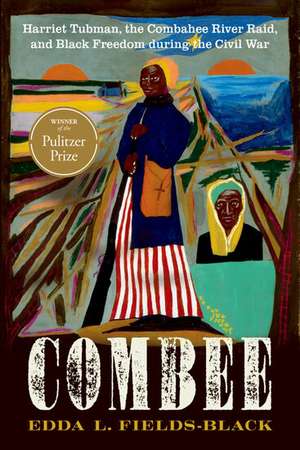
COMBEE: Harriet Tubman, the Combahee River Raid, and Black Freedom during the Civil War
Autor Edda L. Fields-Blacken Limba Engleză Paperback – 4 mai 2027
Preț: 160.88 lei
Preț vechi: 181.95 lei
-12% Precomandă
Puncte Express: 241
Carte nepublicată încă
Livrare prin curier în România Precomanda se expediază când titlul devine disponibil.
Transport gratuit de la 400.00 lei Plată online sau ramburs, în funcție de opțiunile comenzii.
Retur gratuit în 14 zile Comandă securizată și suport în română.
Doresc să fiu notificat când acest titlu va fi disponibil:
Se trimite...
Specificații
ISBN-13: 9780197855355
ISBN-10: 0197855350
Pagini: 784
Ilustrații: 116 color plates and 3 maps
Dimensiuni: 156 x 235 mm
Editura: Oxford University Press
Colecția OUP USA
Locul publicării:New York, United States
ISBN-10: 0197855350
Pagini: 784
Ilustrații: 116 color plates and 3 maps
Dimensiuni: 156 x 235 mm
Editura: Oxford University Press
Colecția OUP USA
Locul publicării:New York, United States
V-ar putea interesa
-
 Places Left Unfinished at the Time of CreationJohn Phillip SantosPreț: 135.83 lei
 -
 Race Relations Within Western ExpansionAlan Levine-30%Preț: 373.50 lei531.77 lei
 -
 -30%Preț: 537.58 lei768.95 lei
 -
 Through Students' Eyes: Combating Racism in United States SchoolsKaren B. Donaldson-30%Preț: 371.93 lei528.74 lei
 -
 -40%Preț: 473.25 lei790.49 lei
 -
 A Journey into the Philosophy of Alain LockeJohnny Washington-41%Preț: 450.35 lei765.73 lei
 -
 Housing, Race and Law: The British ExperienceMartin Macewen-18%Preț: 1264.82 lei1542.47 lei
 -
 Ethnicity: Anthropological ConstructionsMarcus BanksPreț: 403.30 lei
 -
 Race, Politics and Social ChangeLes Back-15%Preț: 519.40 lei611.06 lei
 -
 A Different Vision: African American Economic Thought, Volume 1Thomas D Boston-18%Preț: 1478.82 lei1803.44 lei
 -
 Crazy for Democracy: Women in Grassroots MovementsTemma KaplanPreț: 478.32 lei
 -
 White Trash: Race and Class in AmericaAnnalee Newitz-18%Preț: 1257.26 lei1533.24 lei
 -
 Race, Media, and the Crisis of Civil SocietyRonald N. JacobsPreț: 148.64 lei
 -
 Family TightropeNazli KibriaPreț: 405.23 lei
 -
 After The School Bell RingsCarl Grant Hoefs-Bascom-15%Preț: 414.73 lei487.91 lei
 -
 Reading, Writing, and RaceDavison M. DouglasPreț: 330.61 lei
 -
 Race, Poverty, and American CitiesJohn Charles BogerPreț: 444.29 lei
 -
 Citizen KlansmenLeonard J MoorePreț: 350.57 lei
 -
 The New Chinatown: Revised EditionPeter KwongPreț: 95.92 lei
 -
 -41%Preț: 446.69 lei763.20 lei
 -
 Cultural Diversity in the United StatesLarry Naylor-23%Preț: 239.77 lei309.53 lei
 -
 RiceFrancesca BrayPreț: 350.60 lei
 -
 -15%Preț: 449.06 lei528.30 lei
 -
 Preț: 285.58 lei
 -
 Yugoslavs in LouisianaMilos Michael VujnovichPreț: 200.70 lei
 -
 Ethnographie Fidschis - Die Entwicklung Von Fidschi-Hindi Zu Einer KoineSerebryanskaya, YuliaPreț: 97.70 lei
 -
 Preț: 106.75 lei
Recenzii
Winner of the 2025 Pulitzer Prize for History
Winner of the 2024 Gilder Lehrman Lincoln Prize
Finalist for the 2025 Mark Lynton History Prize
Honorable Mention, 2025 James A Rawley Prize
Finalist, 2025 ASALH Book Prize
Edda Fields-Black takes a legendary event and an iconic figure and with pathbreaking research and elegant prose gives us a striking, living, and breathing history of Black courage and freedom dreams at the dawn of emancipation.
Thanks to her careful reading of Civil War-era documents and historical sources, some never before utilized, Edda L. Fields-Back gives eloquent voice to South Carolina's rice kingdom's enslaved men and women, including her own ancestors, and offers new insights into the experience of more prominent figures, most notably Harriet Tubman. COMBEE makes us think in new ways about the role of African Americans in the destruction of slavery, and the hopes, betrayals, and transformations that accompanied emancipation.
Sprawling and kaleidoscopic, this is a marvel of deep research.
A scholarly and remarkable work about enslavement and Civil War...Readers will gain a deeper understanding of that era's times and experiences, and Fields Black's connection to one of the participants makes it a personal work as well.
With an extensive cast of characters, dramatic action, and findings of great significance, Combee is an exceptional work of American history.
Edda Fields-Black has written a dazzling, soulful - and monumentally researched book - about freedom soldiers, runaway slaves, and Harriet Tubman. An epic project.
These stories, these places, these events of Combahee are legendary. But these stories are not legends, and these actions of Harriet Tubman and her fellow freedom fighters are not mythology - these are the true accountings of heroism, determination, and unparalleled commitment to freedom. This book demands that you feel the chills of muddy water; burn with the anger of suffered indignity; and immerse yourself in the adrenaline and courage of some of the bravest people our nation has ever known. In a time when truth seems malleable, books like ^iCOMBEE^r and historians like Dr. Edda Fields-Black are essential to preserving and propelling stories like this into the consciousness of the world. The story of Combahee River Raid is one of the greatest American history stories of all time - and we should all know it.
A stunning piece of historical reconstruction, unlike anything I've ever seen. COMBEE offers the story of some 750 people who freed themselves in the raid; they were illiterate and didn't leave us letters, diaries, or autobiographies, for the most part. That Edda Fields-Black has reconstructed these people's lives is truly extraordinary. This is an amazing story."
A riveting and original account of Harriet Tubman and the Combahee River Raid, COMBEE is an absolutely essential book-not just for understanding the distant past, but for offering context and insight into tragic events in our own times, and the shadow of racism that still looms over Charleston, Charlottesville, and the nation.
Despite boatloads of Civil War books, no one has dug more deeply into the 1863 Combahee River Raid than Edda Fields-Black. COMBEE brings that daring event alive and establishes its important place in the broader narratives of Harriet Tubman's life and the war to end slavery. Poring over pension files, trapsing through Lowcountry marshes, and tracking down plantation descendants, Fields-Black has left no pluff mud unturned in pursuing this dramatic story, weaving together the lives of her central "freedom seekers"-including her own third great grandfather-with those of Northern commanders and liberated Black Carolinians.
Fields-Black vividly recounts one of the most dramatic events of the Civil War era, revealing Harriet Tubman and her revolutionary glory in exciting, original ways.
Edda Fields-Black doesn't just bring fresh energy to Harriet Tubman's story but, from the shadow of memory, rescues a generation of people who throughout the Lowcountry of South Carolina and Georgia, fought for their freedom, crafted a new cultural, political, and economic identities, and provided a model to the nation for a new birth of equality and justice following the Civil War.
Fields-Black's deep archival research on the participants in the raid transforms our understanding of the event. Tubman doesn't disappear, but now the stories of the other participants emerge. In so doing, they will actually reemphasize the heroism of Tubman herself, as an apotheosis of Black (and Black women's) resistance traditions.
There is a gripping and well-told story about Harriet Tubman and the Civil war at the center of COMBEE, but what stands are the details around the edges of the story, about the history and daily lives of enslaved and free people on the rice plantations. I came away from the book with a realer, thicker understanding of the lives of the people of Combee.
In COMBEE, Edda Fields-Black gives an underappreciated episode in the history of Harriet Tubman, the Black freedom struggle, and the Civil War the careful and care-full treatment it deserves. More than that, this book brings to light whole worlds contained within a grain of time, lifting up the names and stories of freedom seekers whose voices still resonate powerfully today.
Through herculean research and cross-referencing of land, bank, U.S. Army pension and slavery transaction records, Fields-Black is able to name names and offer readers a sense of who these people were and what their lives were like. Combee holds many additional revelatory threads and insights, but this act of resurrection alone makes the book profoundly important.
In her groundbreaking book... Edda Fields-Black tells the rousing story of the Union army's Combahee river raid, which led to the liberation of hundreds of enslaved African-Americans in 1863. Skillfully using pension files and planter records, Ms. Fields-Black...recovers the lives of 'the Combahee freedom seekers through multiple sets of transactions' -records of slave sales, Confederate compensation affidavits and land purchases.
Remarkable new history...
Fields-Black's deep research and breathtaking prose bring to life the 'nameless and faceless enslaved people' who, no less courageous than Harriet Tubman herself, participated in the Combahee River Raid, their heroic actions creating what Fields-Black identifies as 'a small fissure' in the wall around the institution of slavery.
Combee is a transcendent, once-in-a-generation historical exploration of a world mostly veiled in the river damp that rises from the lower Combahee - the long submerged rice plantations of the South Carolina Lowcountry. It tells the story of backbreaking toil under a relentless summer sun; of personal courage and fortitude by numberless, heretofore nameless enslaved men, women, and children. Read closely and one can almost hear the sound of three Yankee gunboats chugging through a humid June dawn carrying 300 Black men outfitted in blue tunics, shiny brass buttons, toting muskets with gleaming steel bayonets, led by an indefatigable Black woman known as "Moses.
Edda Fields-Black has created a monumental work...COMBEE is a ring-shout of a book.
This extraordinary offering, Combee, transcends regional narratives and contributes to a larger collective of human interest stories.
Fields-Black's new history, âCombee,â powerfully situates Tubman among her contemporaries- not only the controversial military geniuses who advanced the war effort through espionage, river raids, and guerrilla tactics but fellow freedom seekers who, like Tubman,
This book represents an important contribution to Civil War history, alongside the history of Black resistance to slavery in the United States.
Elegantly written, this thick volume is supported by 15 appendixes that include the names of liberated bondmen, the names of Tubman's scouts, military orders, correspondence by both white and Black participants, and 151 pages of endnotes.
At times, Fields-Black's prose reads as fiction, complete with the sense of character and Fields-Black's gift of dramatization, of setting the scene.We learn and feel so much with respect to Harriet Tubman, along with John Brown, Frederick Douglass, just to name a few. Not to mention the freedom seekers who heretofore were unknowns until their heroic stories were unearthed and pieced-together...By the time those three gunboats enter the twenty-five-mile-long stretch of the Combahee River with their contingents of Black regiments, readers are sitting at the edge of their seats...COMBEEÂ is above all a history book that offers knowledge culled from painstaking research. It is driven by a need to recover and restore the missing voices that sing freedom through generations of both heroism and suffering. This book is a stunning artifact in and of itself.
Combee: Harriet Tubman, the Combahee River Raid, and Black Freedom during the Civil War is Fields-Black's exhilarating history of Tubman and the heroic everyday men, women, and children who escaped from slavery during the Combahee River Raid. Despite its daunting seven-hundred-plus pages, this long-awaited history makes for a compelling, page-turning narrative, helped along by Fields-Black's clear storytelling and concise writing style. With meticulous attention to details and to careful research, which relies mostly on U.S. Civil War pension files, slave testimonies, and the various biographies written about Tubman, she maps out the shared destiny of different enslaved African Americans who had little in common other than their desire for freedom.
Winner of the 2024 Gilder Lehrman Lincoln Prize
Finalist for the 2025 Mark Lynton History Prize
Honorable Mention, 2025 James A Rawley Prize
Finalist, 2025 ASALH Book Prize
Edda Fields-Black takes a legendary event and an iconic figure and with pathbreaking research and elegant prose gives us a striking, living, and breathing history of Black courage and freedom dreams at the dawn of emancipation.
Thanks to her careful reading of Civil War-era documents and historical sources, some never before utilized, Edda L. Fields-Back gives eloquent voice to South Carolina's rice kingdom's enslaved men and women, including her own ancestors, and offers new insights into the experience of more prominent figures, most notably Harriet Tubman. COMBEE makes us think in new ways about the role of African Americans in the destruction of slavery, and the hopes, betrayals, and transformations that accompanied emancipation.
Sprawling and kaleidoscopic, this is a marvel of deep research.
A scholarly and remarkable work about enslavement and Civil War...Readers will gain a deeper understanding of that era's times and experiences, and Fields Black's connection to one of the participants makes it a personal work as well.
With an extensive cast of characters, dramatic action, and findings of great significance, Combee is an exceptional work of American history.
Edda Fields-Black has written a dazzling, soulful - and monumentally researched book - about freedom soldiers, runaway slaves, and Harriet Tubman. An epic project.
These stories, these places, these events of Combahee are legendary. But these stories are not legends, and these actions of Harriet Tubman and her fellow freedom fighters are not mythology - these are the true accountings of heroism, determination, and unparalleled commitment to freedom. This book demands that you feel the chills of muddy water; burn with the anger of suffered indignity; and immerse yourself in the adrenaline and courage of some of the bravest people our nation has ever known. In a time when truth seems malleable, books like ^iCOMBEE^r and historians like Dr. Edda Fields-Black are essential to preserving and propelling stories like this into the consciousness of the world. The story of Combahee River Raid is one of the greatest American history stories of all time - and we should all know it.
A stunning piece of historical reconstruction, unlike anything I've ever seen. COMBEE offers the story of some 750 people who freed themselves in the raid; they were illiterate and didn't leave us letters, diaries, or autobiographies, for the most part. That Edda Fields-Black has reconstructed these people's lives is truly extraordinary. This is an amazing story."
A riveting and original account of Harriet Tubman and the Combahee River Raid, COMBEE is an absolutely essential book-not just for understanding the distant past, but for offering context and insight into tragic events in our own times, and the shadow of racism that still looms over Charleston, Charlottesville, and the nation.
Despite boatloads of Civil War books, no one has dug more deeply into the 1863 Combahee River Raid than Edda Fields-Black. COMBEE brings that daring event alive and establishes its important place in the broader narratives of Harriet Tubman's life and the war to end slavery. Poring over pension files, trapsing through Lowcountry marshes, and tracking down plantation descendants, Fields-Black has left no pluff mud unturned in pursuing this dramatic story, weaving together the lives of her central "freedom seekers"-including her own third great grandfather-with those of Northern commanders and liberated Black Carolinians.
Fields-Black vividly recounts one of the most dramatic events of the Civil War era, revealing Harriet Tubman and her revolutionary glory in exciting, original ways.
Edda Fields-Black doesn't just bring fresh energy to Harriet Tubman's story but, from the shadow of memory, rescues a generation of people who throughout the Lowcountry of South Carolina and Georgia, fought for their freedom, crafted a new cultural, political, and economic identities, and provided a model to the nation for a new birth of equality and justice following the Civil War.
Fields-Black's deep archival research on the participants in the raid transforms our understanding of the event. Tubman doesn't disappear, but now the stories of the other participants emerge. In so doing, they will actually reemphasize the heroism of Tubman herself, as an apotheosis of Black (and Black women's) resistance traditions.
There is a gripping and well-told story about Harriet Tubman and the Civil war at the center of COMBEE, but what stands are the details around the edges of the story, about the history and daily lives of enslaved and free people on the rice plantations. I came away from the book with a realer, thicker understanding of the lives of the people of Combee.
In COMBEE, Edda Fields-Black gives an underappreciated episode in the history of Harriet Tubman, the Black freedom struggle, and the Civil War the careful and care-full treatment it deserves. More than that, this book brings to light whole worlds contained within a grain of time, lifting up the names and stories of freedom seekers whose voices still resonate powerfully today.
Through herculean research and cross-referencing of land, bank, U.S. Army pension and slavery transaction records, Fields-Black is able to name names and offer readers a sense of who these people were and what their lives were like. Combee holds many additional revelatory threads and insights, but this act of resurrection alone makes the book profoundly important.
In her groundbreaking book... Edda Fields-Black tells the rousing story of the Union army's Combahee river raid, which led to the liberation of hundreds of enslaved African-Americans in 1863. Skillfully using pension files and planter records, Ms. Fields-Black...recovers the lives of 'the Combahee freedom seekers through multiple sets of transactions' -records of slave sales, Confederate compensation affidavits and land purchases.
Remarkable new history...
Fields-Black's deep research and breathtaking prose bring to life the 'nameless and faceless enslaved people' who, no less courageous than Harriet Tubman herself, participated in the Combahee River Raid, their heroic actions creating what Fields-Black identifies as 'a small fissure' in the wall around the institution of slavery.
Combee is a transcendent, once-in-a-generation historical exploration of a world mostly veiled in the river damp that rises from the lower Combahee - the long submerged rice plantations of the South Carolina Lowcountry. It tells the story of backbreaking toil under a relentless summer sun; of personal courage and fortitude by numberless, heretofore nameless enslaved men, women, and children. Read closely and one can almost hear the sound of three Yankee gunboats chugging through a humid June dawn carrying 300 Black men outfitted in blue tunics, shiny brass buttons, toting muskets with gleaming steel bayonets, led by an indefatigable Black woman known as "Moses.
Edda Fields-Black has created a monumental work...COMBEE is a ring-shout of a book.
This extraordinary offering, Combee, transcends regional narratives and contributes to a larger collective of human interest stories.
Fields-Black's new history, âCombee,â powerfully situates Tubman among her contemporaries- not only the controversial military geniuses who advanced the war effort through espionage, river raids, and guerrilla tactics but fellow freedom seekers who, like Tubman,
This book represents an important contribution to Civil War history, alongside the history of Black resistance to slavery in the United States.
Elegantly written, this thick volume is supported by 15 appendixes that include the names of liberated bondmen, the names of Tubman's scouts, military orders, correspondence by both white and Black participants, and 151 pages of endnotes.
At times, Fields-Black's prose reads as fiction, complete with the sense of character and Fields-Black's gift of dramatization, of setting the scene.We learn and feel so much with respect to Harriet Tubman, along with John Brown, Frederick Douglass, just to name a few. Not to mention the freedom seekers who heretofore were unknowns until their heroic stories were unearthed and pieced-together...By the time those three gunboats enter the twenty-five-mile-long stretch of the Combahee River with their contingents of Black regiments, readers are sitting at the edge of their seats...COMBEEÂ is above all a history book that offers knowledge culled from painstaking research. It is driven by a need to recover and restore the missing voices that sing freedom through generations of both heroism and suffering. This book is a stunning artifact in and of itself.
Combee: Harriet Tubman, the Combahee River Raid, and Black Freedom during the Civil War is Fields-Black's exhilarating history of Tubman and the heroic everyday men, women, and children who escaped from slavery during the Combahee River Raid. Despite its daunting seven-hundred-plus pages, this long-awaited history makes for a compelling, page-turning narrative, helped along by Fields-Black's clear storytelling and concise writing style. With meticulous attention to details and to careful research, which relies mostly on U.S. Civil War pension files, slave testimonies, and the various biographies written about Tubman, she maps out the shared destiny of different enslaved African Americans who had little in common other than their desire for freedom.
Notă biografică
Edda L. Fields-Black is Professor of History and Director of the Dietrich College Humanities Center at Carnegie Mellon University and winner of the Pulitzer Prize for History. She is the author of Deep Roots: Rice Farmers in West Africa and the African Diaspora. Fields-Black has served as a consultant for the Smithsonian National Museum of African-American History and Culture's permanent exhibit, "Rice Fields of the Lowcountry." She is the executive producer and librettist of "Unburied, Unmourned, Unmarked: Requiem for Rice," a widely performed original contemporary classical work by celebrated composer John Wineglass.Fields-Black is a descendent of Africans enslaved on rice plantations in Colleton County, South Carolina; her great-great-great grandfather fought in the Combahee River Raid.
Cuprins
- Prologue: The Voices We Have Not Heard
- Part I: The Prison House of Bondage
- Chapter 1: End of Importation
- Chapter 2: The Oldest Old Heads
- Chapter 3: An Economy in Transition
- Chapter 4: "Play Children Together"
- Chapter 5: Flight from Bondage
- Chapter 6: Swamp Reclamation
- Chapter 7: John Brown's Body
- Part II: The Proving Ground of Freedom
- Chapter 8: "Gunshoot at Bay Point"
- Chapter 9: "More Intelligence than Anyone Else"
- Chapter 10: Broken Promises
- Chapter 11: Just the Two of Us
- Chapter 12: "Ropes Around their Necks"
- Part III: The Combahee River Raid
- Chapter 13: "Make the Enemy Pay the Way"
- Chapter 14: "I Was Gwine to the Boat"
- Chapter 15: "Don't We Colored People Deserve Credit?"
- Part IV: "We's Combee"
- Chapter 16: Closing in on Charleston
- Chapter 17: "Lay my Bones in dat air Bush"
- Epilogue: Risking Everything for Black Freedom