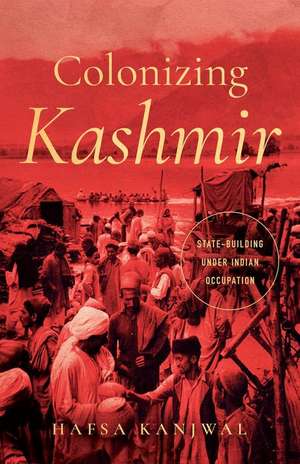
Colonizing Kashmir
Autor Hafsa Kanjwalen Limba Engleză Paperback – 25 iul 2023
Challenging the binaries of colonial and postcolonial, Kanjwal historicizes India's occupation of Kashmir through processes of emotional integration, development, normalization, and empowerment to highlight the new hierarchies of power and domination that emerged in the aftermath of decolonization. In doing so, she urges us to question triumphalist narratives of India's state-formation, as well as the sovereignty claims of the modern nation-state.
Preț: 255.29 lei
Puncte Express: 383
Carte tipărită la comandă
Livrare economică 09-23 decembrie
Livrare prin curier în România Termenul estimat este afișat lângă disponibilitate.
Transport gratuit de la 400.00 lei Plată online sau ramburs, în funcție de opțiunile comenzii.
Retur gratuit în 14 zile Comandă securizată și suport în română.
Specificații
ISBN-13: 9781503636033
ISBN-10: 1503636038
Pagini: 384
Dimensiuni: 151 x 222 x 24 mm
Greutate: 0.54 kg
Editura: Stanford University Press
ISBN-10: 1503636038
Pagini: 384
Dimensiuni: 151 x 222 x 24 mm
Greutate: 0.54 kg
Editura: Stanford University Press
Notă biografică
Hafsa Kanjwal is Assistant Professor of History at Lafayette College.
Cuprins
Introduction
1. Genealogies of Colonial Occupation and State-Building: Becoming Khalid-i-Kashmir
2. Narrating Normalization: Media, Propaganda, and Foreign Policy amid Cold War Politics
3. Producing and Promoting Paradise: Tourism, Cinema, and the Desire for Kashmir
4. Developing Dependency: Economic Planning, Financial Integration, and Corruption
5. Shaping Subjectivities: Education, Secularism, and Its Discontents
6. Jashn-e-Kashmir: Patronage and the Institutionalization of Kashmiri Culture
7. The State of Emergency: State Repression, Political Dissent, and the Struggle for Self-Determination
Conclusion
1. Genealogies of Colonial Occupation and State-Building: Becoming Khalid-i-Kashmir
2. Narrating Normalization: Media, Propaganda, and Foreign Policy amid Cold War Politics
3. Producing and Promoting Paradise: Tourism, Cinema, and the Desire for Kashmir
4. Developing Dependency: Economic Planning, Financial Integration, and Corruption
5. Shaping Subjectivities: Education, Secularism, and Its Discontents
6. Jashn-e-Kashmir: Patronage and the Institutionalization of Kashmiri Culture
7. The State of Emergency: State Repression, Political Dissent, and the Struggle for Self-Determination
Conclusion