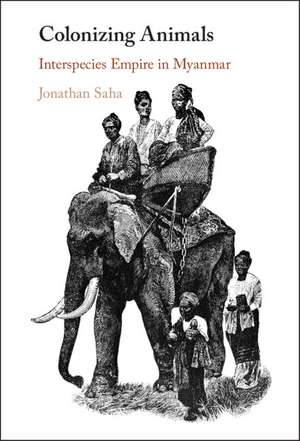
Colonizing Animals
Autor Jonathan Sahaen Limba Engleză Hardback – 14 oct 2021
Preț: 594.49 lei
Preț vechi: 667.98 lei
-11%
Puncte Express: 892
Carte tipărită la comandă
Livrare economică 29 iunie-13 iulie
Specificații
ISBN-13: 9781108839402
ISBN-10: 1108839401
Pagini: 250
Dimensiuni: 157 x 235 x 18 mm
Greutate: 0.52 kg
Editura: Cambridge University Press
Locul publicării:Cambridge, United Kingdom
ISBN-10: 1108839401
Pagini: 250
Dimensiuni: 157 x 235 x 18 mm
Greutate: 0.52 kg
Editura: Cambridge University Press
Locul publicării:Cambridge, United Kingdom
Cuprins
Introduction; 1. Valuing animals; 2. Vital resources; 3. Regulating death; 4. Imperial differentiations; 5. Anticolonial affinities; 6. Revolting creatures; Conclusion; Bibliography.
Recenzii
'Colonizing Animals relies on the double meaning of its title to resist the racial logics and political ecologies that have made human species domination so foundational to the global imperial project. Rooted in the past and present of Myanmar's creature worlds, Saha's book reckons with the possibilities of interspecies histories like no other.' Antoinette Burton, University of Illinois, Urbana Champaign
'This stunning book makes a novel argument for understanding empire as a thoroughly interspecies enterprise. Through a riveting tracing out of collisions and collaborations between humans and animals in colonial Myanmar it also poses a forceful challenge to lingering Eurocentrism in the writing of both history and animal studies.' Nayanika Mathur, University of Oxford
'With brilliant theoretical clarity, reach and ambition and with rich and perceptive insights from the past and future which faces Myanmar, Saha mounts a genealogy of the animal and animal studies. This is a genealogy of radical import and wide critical importance. Instead of centring the animal or the marginalized human, Saha attends to the messiness and unruliness of interspecies relations. This allows an original entry-point to long-standing concerns in postcolonial studies as well as Asian and imperial history. A deft intervention which powerfully excavates the current impasse between the social, cultural and economic in animal studies, this book will provide a model for future work, not least for the way in which it eschews an easy emphasis on inclusivity for rigorous attention to capitalism.' Sujit Sivasundaram, University of Cambridge
'This book would be an excellent text for courses addressing decolonial/postcolonial studies, animal studies, and historical methodology. Readers would benefit from an introductory foundation in some of the theoretical approaches the text employs … Highly recommended.' S. M. Weiss, Choice Connect
'This stunning book makes a novel argument for understanding empire as a thoroughly interspecies enterprise. Through a riveting tracing out of collisions and collaborations between humans and animals in colonial Myanmar it also poses a forceful challenge to lingering Eurocentrism in the writing of both history and animal studies.' Nayanika Mathur, University of Oxford
'With brilliant theoretical clarity, reach and ambition and with rich and perceptive insights from the past and future which faces Myanmar, Saha mounts a genealogy of the animal and animal studies. This is a genealogy of radical import and wide critical importance. Instead of centring the animal or the marginalized human, Saha attends to the messiness and unruliness of interspecies relations. This allows an original entry-point to long-standing concerns in postcolonial studies as well as Asian and imperial history. A deft intervention which powerfully excavates the current impasse between the social, cultural and economic in animal studies, this book will provide a model for future work, not least for the way in which it eschews an easy emphasis on inclusivity for rigorous attention to capitalism.' Sujit Sivasundaram, University of Cambridge
'This book would be an excellent text for courses addressing decolonial/postcolonial studies, animal studies, and historical methodology. Readers would benefit from an introductory foundation in some of the theoretical approaches the text employs … Highly recommended.' S. M. Weiss, Choice Connect
Descriere
A pathbreaking history of British imperialism in Myanmar from the early nineteenth century to 1942 populated by animals.