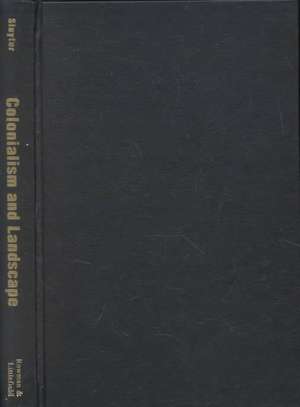
Colonialism and Landscape: Postcolonial Theory and Applications
Autor Andrew Sluyteren Limba Engleză Hardback – 20 dec 2001
Preț: 830.40 lei
Preț vechi: 1185.69 lei
-30%
Puncte Express: 1246
Carte tipărită la comandă
Livrare economică 20 noiembrie-04 decembrie
Livrare prin curier în România Termenul estimat este afișat lângă disponibilitate.
Transport gratuit pentru acest produs Plată online sau ramburs, în funcție de opțiunile comenzii.
Retur gratuit în 14 zile Comandă securizată și suport în română.
Specificații
ISBN-13: 9780742515598
ISBN-10: 0742515591
Pagini: 267
Dimensiuni: 151 x 236 x 24 mm
Greutate: 0.57 kg
Editura: Bloomsbury Publishing
Colecția Rowman & Littlefield
Locul publicării:New York, United States
ISBN-10: 0742515591
Pagini: 267
Dimensiuni: 151 x 236 x 24 mm
Greutate: 0.57 kg
Editura: Bloomsbury Publishing
Colecția Rowman & Littlefield
Locul publicării:New York, United States
V-ar putea interesa
-
 LandmarksRobert MacFarlane-18%Preț: 77.09 lei94.27 lei
 -
 The London County Council Bomb Damage Maps 1939-1945Laurence Ward-16%Preț: 474.57 lei561.89 lei
 -
 Sea Monsters on Medieval and Renaissance MapsChet Van DuzerPreț: 136.81 lei
 -
 -14%Preț: 206.64 lei240.44 lei
 -
 Glasgow: Mapping the CityJohn MoorePreț: 240.80 lei
 -
 Metropolis: Mapping the CityJeremy Black-24%Preț: 208.35 lei275.77 lei
 -
 Preț: 148.05 lei
Cuprins
Chapter 1 Colonialism and Landscape
Chapter 2 The Precolonial Landscape
Chapter 3 Colonization
Chapter 4 From Archive to Map to Landscape
Chapter 5 Material/Conceptual Colonization
Chapter 6 The Postcolonial Landscape
Chapter 7 Colonialism, Landscape, and the Future of Geography
Chapter 8 Bibliography
Chapter 2 The Precolonial Landscape
Chapter 3 Colonization
Chapter 4 From Archive to Map to Landscape
Chapter 5 Material/Conceptual Colonization
Chapter 6 The Postcolonial Landscape
Chapter 7 Colonialism, Landscape, and the Future of Geography
Chapter 8 Bibliography
Recenzii
An important book that addresses some of the key debates in geography today. Opens a rich and diversified research agenda that will most certainly generate fertile partnerships between physical and human geographers.
Challenging and valuable. . . . I highly recommend this book to geographers of Latin American landscape change and especially to nongeographers interested in colonialism and landscape.
The author is not only skilled and assiduous in the analysis of the relevant historical literature-he fairly scythes through primary and secondary sources-but he also does his own paleoecology. He is thus excellently equipped to make environmental historical analyses that sweep across inherited epochs and constructs, which he does fearless of controversy, ready to theorize. And his maps are delectable.
Challenging and valuable. . . . I highly recommend this book to geographers of Latin American landscape change and especially to nongeographers interested in colonialism and landscape.
The author is not only skilled and assiduous in the analysis of the relevant historical literature-he fairly scythes through primary and secondary sources-but he also does his own paleoecology. He is thus excellently equipped to make environmental historical analyses that sweep across inherited epochs and constructs, which he does fearless of controversy, ready to theorize. And his maps are delectable.