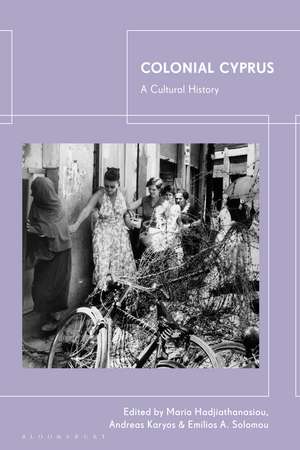
Colonial Cyprus: A Cultural History
Editat de Maria Hadjiathanasiou, Andreas Karyos, Emilios A. Solomouen Limba Engleză Paperback – 25 iun 2026
Preț: 214.39 lei
Preț vechi: 282.79 lei
-24%
Puncte Express: 322
Carte disponibilă
Livrare economică 11-25 noiembrie
Livrare prin curier în România Termenul estimat este afișat lângă disponibilitate.
Transport gratuit de la 400.00 lei Plată online sau ramburs, în funcție de opțiunile comenzii.
Retur gratuit în 14 zile Comandă securizată și suport în română.
Specificații
ISBN-13: 9780755640676
ISBN-10: 0755640675
Pagini: 256
Dimensiuni: 152 x 232 x 14 mm
Greutate: 0.7 kg
Editura: Bloomsbury Publishing
Colecția Bloomsbury Academic
Locul publicării:London, United Kingdom
ISBN-10: 0755640675
Pagini: 256
Dimensiuni: 152 x 232 x 14 mm
Greutate: 0.7 kg
Editura: Bloomsbury Publishing
Colecția Bloomsbury Academic
Locul publicării:London, United Kingdom
Cuprins
List of Figures
Notes on Contributors
Preface
Foreword
Acknowledgements
Introduction
Chapter 1. Excavating at Amathus, 1893-1894: Collecting Cypriot Antiquities in a Colonial Landscape (Polina Nikolaou)
Chapter 2. Traces of Imperialist Ideologies in the Work of Female Travel Writers in Colonial Cyprus
(Margarita Ioannou and Katerina Gotsi)
Chapter 3. A 'garden useful and pleasant': The Case of the Municipal Garden in Nicosia (Elena Parpa)
Chapter 4. Blackness in Imaginary Artworks of Colonial Cyprus (Marilena Zackheos)
Chapter 5. Posters of Cyprus: Promoting the Colony during the Interwar Period (Niki Sioki)
Chapter 6. Cultural Imperialism, the Dissemination of Modern Sports and the Sociogenesis of the First Sports Clubs in British Cyprus (1878- 1931) (Tonia Georgiou)
Chapter 7. Passive Resistance and Europeanization via Garment Making in British Colonial Cyprus (Noly Moyssi)
Chapter 8. Of heroes and Villains: Manifestations of National and Colonial Identity in Cyprus through Historical Theatre Plays, 1878-1960 (Ellada Evangelou)
Chapter 9. Queen Victoria's Head on Postage Stamp as a Marker in Cyprus's History (Annita Antoniadou)
Chapter 10. Photographic Representations of Colonial Cyprus and the Ledra Palace Hotel (Theopisti Stylianou-Lambert and Antigone Heraclidou)
Conclusion
Bibliography
Index
Notes on Contributors
Preface
Foreword
Acknowledgements
Introduction
Chapter 1. Excavating at Amathus, 1893-1894: Collecting Cypriot Antiquities in a Colonial Landscape (Polina Nikolaou)
Chapter 2. Traces of Imperialist Ideologies in the Work of Female Travel Writers in Colonial Cyprus
(Margarita Ioannou and Katerina Gotsi)
Chapter 3. A 'garden useful and pleasant': The Case of the Municipal Garden in Nicosia (Elena Parpa)
Chapter 4. Blackness in Imaginary Artworks of Colonial Cyprus (Marilena Zackheos)
Chapter 5. Posters of Cyprus: Promoting the Colony during the Interwar Period (Niki Sioki)
Chapter 6. Cultural Imperialism, the Dissemination of Modern Sports and the Sociogenesis of the First Sports Clubs in British Cyprus (1878- 1931) (Tonia Georgiou)
Chapter 7. Passive Resistance and Europeanization via Garment Making in British Colonial Cyprus (Noly Moyssi)
Chapter 8. Of heroes and Villains: Manifestations of National and Colonial Identity in Cyprus through Historical Theatre Plays, 1878-1960 (Ellada Evangelou)
Chapter 9. Queen Victoria's Head on Postage Stamp as a Marker in Cyprus's History (Annita Antoniadou)
Chapter 10. Photographic Representations of Colonial Cyprus and the Ledra Palace Hotel (Theopisti Stylianou-Lambert and Antigone Heraclidou)
Conclusion
Bibliography
Index
Recenzii
Gathering established and young scholars, independent researchers and cultural practitioners, Colonial Cyprus: A Cultural History is a path-breaking incursion into the historiography of Cyprus under British rule in more senses than one. Fundamentally interdisciplinary and touching on questions of visual and textual representations, material culture and cultural heritage, gender and identity, this unprecedented initiative gives flesh to the experience of colonialism in the island, too often still confined to the dry realms of politics and diplomacy. It is therefore an essential read for anyone interested in understanding modern Cyprus, the product of a colonial encounter at the crossroads of cultural hybridity and resistance.
The editors should be commended for the concept, for the interesting chapters...and for the fact that all the contributors are women. The ten contributors are to be praised for their interesting research.
This collection of innovative and eclectic essays makes a notable contribution to one of the hallmarks in recent writing on the history of Cyprus: the shift of focus from politics to more experimental concerns with culture. Animating the whole is a striking paradigm: the dynamism, but also the pitfalls, of a small island society experiencing modernity through the agency of a curiously hybrid form of British colonialism. Along the way Cypriots increasingly embraced opportunities for change, fresh forms of expression and organization, social flux and (for some at least) cosmopolitan practices. Yet the new society that emerged was also one where differences between Cypriots became more acutely felt rather than less, with dangerous implications for the future. The book keenly evokes this razor's edge which patchwork modernization brought to wider Cypriot experience.
This book offers rich and novel analysis of the long-neglected cultural history of Cyprus in the colonial period. Covering a wide and diverse range of topics, it interrogates how colonial rule and the forms of hybridity, negotiation, and resistance it provoked, shaped and were, in turn, shaped by modes of cultural expression on the island. Through its critical engagement with the cultural history of colonial rule in Cyprus, this book not only offers new insights that look beyond the dominant political histories of the island, but also integrates the Cypriot case into wider cultural histories of empire. Thus, Colonial Cyprus is vital reading both for historians of the island itself but also for cultural historians of the British Empire and of colonialism more broadly.
The book Colonial Cyprus: A Cultural History is a fascinating read.
It dives deep into different aspects of the cultural history of Cyprus, aspects that have not been extensively, or holistically discussed so far.
It is a collection of micro-histories focusing on photography, architecture, theatre, public gardens, sports, advertising, and so on, that together weave a dense and thought-provoking macro-history of colonialism and the intricacies of the power relations between the periphery and the center, as these are understood within colonial regimes.
By making these relationships visible and theorizing them within a wider historical framework, by shedding light on individual and collective cultural preferences and decisions, this book becomes part of a call to consider culture as a significant, yet often ignored, parameter in decision-making, politics, and history.
This cross-disciplinary volume uses tools from different fields and areas of research, such as history, cultural studies, media, architecture etc., to analyse and discuss data from primary and largely unpublished sources. It can thus greatly contribute to many different areas of research and will be of interest to a wider readership.
This volume is both a feast of scholarship and a roadmap for future research. It demonstrates that eight decades of British rule on Cyprus were not just a geopolitical afterthought but a multifaceted cultural project, rooted in fantasies of Mediterranean gardens, classical splendor, and consumerist modernization. The attention to diverse cultural forms-from plays and fashion shows to posters and postage stamps-is particularly impressive.
The editors should be commended for the concept, for the interesting chapters...and for the fact that all the contributors are women. The ten contributors are to be praised for their interesting research.
This collection of innovative and eclectic essays makes a notable contribution to one of the hallmarks in recent writing on the history of Cyprus: the shift of focus from politics to more experimental concerns with culture. Animating the whole is a striking paradigm: the dynamism, but also the pitfalls, of a small island society experiencing modernity through the agency of a curiously hybrid form of British colonialism. Along the way Cypriots increasingly embraced opportunities for change, fresh forms of expression and organization, social flux and (for some at least) cosmopolitan practices. Yet the new society that emerged was also one where differences between Cypriots became more acutely felt rather than less, with dangerous implications for the future. The book keenly evokes this razor's edge which patchwork modernization brought to wider Cypriot experience.
This book offers rich and novel analysis of the long-neglected cultural history of Cyprus in the colonial period. Covering a wide and diverse range of topics, it interrogates how colonial rule and the forms of hybridity, negotiation, and resistance it provoked, shaped and were, in turn, shaped by modes of cultural expression on the island. Through its critical engagement with the cultural history of colonial rule in Cyprus, this book not only offers new insights that look beyond the dominant political histories of the island, but also integrates the Cypriot case into wider cultural histories of empire. Thus, Colonial Cyprus is vital reading both for historians of the island itself but also for cultural historians of the British Empire and of colonialism more broadly.
The book Colonial Cyprus: A Cultural History is a fascinating read.
It dives deep into different aspects of the cultural history of Cyprus, aspects that have not been extensively, or holistically discussed so far.
It is a collection of micro-histories focusing on photography, architecture, theatre, public gardens, sports, advertising, and so on, that together weave a dense and thought-provoking macro-history of colonialism and the intricacies of the power relations between the periphery and the center, as these are understood within colonial regimes.
By making these relationships visible and theorizing them within a wider historical framework, by shedding light on individual and collective cultural preferences and decisions, this book becomes part of a call to consider culture as a significant, yet often ignored, parameter in decision-making, politics, and history.
This cross-disciplinary volume uses tools from different fields and areas of research, such as history, cultural studies, media, architecture etc., to analyse and discuss data from primary and largely unpublished sources. It can thus greatly contribute to many different areas of research and will be of interest to a wider readership.
This volume is both a feast of scholarship and a roadmap for future research. It demonstrates that eight decades of British rule on Cyprus were not just a geopolitical afterthought but a multifaceted cultural project, rooted in fantasies of Mediterranean gardens, classical splendor, and consumerist modernization. The attention to diverse cultural forms-from plays and fashion shows to posters and postage stamps-is particularly impressive.