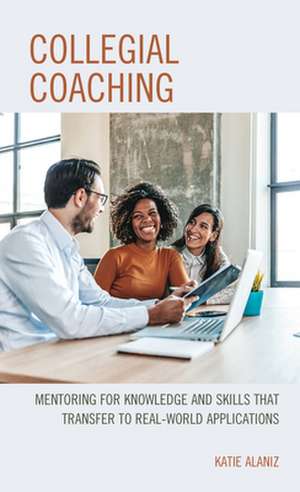
Collegial Coaching: Mentoring for Knowledge and Skills That Transfer to Real-World Applications
Autor Katie Alanizen Limba Engleză Hardback – 15 dec 2021
Preț: 350.95 lei
Preț vechi: 505.77 lei
-31%
Puncte Express: 526
Carte tipărită la comandă
Livrare economică 04-18 decembrie
Livrare prin curier în România Termenul estimat este afișat lângă disponibilitate.
Transport gratuit de la 400.00 lei Plată online sau ramburs, în funcție de opțiunile comenzii.
Retur gratuit în 14 zile Comandă securizată și suport în română.
Specificații
ISBN-13: 9781475860306
ISBN-10: 1475860307
Pagini: 120
Ilustrații: 19 b/w photos
Dimensiuni: 140 x 218 x 14 mm
Greutate: 0.31 kg
Editura: Bloomsbury Publishing
Colecția Rowman & Littlefield
Locul publicării:New York, United States
ISBN-10: 1475860307
Pagini: 120
Ilustrații: 19 b/w photos
Dimensiuni: 140 x 218 x 14 mm
Greutate: 0.31 kg
Editura: Bloomsbury Publishing
Colecția Rowman & Littlefield
Locul publicării:New York, United States
Cuprins
Preface
Acknowledgements
Introduction
Chapter 1: Resuscitating Professional Development with Collegial Coaching
Chapter 2: Coaches to the Rescue in an Age of Rapid Response
Chapter 3: Deploying the Coaching CPR Model
Chapter 4: First Responders of Professional Development
Chapter 5: The Urgency of Content-Focused Coaching
Chapter 6: The Life-Giving Power of Purposeful Pedagogy
Chapter 7: Reviving Learning through Authentic Assessment
Chapter 8: Conclusion
Acknowledgements
Introduction
Chapter 1: Resuscitating Professional Development with Collegial Coaching
Chapter 2: Coaches to the Rescue in an Age of Rapid Response
Chapter 3: Deploying the Coaching CPR Model
Chapter 4: First Responders of Professional Development
Chapter 5: The Urgency of Content-Focused Coaching
Chapter 6: The Life-Giving Power of Purposeful Pedagogy
Chapter 7: Reviving Learning through Authentic Assessment
Chapter 8: Conclusion
Recenzii
Build a culture of coaching that creates partnerships that result in student success. This book offers a roadmap you can follow. With engaging quotes and easy to read prose, Dr. Alaniz grabs your attention from the get-go. She blends technology into the quintessential human experience. Work is that experience, a community of educators focused on one goal - student success.
I have spent the last 40 years in public education with 34 of them in a leadership role. In that time, I have seen numerous attempts to reform and improve instructional performance in schools. Some have been successful, but very few of them have been successfully implemented on a nationwide basis. Unfortunately, high schools, especially today, operate in a very similar manner to those of 75 years ago. In her work Collegial Coaching: Mentoring for Knowledge and Skills That Transfer to Real-World Applications, Dr. Katie Alaniz identifies and suggests solutions to this problem by recognizing that failed implementations are most often not the result of flawed methodology, but a failure of leadership. The most common operating practice of many leaders is simply to introduce the change and demand compliance. This approach fails to inspire or build capacity in teachers. The proposed change is then blamed for the failure instead of the method of implementation and, therefore, educational practice remains mired in outdated traditions of the past. Dr. Alaniz's work proposes a better plan; one that builds teacher capacity in a secure environment and increases the likelihood of success. She shows us how to learn from our past mistakes. The key is the translation of proposed practiced into consistent, regular, real-world application that teachers can access on a daily basis. Building capacity requires incremental and regular practice for growth. It is an excellent read and timely work.
Coaching is one of the best tools educators can use to improve instruction and positively impact student learning outcomes. This book serves as a guide to instructional coaching and mentoring that supports the growth of not only teachers but more importantly their students.
Collegial Coaching offers coaches invaluable guidance in their efforts to help teachers to integrate technology meaningfully. This work provides coaches with a variety of valuable resources to guide the journey from using technology to support traditional instruction to the goal of offering students authentic, engaging, technology rich learning. Alaniz also offers unique insights into how successful coaches build trust, learn with and from the peers, keep change reasonable, offer positive feedback, encourage reflection, and celebrate success. Collegial Coaching insists that the foundation all these coaching strategies rest on is the coach's understanding that the collaboration between them and their learning partner must be driven by the needs of their partner.
I have spent the last 40 years in public education with 34 of them in a leadership role. In that time, I have seen numerous attempts to reform and improve instructional performance in schools. Some have been successful, but very few of them have been successfully implemented on a nationwide basis. Unfortunately, high schools, especially today, operate in a very similar manner to those of 75 years ago. In her work Collegial Coaching: Mentoring for Knowledge and Skills That Transfer to Real-World Applications, Dr. Katie Alaniz identifies and suggests solutions to this problem by recognizing that failed implementations are most often not the result of flawed methodology, but a failure of leadership. The most common operating practice of many leaders is simply to introduce the change and demand compliance. This approach fails to inspire or build capacity in teachers. The proposed change is then blamed for the failure instead of the method of implementation and, therefore, educational practice remains mired in outdated traditions of the past. Dr. Alaniz's work proposes a better plan; one that builds teacher capacity in a secure environment and increases the likelihood of success. She shows us how to learn from our past mistakes. The key is the translation of proposed practiced into consistent, regular, real-world application that teachers can access on a daily basis. Building capacity requires incremental and regular practice for growth. It is an excellent read and timely work.
Coaching is one of the best tools educators can use to improve instruction and positively impact student learning outcomes. This book serves as a guide to instructional coaching and mentoring that supports the growth of not only teachers but more importantly their students.
Collegial Coaching offers coaches invaluable guidance in their efforts to help teachers to integrate technology meaningfully. This work provides coaches with a variety of valuable resources to guide the journey from using technology to support traditional instruction to the goal of offering students authentic, engaging, technology rich learning. Alaniz also offers unique insights into how successful coaches build trust, learn with and from the peers, keep change reasonable, offer positive feedback, encourage reflection, and celebrate success. Collegial Coaching insists that the foundation all these coaching strategies rest on is the coach's understanding that the collaboration between them and their learning partner must be driven by the needs of their partner.