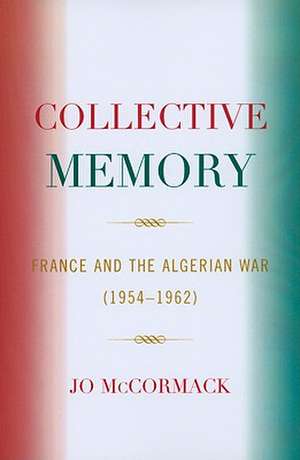
Collective Memory: France and the Algerian War (1954-62): After the Empire: The Francophone World and Postcolonial France
Autor Jo McCormacken Limba Engleză Paperback – 3 feb 2010
Din seria After the Empire: The Francophone World and Postcolonial France
- 22%
 Preț: 375.48 lei
 - 29%
 Preț: 342.63 lei
 - 29%
 Preț: 343.67 lei
 - 35%
 Preț: 594.01 lei
 - 35%
 Preț: 594.73 lei
 - 29%
 Preț: 343.67 lei
 - 31%
 Preț: 529.40 lei
 - 25%
 Preț: 306.46 lei
 - 23%
 Preț: 335.60 lei
 - 35%
 Preț: 594.56 lei
 - 29%
 Preț: 561.12 lei
 - 26%
 Preț: 592.68 lei
 - 23%
 Preț: 320.82 lei
 - 24%
 Preț: 318.74 lei
 - 23%
 Preț: 321.63 lei
 - 30%
 Preț: 505.39 lei
 - 36%
 Preț: 565.57 lei
 - 29%
 Preț: 345.51 lei
 - 30%
 Preț: 564.34 lei
 - 29%
 Preț: 346.12 lei
 - 35%
 Preț: 594.73 lei
 - 29%
 Preț: 341.92 lei
 - 34%
 Preț: 568.23 lei
 - 33%
 Preț: 594.98 lei
 - 29%
 Preț: 342.93 lei
 - 23%
 Preț: 322.99 lei
 - 34%
 Preț: 552.85 lei
 - 22%
 Preț: 326.24 lei
 - 14%
 Preț: 633.75 lei
 - 35%
 Preț: 593.23 lei
 - 23%
 Preț: 319.28 lei
 - 23%
 Preț: 321.15 lei
 - 22%
 Preț: 327.05 lei
 - 35%
 Preț: 807.77 lei
 - 34%
 Preț: 568.84 lei
 - 25%
 Preț: 306.14 lei
 - 35%
 Preț: 594.28 lei
 - 36%
 Preț: 679.02 lei
 - 29%
 Preț: 344.06 lei
 - 23%
 Preț: 335.38 lei
Preț: 344.18 lei
Preț vechi: 483.26 lei
-29%
Puncte Express: 516
Carte tipărită la comandă
Livrare economică 23 noiembrie-07 decembrie
Livrare prin curier în România Termenul estimat este afișat lângă disponibilitate.
Transport gratuit de la 400.00 lei Plată online sau ramburs, în funcție de opțiunile comenzii.
Retur gratuit în 14 zile Comandă securizată și suport în română.
Specificații
ISBN-13: 9780739145623
ISBN-10: 0739145622
Pagini: 221
Dimensiuni: 156 x 232 x 17 mm
Greutate: 0.36 kg
Editura: Bloomsbury Publishing
Colecția Lexington Books
Seria After the Empire: The Francophone World and Postcolonial France
Locul publicării:New York, United States
ISBN-10: 0739145622
Pagini: 221
Dimensiuni: 156 x 232 x 17 mm
Greutate: 0.36 kg
Editura: Bloomsbury Publishing
Colecția Lexington Books
Seria After the Empire: The Francophone World and Postcolonial France
Locul publicării:New York, United States
Cuprins
Chapter 1 Introduction: The Algerian War: Between Memory and History
Chapter 2 Chapter One: Critical Literature and Recent Developments
Chapter 3 Chapter Two: Pedagogy: Imagining the French Nation
Chapter 4 Chapter Three: The Family: Discussing the War Years, Personal and Family Stories
Chapter 5 Chapter Four: The Media: Reporting the War Forty Years On
Chapter 6 Conclusion: Teaching, Reporting, and Discussing the Algerian War in Contemporary France
Chapter 2 Chapter One: Critical Literature and Recent Developments
Chapter 3 Chapter Two: Pedagogy: Imagining the French Nation
Chapter 4 Chapter Three: The Family: Discussing the War Years, Personal and Family Stories
Chapter 5 Chapter Four: The Media: Reporting the War Forty Years On
Chapter 6 Conclusion: Teaching, Reporting, and Discussing the Algerian War in Contemporary France
Recenzii
This pioneering study is a welcome addition to the scientific literature of the Algerian War. Drawing on original empirical and archival research, it casts new light on the single most traumatic episode in France's reluctant retreat from overseas empire. At the core of Jo McCormack's analysis is pedagogy, understood as the national imaginative paradigm that shapes the way in which the history of the conflict is (or, crucially, is not) taught: an "educational chain" that leads from the most eminent historians and legislators to high-school teachers an their students, and which McCormack productively links to such other essential vectors of deficiencies in official processes of commemoration, and thereby underlines the troubled legacy - and specifically, the still contested memory politics - of France's final colonial conflict. This volume will be essential reading for students and academics with an interest in decolonization in general and the Algerian War in particular, as well as for all those concerned with the broader challenges of commemoration and reconciliation in the post-colonial world.
Jo McCormack's informative study of the multiple, often conflicting ways in which the Algerian War is remembered sheds interesting light on the complexities of memory politics in contemporary France. With its emphasis on the transmission of memory through the education system, the family, and the media, this clearly written, well documented volume is a welcome contribution to research on the traumatic legacies of the Algerian War and will be of interest to both historians and literary scholars.
Jo McCormack...offers a worthy study on a complex issue: the transmission of the memory of the Algerian War (1954-62) in contemporary France.... McCormack successively studies each of the three vectors of memory he has selected.
The overseas empire, especially French rule in Algeria, was long a marginal subject in French public life, though recent conflicts about migration and multiculturalism have brought colonialism and its legacy vividly to French attention. As France now seeks to work through and come to terms with its colonial past, Jo McCormack's study of three vectors for the transmission of knowledge about the overseas empire - schools, families and the press - provides interesting insight into the 'memory work' that is an essential part of this process. His book integrates theoretical perspectives with evidence drawn, in particular, from interviews with teachers and students and from a content analysis of France's leading newspaper, and it contributes to a 'rediscovery' of colonial history by scholars and the general public alike.
Jo McCormack's informative study of the multiple, often conflicting ways in which the Algerian War is remembered sheds interesting light on the complexities of memory politics in contemporary France. With its emphasis on the transmission of memory through the education system, the family, and the media, this clearly written, well documented volume is a welcome contribution to research on the traumatic legacies of the Algerian War and will be of interest to both historians and literary scholars.
Jo McCormack...offers a worthy study on a complex issue: the transmission of the memory of the Algerian War (1954-62) in contemporary France.... McCormack successively studies each of the three vectors of memory he has selected.
The overseas empire, especially French rule in Algeria, was long a marginal subject in French public life, though recent conflicts about migration and multiculturalism have brought colonialism and its legacy vividly to French attention. As France now seeks to work through and come to terms with its colonial past, Jo McCormack's study of three vectors for the transmission of knowledge about the overseas empire - schools, families and the press - provides interesting insight into the 'memory work' that is an essential part of this process. His book integrates theoretical perspectives with evidence drawn, in particular, from interviews with teachers and students and from a content analysis of France's leading newspaper, and it contributes to a 'rediscovery' of colonial history by scholars and the general public alike.